
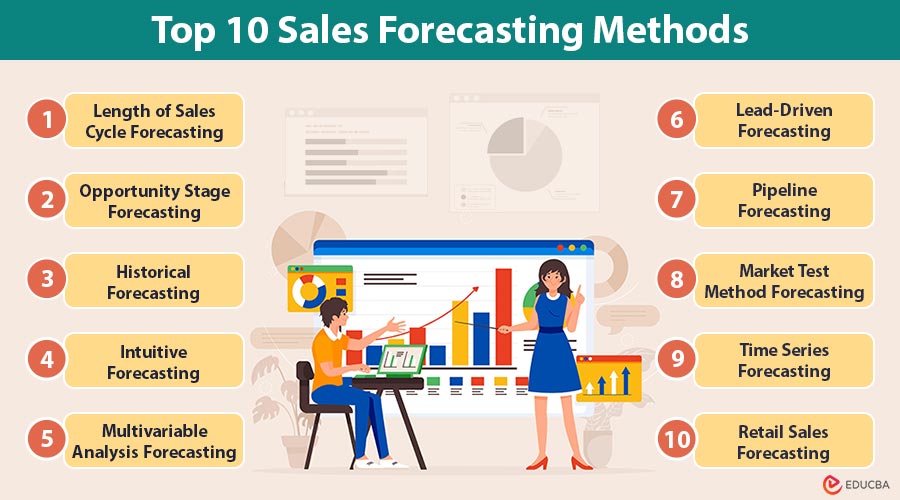
Introduction to Sales Forecasting Methods
Sales forecasting methods enable businesses to predict future revenue by analyzing historical data, market trends, and key sales performance indicators. These techniques would allow companies to estimate demand accurately, set realistic targets, allocate resources efficiently, and make informed strategic decisions. From data-driven models, such as multivariable analysis, to intuitive predictions, selecting the right forecasting method ensures accurate insights, informed decision-making, and sustainable business growth. Here are the top 10 sales forecasting methods explained below.
Top 10 Sales Forecasting Methods
Let us explore the top 10 methods used by businesses to predict sales performance accurately.
#1. Length of Sales Cycle Forecasting
This method allows for the assessment of deal closing timing and revenue generation by forecasting future sales based on the average time it takes for leads to move through the sales process.
Advantages:
- Predicts short-term revenue accurately
- Ideal for businesses with consistent sales cycles
Disadvantages:
- Not suitable for products with irregular or seasonal cycles.
- Less effective for companies with diverse or lengthy buying processes.
#2. Opportunity Stage Forecasting
It estimates potential sales by assigning probability percentages to each stage of the sales funnel, multiplying opportunity values by their likelihood of closing to calculate total forecasted revenue.
Advantages:
- Provides data-driven visibility into pipeline health
- Useful for managing multiple deals
Disadvantages:
- Accuracy depends on correct probability assignments.
- It can be misleading if CRM data is outdated or incomplete.
#3. Historical Forecasting
This technique utilizes past sales data and performance trends to predict future results, assuming that similar market conditions and customer behavior will persist over upcoming sales periods.
Advantages:
- Simple and data-driven
- Works well for stable markets
Disadvantages:
- Fails to account for sudden market changes or economic shifts.
- Not suitable for new products or rapidly evolving industries.
#4. Intuitive Forecasting
Intuitive forecasting relies on sales representatives’ experience and judgment to predict sales outcomes, often used when data is limited or products are newly introduced to the market.
Advantages:
- Useful when limited data is available (e.g., for new products)
- Leverages frontline sales experience
Disadvantages:
- Highly subjective and prone to human bias
- Lacks quantitative accuracy
#5. Multivariable Analysis Forecasting
This advanced, data-driven method utilizes multiple variables—such as deal stage, sales cycle, and rep performance—combined through statistical or AI models to generate highly accurate sales predictions.
Advantages:
- Highly accurate for data-rich organizations
- Adapts dynamically to changing sales patterns
Disadvantages:
- Requires advanced analytics tools and expertise
- Data quality directly affects accuracy
#6. Lead-Driven Forecasting
It forecasts future sales by analyzing the number and quality of generated leads, along with historical conversion rates, to estimate the likelihood of leads becoming paying customers.
Advantages:
- Ideal for marketing and lead-generation-focused businesses
- Enables better alignment between marketing and sales
Disadvantages:
- Dependent on consistent lead quality and accurate tracking
- Inaccurate if conversion rates fluctuate significantly.
#7. Pipeline Forecasting
Pipeline forecasting evaluates all current deals in a CRM, considering deal size, stage, and probability of closing, to deliver a real-time estimate of potential sales revenue.
Advantages:
- Real-time, data-driven insights
- Useful for sales managers and revenue planning
Disadvantages:
- Accuracy depends on proper CRM data management
- May not account for sudden deal cancellations or delays.
#8. Market Test Method Forecasting
This approach forecasts sales by launching products in small test markets, analyzing customer feedback, sales performance, and market reactions before rolling out the product more broadly.
Advantages:
- Reduces risk before large-scale launch
- Provides realistic sales insights
Disadvantages:
- Time-consuming and costly
- May not accurately reflect full-market conditions
#9. Time Series Forecasting
Time series forecasting utilizes historical sales data across time intervals to identify patterns, trends, and seasonal variations, enabling businesses to predict future demand with statistical accuracy.
Advantages:
- Excellent for identifying trends and seasonal fluctuations
- Effective for long-term strategic planning
Disadvantages:
- Requires substantial historical data
- May not account for sudden market disruptions
#10. Retail Sales Forecasting
It predicts retail product demand by analyzing past sales data, promotions, seasonal trends, and customer insights, enabling retailers to optimize inventory levels, pricing strategies, and sales performance.
Advantages:
- Enhances inventory control and reduces stockouts
- Helps plan promotions and pricing strategies
Disadvantages:
- Needs a comprehensive POS and customer data.
- Sensitive to unexpected market factors like economic downturns or consumer behavior shifts.
Final Thoughts
Sales forecasting is both an art and a science — combining data analytics with human insight. Choosing the right sales forecasting method enables businesses to predict revenue more accurately, optimize resources, and make proactive decisions. Whether you use historical forecasting for simplicity, multivariable analysis for precision, or lead-driven forecasting for marketing alignment, the key lies in consistency, data accuracy, and regular performance evaluation. With the right forecasting approach, businesses can turn uncertainty into opportunity and achieve sustainable growth.
Frequently Asked Questions (FAQs)
Q1. Which approach of sales forecasting is the most accurate?
Answer: Multivariable analysis forecasting is often the most accurate, as it uses multiple data points and predictive analytics.
Q2. Which forecasting method works best for new businesses?
Answer: Intuitive forecasting or market test methods are best when historical data is unavailable.
Q3. Why is sales forecasting important?
Answer: It helps predict revenue, allocate budgets, optimize production, and plan strategic decisions effectively.
Q4. How often should forecasts be updated?
Answer: Ideally, forecasts should be updated monthly or quarterly, depending on sales cycle length and market dynamics.
Recommended Articles
We hope that this EDUCBA information on “Sales Forecasting Methods” was beneficial to you. You can view EDUCBA’s recommended articles for more information.

