


What Is Adaptive Leadership?
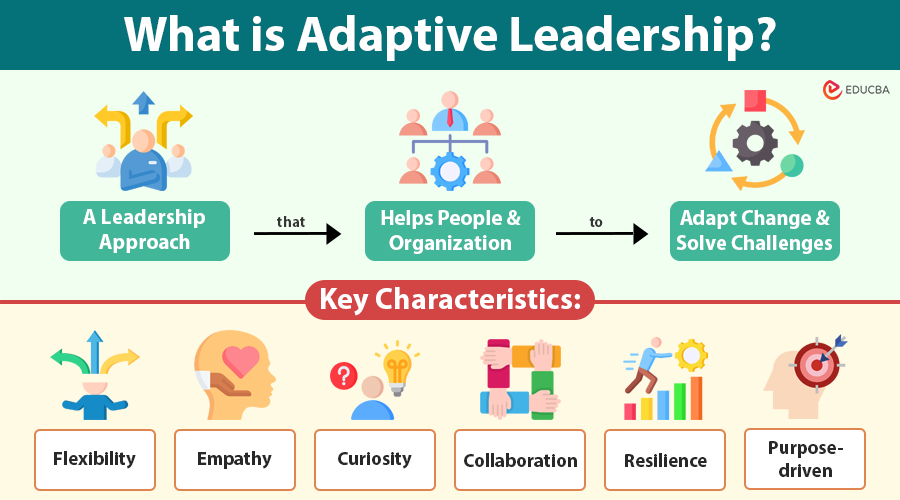
Adaptive leadership is a leadership framework developed by Ronald Heifetz and Marty Linsky at Harvard Kennedy School. It is a leadership approach that helps individuals and organizations adjust to change, solve complex problems, and thrive in challenging environments. It focuses on flexibility, learning, and collaboration rather than relying on fixed solutions or authority.
Example: In adaptive leadership, when a company transitions to remote work, the leader encourages feedback, experiments with new tools, and supports team collaboration instead of enforcing a one-size-fits-all policy.
Table of Contents
- Meaning
- Key Characteristics
- Core Principles
- Skills
- Examples
- Benefits
- Challenges
- How to Develop in Your Organization?
- Adaptive Leadership vs Traditional Leadership
Key Characteristics of Adaptive Leadership
- Flexibility: Ability to pivot strategies as circumstances evolve.
- Empathy: Understanding people’s emotional and psychological reactions to change.
- Curiosity: Asking questions, challenging assumptions, and learning continuously.
- Collaboration: Engaging diverse perspectives to co-create solutions.
- Resilience: Maintaining composure and focus in the face of setbacks.
- Purpose-driven: Aligning actions with long-term vision and shared values.
Adaptive leaders are not necessarily the ones with all the answers; they are the ones who ask the right questions and empower others to find the answers together.
Core Principles of Adaptive Leadership
Heifetz and Linsky outlined a few fundamental principles that define the practice of adaptive leadership. Understanding these principles can help leaders apply the framework effectively in any context.
1. Distinguish Technical Problems from Adaptive Challenges
This is the foundation of adaptive leadership.
- Technical problems are clear and solvable with existing knowledge, expertise, and processes.
- Adaptive challenges, however, are complex, value-laden, and require learning, behavioral change, and experimentation.
For example, upgrading company software is a technical challenge; changing employees’ mindsets toward digital transformation is an adaptive challenge.
Adaptive leaders accurately diagnose the situation before acting, knowing when to use authority and when to foster learning.
2. Regulate Distress
Change often brings anxiety, fear, and resistance. Adaptive leaders act as stabilizers, managing the emotional climate so that tension drives progress rather than paralysis.
They maintain what Heifetz calls the “productive zone of disequilibrium,” a balance between too much stress (which leads to burnout) and too little (which causes complacency).
By pacing change, offering support, and encouraging small wins, leaders help people adjust without feeling overwhelmed.
3. Maintain Disciplined Attention
Organizations often avoid confronting difficult truths or engaging in uncomfortable discussions. Adaptive leaders ensure that the team stays focused on core issues, even when it is tempting to turn away.
They encourage transparency, honest conversations, and collective accountability.
This “disciplined attention” keeps energy directed toward meaningful change rather than distraction or denial.
4. Give the Work Back to the People
Adaptive leaders resist the urge to solve every problem on their own. Instead, they empower teams to take ownership of challenges.
By involving employees in decision-making, they promote engagement, creativity, and accountability.
This approach develops the team’s capacity for independent thinking and ensures that change is sustained over time, rather than relying on a single leader.
5. Protect Voices of Leadership from Below
Sometimes the best ideas come from those who are not in positions of formal authority. Adaptive leaders create safe spaces for everyone, especially dissenting voices, to speak up.
They recognize that innovation often begins with people who challenge the status quo.
Encouraging diverse viewpoints not only enhances solutions but also strengthens an organization’s culture.
Adaptive Leadership Skills
Being an adaptive leader requires mastering both emotional and strategic skills. These skills help leaders navigate uncertainty and guide others through transformation.
| Skill | Description |
| Emotional Intelligence (EI) | Ability to perceive, manage, and influence emotions in oneself and others. EI helps leaders build trust and empathy during change. |
| Critical and Strategic Thinking | Evaluating complex issues, identifying underlying causes, and developing creative solutions. |
| Communication and Storytelling | Clearly articulating vision, values, and purpose to inspire and align teams. |
| Learning Agility | Quickly absorbing new information and adapting behavior based on feedback and results. |
| Conflict Management | Turning disagreements into opportunities for learning and growth rather than division. |
| Empathy and Listening | Understanding different perspectives and addressing people’s emotional needs during transitions. |
| Resilience | Maintaining calm, confidence, and determination amid uncertainty or crisis. |
Adaptive leaders continually cultivate these skills; they view leadership not as a position, but as a lifelong learning journey.
Examples of Adaptive Leadership in Action
1. Satya Nadella – Microsoft
When Satya Nadella became Microsoft’s CEO in 2014, he transformed a rigid, competitive culture into a learning-driven, collaborative environment.
His emphasis on “growth mindset,” empathy, and cloud innovation revitalized Microsoft, making it one of the world’s most valuable companies. Nadella’s leadership exemplifies adaptive transformation.
2. Jacinda Ardern – New Zealand
During crises such as the COVID-19 pandemic and the Christchurch attacks, Jacinda Ardern demonstrated empathy, transparency, and adaptability.
Her ability to combine compassionate communication with decisive action earned her global recognition as an adaptive leader who inspires unity during adversity.
3. Howard Schultz – Starbucks
Schultz returned to Starbucks when the company’s growth was declining. Instead of focusing only on profit, he reconnected employees and customers to the company’s purpose, ethical sourcing, community, and culture.
His adaptive approach revitalized the brand and restored its identity in a changing global marketplace.
4. Elon Musk – SpaceX & Tesla
Musk’s leadership thrives on experimentation and learning from failure. Each rocket test, product setback, or market challenge becomes a data point for improvement.
His ability to push boundaries and pivot strategies exemplifies the trial-and-learn mindset that defines adaptive leadership.
Benefits of Adaptive Leadership
Adaptive leadership offers lasting benefits to both individuals and organizations:
- Enhanced resilience: Teams become more capable of handling uncertainty.
- Higher engagement: Employees feel empowered and involved in the change process.
- Faster innovation: Open communication and experimentation foster creativity, driving innovation.
- Sustainable success: Organizations evolve continuously instead of reacting reactively.
- Improved decision-making: Diverse input leads to more informed, holistic choices.
- Stronger culture: Trust, empathy, and shared purpose form the foundation of growth.
By staying adaptable, organizations cannot only survive disruptions but also use them as opportunities to grow.
Challenges of Adaptive Leadership
While adaptive leadership is powerful, implementing it is not an easy task. Some common challenges include:
- Resistance to change: People fear losing stability or their sense of identity.
- Unclear solutions: Adaptive problems rarely have straightforward answers.
- Emotional fatigue: Managing tension and ambiguity can drain leaders and teams.
- Conflict and discomfort: Adaptive change often requires confronting deep-rooted issues.
- Long-term effort: Unlike technical solutions, adaptive change unfolds gradually.
Effective adaptive leaders address these challenges by communicating consistently, celebrating small wins, and leading with empathy.
How to Develop Adaptive Leadership in Your Organization?
Building adaptive leadership capacity takes time and intention. Here are practical steps to cultivate it:
- Encourage open communication: Build a workplace where everyone feels comfortable sharing feedback and new ideas.
- Promote continuous learning: Invest in leadership training, cross-functional projects, and mentorship programs to foster a culture of learning and growth.
- Empower decision-making: Delegate authority and trust teams to make choices aligned with core values.
- Embrace experimentation: Encourage testing and iteration instead of punishing failure.
- Model adaptability: Leaders should demonstrate humility, flexibility, and willingness to learn.
- Align purpose and vision: Ensure everyone understands not only what needs to change, but also why change is happening.
- Build emotional resilience: Offer coaching and psychological safety to help individuals navigate the stress of transformation.
When leaders embody adaptability, it cascades throughout the organization, creating a culture that thrives on learning and innovation.
Adaptive Leadership vs Traditional Leadership
| Aspect | Adaptive Leadership | Traditional Leadership |
| Approach | Collaborative, flexible, and learning-oriented | Authoritative, rule-based, and control-oriented |
| Decision-Making | Shared, participatory, and decentralized | Centralized, top-down |
| Response to Change | Welcomes uncertainty and experimentation | Seeks stability and predictability |
| Focus | Long-term adaptability and growth | Short-term efficiency and order |
| View of Failure | Source of insight and learning | Sign of weakness or poor performance |
| Leadership Role | Facilitator and guide | Commander and problem-solver |
Adaptive leadership does not replace traditional leadership; it complements it by providing the tools needed to navigate modern complexity.
Final Thoughts
In an era defined by rapid change, adaptive leadership is not just a trend; it is a necessity. It teaches leaders to embrace uncertainty, engage people in problem-solving, and build organizations that learn faster than they change.
By practicing empathy, openness, and continuous learning, adaptive leaders cultivate resilient teams that can thrive in any environment.
To future-proof your organization, start by nurturing adaptive leadership at every level because adaptability is the new competitive edge.
Frequently Asked Questions (FAQs)
Q1. How does adaptive leadership relate to organizational culture change?
Answer: Adaptive leadership plays a crucial role in shaping and transforming culture. It helps leaders challenge outdated norms, promote openness, and encourage learning-based values. Over time, it transforms a compliance-driven culture into one that embraces innovation and collaboration.
Q2. What psychological traits support adaptive leadership?
Answer: Traits such as emotional stability, self-awareness, curiosity, and openness to experience strongly support adaptive leadership. Leaders who can tolerate ambiguity and manage their own anxiety are better equipped to guide others through complex transitions.
Q3. Is adaptive leadership suitable for crises?
Answer: Yes. Adaptive leadership is highly effective during crises because it enables leaders to respond dynamically, involve teams in rapid problem-solving, and adjust strategies in real time while maintaining calm and focus.
Q4. Can adaptive leadership work in highly regulated industries?
Answer: Yes, but with balance. In sectors such as finance, aviation, or healthcare, where compliance is non-negotiable, adaptive leadership focuses on innovating within constraints, improving processes and culture while adhering to regulations.
Q5. How does technology support adaptive leadership?
Answer: Digital tools enable real-time communication, collaboration, and data-driven insights that strengthen adaptive decision-making. Platforms for feedback, project tracking, and knowledge sharing enable organizations to be more responsive to change.
Recommended Articles
We hope this comprehensive guide on Adaptive Leadership helps you understand how to lead effectively through complexity and change.

