


Definition of Bureaucracy
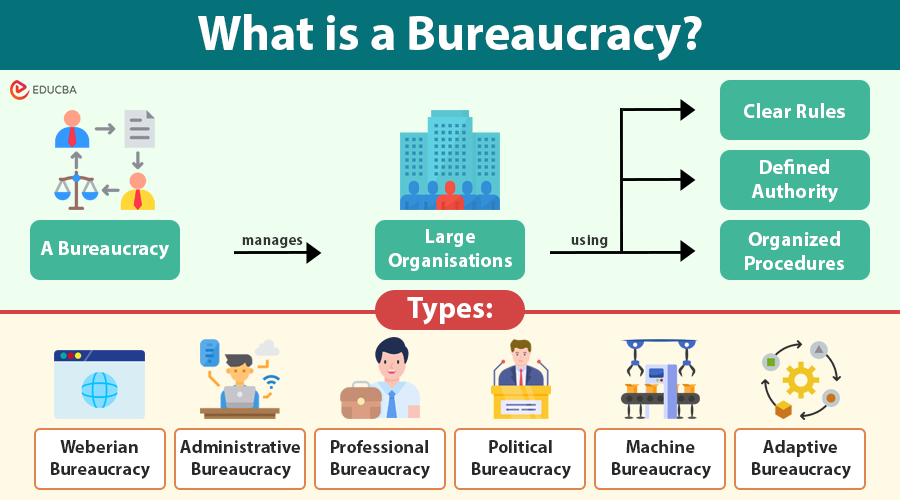
An administrative system manages large institutions through structured procedures, clear authority, and standardized rules in a bureaucracy.
According to Max Weber, bureaucracy is “a system of administration characterized by division of labor, hierarchy of authority, formal rules, and impersonal relationships.”
For example, when you apply for a passport, bank loan, or driver’s license, you go through a bureaucratic process where officials follow step-by-step procedures.
Table of Contents
- Definition
- Key Features
- Types
- Advantages
- Criticisms
- Bureaucracy in Government and Organizations
- Real-World Examples
Key Features of Bureaucracy
Bureaucracy has unique features that make it different from informal organizations:
1. Hierarchical Structure
Bureaucracies operate on a clear chain of command, where authority flows from the top levels to the bottom. Each level reports to the one above it, ensuring a structured and organized approach to decision-making. This hierarchy helps maintain order, accountability, and efficient supervision.
2. Division of Labor and Specialization
Employees perform specific roles and responsibilities. Each member of the bureaucracy specializes in a particular function, which increases efficiency and expertise. Specialization ensures tasks are handled by trained personnel, reducing errors and improving productivity.
3. Formal Rules and Regulations
Bureaucracies function according to formal rules, policies, and procedures. These regulations provide consistency and predictability in decision-making, ensuring that all employees follow a standard protocol regardless of personal discretion.
4. Impersonality and Objectivity
Decisions are made based on rules and merit rather than personal preferences or relationships. This impersonal approach ensures fairness, reduces favoritism, and promotes equality among employees and citizens interacting with the system.
5. Merit-Based Recruitment and Promotion
Organizations select and promote employees based on their qualifications, competence, and performance, rather than social status or personal connections. This feature ensures that the most capable individuals are assigned to handle important tasks.
6. Fixed and Defined Responsibilities
Each position has clearly defined duties. Employees know exactly what is expected of them, minimizing confusion, overlapping roles, and inefficiency.
7. Career Orientation
Bureaucracies often provide employees with a clear career path, including job security, opportunities for promotions, and benefits. This encourages commitment, loyalty, and long-term development within the organization.
8. Record-Keeping and Documentation
Organizations maintain formal records and documentation for all decisions, policies, and procedures. This ensures transparency, accountability, and a reference for future decisions or audits.
9. Centralized Authority
Higher-level authorities centralize decision-making, especially for important policies and strategic decisions. While lower levels handle routine tasks, central authority ensures coherence and uniformity in organizational objectives.
10. Standardization and Uniformity
Bureaucracies emphasize standard procedures and uniform practices. This reduces errors, ensures consistency across departments, and facilitates coordination between different units of the organization.
Types of Bureaucracy
Bureaucracies differ in structure and function. The main types include:
| Type of Bureaucracy | Key Features | Example |
| Weberian Bureaucracy | Structured hierarchy, rule-based, merit-oriented, rational-legal authority | Government civil services |
| Administrative Bureaucracy | Focus on formal administration, standard procedures, and policy enforcement | Public sector departments (tax, licenses) |
| Professional Bureaucracy | Skilled professionals, autonomy in work, and less rigid hierarchy | Hospitals, universities, law firms |
| Political Bureaucracy | Implements political decisions, which may involve policy influence | Ministries, local government agencies |
| Machine Bureaucracy | Highly formalized, centralized, standardized, efficiency-focused | Manufacturing firms, assembly-line industries |
| Innovative/ Adaptive Bureaucracy | Flexible, encourages innovation and problem-solving, collaborative | Tech companies, R&D organizations |
Advantages of Bureaucracy
Despite being criticized, it offers several benefits that make it indispensable:
- Efficiency in administration: Division of labor increases productivity and expertise.
- Accountability and responsibility: A clear hierarchy ensures that each level is answerable.
- Predictability and stability: Written rules ensure that policies remain consistent over time, providing stability and predictability.
- Fairness and equality: Impersonal decision-making reduces favoritism and bias.
- Professional growth: Merit-based recruitment motivates individuals to enhance skills.
- Specialization: Professionals in specialized roles bring expertise, improving overall outcomes.
Criticisms of Bureaucracy
Critics have pointed out several drawbacks:
- Rigidity: Fixed rules leave little room for flexibility or innovation.
- Red tape: Excessive paperwork slows down processes and frustrates citizens.
- Impersonality: Overemphasizing rules can overlook human needs and emotions.
- Delay in decision-making: Multiple layers of approval cause inefficiency.
- Goal displacement: Officials may prioritize following rules over achieving real objectives.
- Resistance to change: Bureaucratic systems often struggle to adapt to new technologies and modern needs.
Bureaucracy in Government and Organizations
In Government
Public administration relies on bureaucracy to implement laws, deliver public services, and consistently enforce societal regulations. It provides structure, accountability, and continuity in governance.
In Organizations
Corporations rely on bureaucracy to maintain structured management, ensure compliance, and uphold accountability. Standardized procedures and clear hierarchies help organizations operate efficiently and minimize errors.
Global Context
In countries such as Sweden and Norway, bureaucracies are renowned for their efficiency, transparency, and effective delivery of welfare services. In contrast, some developing nations struggle with bureaucratic inefficiencies, delays, and corruption, which can hinder development and public trust.
Real-World Examples of Bureaucracy
1. Government Administration
Bureaucracies play a crucial role in efficiently running government operations. Civil services, regulatory agencies, and administrative departments follow structured hierarchies and formal procedures to implement laws and policies.
- India’s civil services (IAS, IPS, IFS) oversee law enforcement and implement public policies across the country.
- S. federal agencies, such as the IRS or FDA, regulate taxation, public health, and safety.
2. Public Sector Organizations
Public sector enterprises use bureaucracy to ensure transparency, accountability, and standardized operations.
- The Indian Railways operates through a hierarchical structure to efficiently manage millions of passengers and cargo.
- The UK’s National Health Service (NHS) employs formal procedures to deliver healthcare services nationwide.
3. Corporations and Private Organizations
Many large corporations adopt bureaucratic structures to manage complex operations and maintain compliance.
- Banks, such as JPMorgan Chase or the State Bank of India, utilize bureaucratic systems for loan processing, auditing, and reporting.
- Multinational companies, such as IBM and Microsoft, have hierarchical departments for HR, finance, and operations.
4. International Organizations
Global institutions rely on bureaucracy for coordination, policy implementation, and maintaining international standards.
- The United Nations follows formal structures and committees to implement global initiatives.
- The World Health Organization (WHO) uses bureaucratic systems to coordinate international health responses.
Final Thoughts
Bureaucracy remains one of the most enduring organizational systems in history. It ensures order, predictability, and accountability, making it essential for managing large organizations, such as governments and corporations. However, excessive rules, delays, and rigidity can undermine its effectiveness.
The challenge for the 21st century lies in reforming bureaucracy, retaining its strengths while reducing inefficiency. By integrating technology, transparency, and citizen-centric approaches, modern bureaucracies can strike a balance between order and flexibility, fostering innovation.
Frequently Asked Questions (FAQs)
Q1. How does technology impact bureaucracy?
Answer: Technology can streamline bureaucratic processes, reduce paperwork, enhance communication, and facilitate faster and more transparent decision-making.
Q2. What is the difference between a bureaucracy and a meritocracy?
Answer: Bureaucracy focuses on structured administration and standardized rules, whereas meritocracy emphasizes rewarding individuals based on talent and performance. Many bureaucracies incorporate meritocratic principles into their recruitment and promotion processes.
Q3. How do bureaucracies handle accountability?
Answer: Clear hierarchies, accurate records, and defined roles allow bureaucracies to trace every decision back to the responsible person, ensuring accountability.
Q4. Are there modern alternatives to traditional bureaucracy?
Answer: Yes, modern organizations often use flexible structures, such as networked teams or agile frameworks, which reduce rigid hierarchies while retaining some bureaucratic principles for accountability and process control.
Q5. How do citizens interact with bureaucracy?
Answer: Citizens typically interact with bureaucracy when accessing public services, such as obtaining licenses, permits, healthcare, or social benefits, all of which follow formal procedures.
Recommended Articles
We hope this detailed guide on Bureaucracy has enhanced your understanding of its meaning, features, types, and criticisms. You may also read the following related topics:


