


Blockchain for Intellectual Property Rights Management
Protecting intellectual property (IP) is no easy task. Whether it is copyrights, patents, or trademarks, creators and businesses often face challenges like theft, ownership disputes, and unclear licensing rules. Securing your work and proving ownership can feel overwhelming. Blockchain in intellectual property management is changing this landscape. By providing unalterable records, transparent ownership tracking, and automated contracts, blockchain enhances security, efficiency, and clarity in managing IP. In this article, we explore how blockchain is transforming IP protection for creators and organizations.
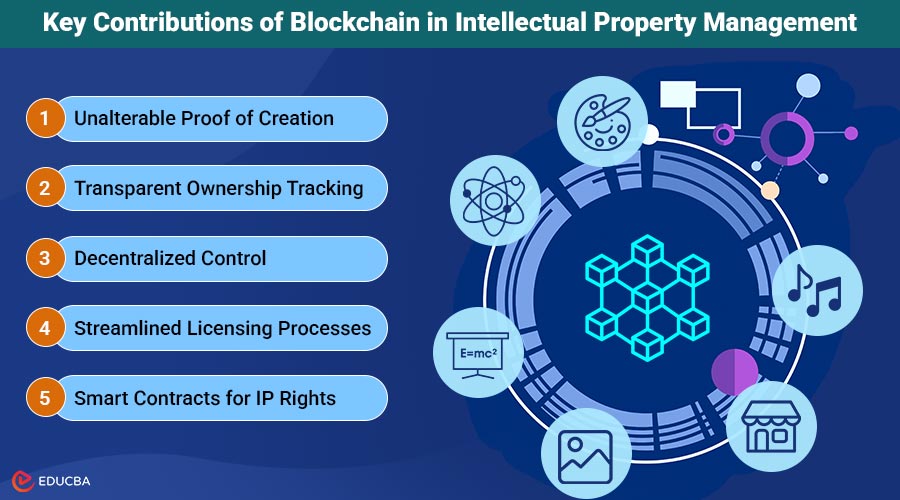
Key Contributions of Blockchain in Intellectual Property Management
Blockchain technology brings clarity, security, and efficiency to IP management. Its key contributions include:
1. Unalterable Proof of Creation
Creators often struggle with proving the originality of their work. Blockchain addresses this issue by using cryptography to timestamp digital rights at the moment of creation. This establishes an unchangeable record, ensuring no one can interfere with it.
Each entry in a blockchain ledger is permanent and time-stamped. Artists, inventors, and creators can depend on this technology for copyright protection or patent management. It establishes the basis for clear ownership tracking next.
2. Transparent Ownership Tracking
Blockchain ensures clear ownership of intellectual property by maintaining a transparent record. Each transaction or change gets logged on a distributed ledger. This makes it nearly impossible to tamper with who owns what or when they acquired it. Every party involved can verify these records in real time without relying on intermediaries. It promotes trust while reducing disputes over rights.
Artists, inventors, and businesses benefit from this clarity of ownership tracking. For instance, someone filing for patent management can feel confident that their claim will be secure and visible to all parties concerned. “Transparency builds accountability at its core,” fits perfectly here as blockchain eliminates concealed agreements entirely.
3. Decentralized Control
Decentralized control removes the dependency on a single authority for intellectual property rights management. Ownership verification, patent management, and copyright protection all take place using distributed ledger technology.
This structure minimizes risks of fraud by ensuring no single party can modify records. Businesses achieve greater clarity and increased trust with this model. Trademark registration becomes easier because updates are shared immediately among participants. Managed IT services also benefit from simplified monitoring without requiring external validation or lengthy audits. For example, businesses exploring IT support options can learn more about ESI Tech online to see how technology partners are helping organizations adopt secure, scalable solutions.
4. Streamlined Licensing Processes
Blockchain makes licensing for intellectual property easier. It records agreements on a secure, clear ledger. This cuts down on disputes and accelerates approvals. Smart contracts manage automatic payments and renewals without intermediaries.
Business owners gain from quicker, cost-effective processes. Rights holders can monitor usage instantly using distributed ledgers. Working with a trusted Greenville IT managed provider can also help businesses implement these systems effectively while ensuring long-term support.
5. Smart Contracts for IP Rights
Smart contracts automate licensing agreements and royalty payments with accuracy. These digital contracts execute terms only when specific conditions are met, reducing the need for manual monitoring. For example, an artist granting usage rights can program a smart contract to ensure payment is processed immediately after their work is downloaded or streamed.
They also assist in enforcing copyright protection by embedding clear rules within the code itself. This restricts unauthorized use of intellectual property while providing transparent ownership tracking for digital assets. Using cryptography, these contracts enhance security measures, making fraud prevention significantly more efficient than traditional methods.
Real-World Applications of Blockchain in IP Management
Businesses are using blockchain to safeguard intellectual property in remarkable ways. These tools help streamline processes and minimize disputes over ownership.
1. Blockai
Blockai helps creators safeguard their intellectual property using blockchain technology. It timestamps digital works, such as photos, music, and documents, on a public ledger. This establishes an unchangeable record of ownership linked to the creator. Copyright protection is straightforward with Blockai’s platform. It enables users to demonstrate authorship without depending on intermediaries or time-consuming processes. Creators can protect assets promptly while feeling assured against theft or misuse.
2. Verisart
Verisart uses blockchain technology for intellectual property rights management. It provides creators with permanent records to protect copyrights and verify ownership. Businesses can register artwork, patents, or trademarks on their platform, gaining access to detailed timestamps and certificates supported by cryptography. Its decentralized system allows users to track provenance transparently without relying on central authorities. Verisart also connects seamlessly with creative marketplaces, simplifying licensing processes for digital assets. This naturally leads to the broader topic of Bernstein’s role in IP management solutions.
3. Bernstein
Bernstein uses blockchain technology to safeguard intellectual property. It functions as a digital notary, securely documenting creation dates and ownership of assets with timestamped certificates. Businesses can rely on Bernstein for patent management and copyright protection. Its encrypted system guarantees that sensitive information remains private while still being verifiable through cryptographic methods. This minimizes fraud risks and makes rights management processes easier.
Challenges in Adopting Blockchain for IP Management
Integrating blockchain in intellectual property management faces some challenges. These obstacles often leave businesses uncertain about the practical adoption of these solutions.
1. Legal Uncertainty
Legal frameworks struggle to keep pace with blockchain technology. Many jurisdictions lack clear regulations for intellectual property management using decentralized systems. This creates uncertainty for businesses trying to adopt blockchain approaches for patent management or copyright protection.
Disputes over ownership and licensing terms can arise without globally recognized standards. For example, laws in one country may not support smart contracts, while others fully accept them. Businesses face risks when addressing these legal gray areas, making compliance a challenge across different regions.
2. Lack of Industry-Wide Adoption
Many industries are reluctant to adopt blockchain for intellectual property rights management. Companies are concerned about compatibility with current systems and the significant costs of integration. Some organizations are also doubtful due to a few proven success stories in IP registries or copyright protection.
Without widespread adoption, cooperation across sectors remains disconnected. This hinders progress and diminishes confidence in the technology’s dependability for ownership verification and digital rights management.
3. Jurisdictional Issues
Legal systems vary across countries, creating challenges for blockchain-based Intellectual Property (IP) rights management. Laws regarding copyright protection, trademark registration, and patent enforcement differ significantly between jurisdictions. A decentralized system like blockchain operates globally, but legal disputes often depend on national or regional rules. This mismatch complicates ownership tracking and rights validation processes in cross-border cases.
Enforcing smart contracts adds another layer of complexity due to differing regulations surrounding digital agreements. For example, a contract that is valid in one country may face scrutiny or rejection in another. Disparities among IP registries worldwide can also hinder the adoption of a unified approach to tokenization and ownership verification through blockchain technology. Addressing jurisdictional conflicts is crucial before improving licensing processes with transparency tools, such as distributed ledger technology, which leads to better applications, including real-world integration methods, as discussed in “Smart Contracts for IP Rights”.
Final Thoughts
Blockchain in intellectual property management is revolutionizing how creators and businesses protect their IP. From transparent ownership tracking to automated smart contracts, blockchain provides clarity, security, and efficiency. While adoption challenges exist, the advantages far outweigh the obstacles, giving early adopters a competitive edge.
Recommended Articles
We hope this guide on blockchain in intellectual property management helps you understand its benefits and applications. Check more such articles to enhance your IP protection.


