
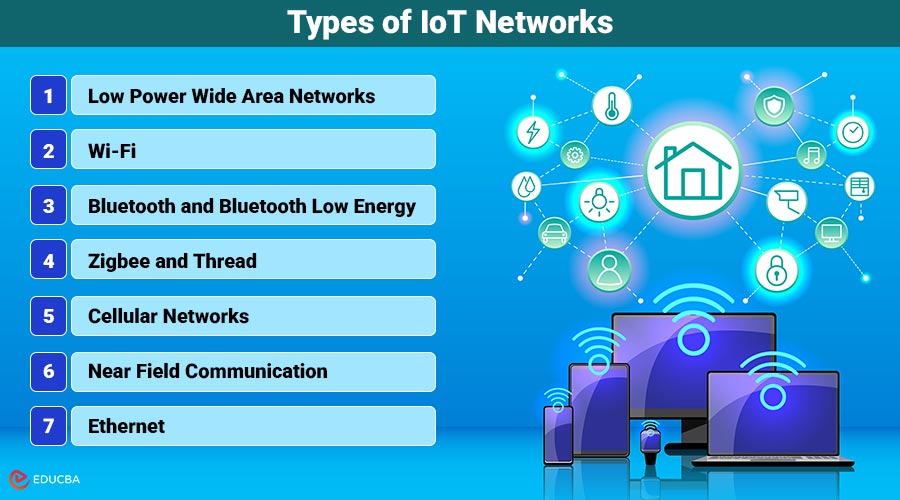
Introduction to Types of IoT Networks
Types of IoT (Internet of Things) Networks refer to the various communication frameworks that connect Internet of Things devices, enabling them to exchange data and perform tasks efficiently. These networks differ in terms of range, power consumption, speed, and reliability, making them suitable for various applications, including smart homes, industrial automation, healthcare, and smart cities. In this blog, we will examine the 7 most widely used types of IoT networks, along with their features, use cases, advantages, and disadvantages.
7 Types of IoT Networks
Let us explore the most widely used IoT networks.
#1. Low Power Wide Area Networks
Low Power Wide Area Networks (LPWANs) are long-range, low-power, cost-effective wireless IoT networks supporting massive device connectivity. They cover large areas in cities or countryside while using very little energy, making them perfect for things like smart meters, farm monitoring, and keeping track of valuable items.
Features:
- Long-range coverage (up to 10–40 km in rural areas).
- Extremely low power consumption (devices can last for years on a battery).
- Low data rates (suited for small, infrequent data packets).
Use Cases:
- Smart metering (water, gas, electricity).
- Environmental monitoring (air quality sensors, agriculture).
- Asset tracking and logistics.
Advantages:
- Low power and cost-effective.
- Excellent scalability (millions of devices).
- Wide coverage suitable for rural and urban environments.
Disadvantages:
- It is not good for sending large amounts of data
- Latency may be high.
- Limited interoperability across standards
#2. Wi-Fi
Wi-Fi is a widely adopted short-to-medium range wireless network delivering high-speed internet connectivity. It easily works with existing systems and can handle IoT applications that need a lot of data, like smart home devices, health monitoring, video streaming, and automated stores.
Features:
- High data rates (up to gigabits per second with newer standards).
- Short to medium range (typically 50–100 meters indoors).
- Widely available infrastructure.
Use Cases:
- Smart homes (including cameras, appliances, and speakers).
- Healthcare wearables connected to local routers.
- Retail (point-of-sale devices, smart shelves).
Advantages:
- High bandwidth for video and multimedia IoT applications.
- Easy integration with existing infrastructure.
- Widely adopted and standardized.
Disadvantages:
- High power consumption (not ideal for battery-powered sensors).
- Limited range compared to LPWAN or cellular.
- Network congestion in dense environments
#3. Bluetooth and Bluetooth Low Energy
Bluetooth and BLE are short-range wireless communication standards enabling device-to-device connectivity. BLE optimizes power efficiency, supporting IoT applications such as wearables, beacons, and smart locks, although range and bandwidth are more limited than those of Wi-Fi or cellular networks.
Features:
- Short range (typically up to 100 meters).
- BLE consumes significantly less power compared to traditional Bluetooth.
- Moderate data rates (suitable for small data packets).
Use Cases:
- Wearables (fitness trackers, smartwatches).
- Proximity marketing (beacons in retail).
- Smart locks and access systems.
Advantages:
- Low energy consumption with BLE.
- Widespread adoption in consumer electronics.
- Good for device-to-device communication.
Disadvantages:
- Limited range compared to Wi-Fi or cellular.
- Not suitable for high-data applications.
- Susceptible to interference
#4. Zigbee and Thread
Zigbee and Thread are short-range, low-power mesh networking standards for IoT. These networks help devices communicate and send signals to one another. They can repair themselves, use energy efficiently, and automate jobs in smart homes, factories, and power systems.
Features:
- Mesh networking enables devices to relay data to one another, thereby extending coverage.
- Low power consumption and low data rates.
- Operates in the 2.4 GHz frequency band.
Use Cases:
- Smart homes (lighting, thermostats, sensors).
- Industrial automation.
- Energy management systems.
Advantages:
- Reliable mesh connectivity (self-healing network).
- Very low power usage.
- Supports large device networks.
Disadvantages:
- Limited bandwidth.
- Requires dedicated gateways to connect with the internet.
- Susceptible to interference in crowded 2.4 GHz spectrum
#5. Cellular Networks
Cellular networks (2G, 3G, 4G, 5G) provide global IoT connectivity using mobile infrastructure. 5G networks are super fast, reliable, and react instantly. They can carry a lot of data, making them ideal for self-driving cars, smart factories, health monitoring, and other things that need constant, smooth connections.
Features:
- Wide coverage (global availability).
- High bandwidth with 4G and 5G.
- Reliable connectivity and mobility support.
Use Cases:
- Connected cars and autonomous vehicles.
- Industrial IoT (factories, robotics).
- Healthcare (remote monitoring, telemedicine).
Advantages:
- High reliability and coverage.
- Supports high data-intensive applications (e.g., video surveillance).
- 5G enables ultra-low latency communication.
Disadvantages:
- Higher costs (SIM cards, subscriptions).
- Power consumption is higher than LPWAN.
- Network dependency and potential congestion
#6. Near Field Communication
Near Field Communication (NFC) lets devices talk to each other without touching and uses very little power. It is often used for ID checks, contactless payments, and tracking items. It’s fast and safe, but it only works over short distances and can handle only a small amount of data.
Features:
- Very short range (a few centimeters).
- Minimal power requirements.
- Ideal for identification and authentication.
Use Cases:
- Contactless payments.
- Inventory and supply chain tracking.
- Access control and security.
Advantages:
- Extremely low power.
- Fast, contactless interactions.
- Cost-effective for tagging.
Disadvantages:
- Very short-range limits use cases.
- Low data capacity.
- Requires proximity for operation
#7. Ethernet
Ethernet is a wired IoT networking technology offering high-speed, reliable, low-latency communication. It works well for industrial IoT, security cameras, and smart electricity grids. It needs wired connections, which makes it secure and stable, but it can’t move around like wireless networks.
Features:
- High-speed data transfer.
- Reliable and interference-free.
- Requires cabling infrastructure.
Use Cases:
- Industrial IoT in factories.
- Data centers and smart grids.
- Surveillance systems.
Advantages:
- High security and reliability
- Unlimited bandwidth potential.
- Low latency.
Disadvantages:
- Limited mobility.
- Installation costs can be high.
- Infrastructure dependency
Final Thoughts
Choosing the right type of IoT network is crucial for maximizing efficiency, reliability, and scalability. Different types of networks—like LPWANs for long-range, low-power devices, or fast networks like Ethernet and cellular—have their own good points and limitations. Knowing what each network can do and where it works best helps you pick the right one. This makes sure your devices, like smart home gadgets, factory machines, health monitors, or city systems, work smoothly and efficiently.
Recommended Articles
We hope that this EDUCBA information on “Types of IoT Networks” was beneficial to you. You can view EDUCBA’s recommended articles for more information.


