


Updated October 5, 2024
What are IoT-Embedded Systems?
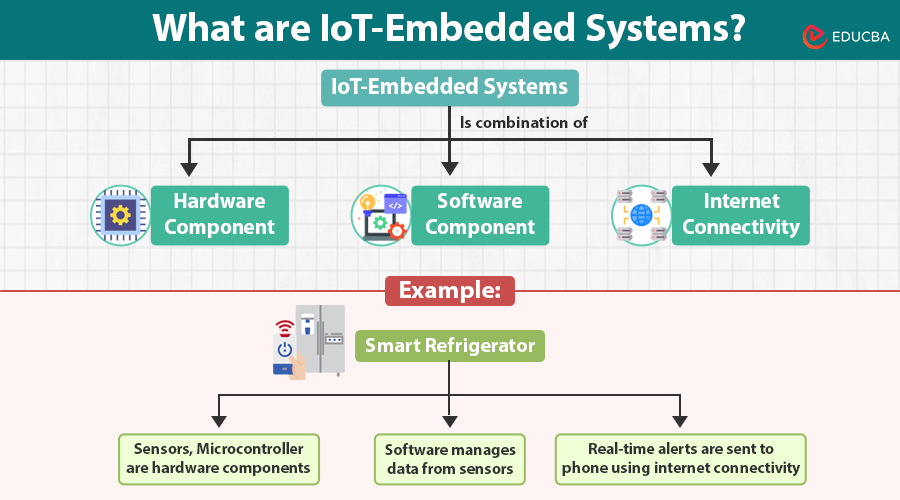
IoT-embedded systems combine hardware and software to perform specific tasks while connected to the Internet. An example is a smart refrigerator, which monitors food inventory and can send alerts to your phone when items are running low or nearing expiration. Here, the hardware components (sensors, microcontrollers) are part of the embedded systems, and the ability to send alerts via the Internet is the IoT aspect.
Why are IoT-Embedded Systems Important?
Integrating IoT-embedded systems enables devices to interact and exchange real-time data. This connectivity is beneficial as it:
- Improves automation
- Reduces manual tasks
- Creates smarter, more interconnected systems
Industries like manufacturing, transportation, and healthcare benefit greatly from embedded systems with IoT, enhancing monitoring, decision-making, and overall productivity.
Moreover, an embedded software development company can greatly enhance embedded systems by integrating advanced IoT technologies, driving innovation, and improving connectivity across devices.
How Embedded Systems and IoT Work Together?
1. Edge Computing
With edge computing, data processing happens directly at the device, reducing the need for cloud-based systems. This results in lower latency and faster responses. For example, in smart factories, embedded systems with IoT analyze sensor data immediately, improving safety and productivity.
2. Power Optimization
Power efficiency is crucial for these systems, especially in remote or hard-to-reach locations. Many IoT devices rely on ultra-low-power microcontrollers (MCUs) to extend battery life, ensuring that these systems can operate for long periods without intervention.
Some devices use embedded systems and IoT to capture energy from the environment (e.g., solar power) and convert it into usable electricity. For instance, solar-powered IoT sensors in agriculture monitor soil moisture, optimizing irrigation without manual labor.
| Power Optimization Strategy | Example |
| Ultra-Low-Power MCUs | Smartwatches |
| Energy Harvesting | Solar-Powered Agricultural Sensors |
How to Secure Embedded Systems and IoT?
Embedded systems, in general, need special security solutions, as they have been shown to be susceptible due to their usually limited processing power and memory.
- End-to-End Encryption: From smart home systems to medical devices, if IoT devices are handling sensitive data (which they almost always are), they need encryption. This is especially crucial in healthcare, where IoT-based medical equipment collects patient information and transmits this data to the cloud for monitoring.
- Authentication Protocols: In addition to encryption, it is essential to avoid using weak authentication methods that can be easily guessed or phished. To prevent unauthorized access, measures such as two-factor authentication (2FA) are integrated into device-level authentication to guarantee that only authorized users can interact with IoT systems. For instance, a traffic management system in a smart city should permit only qualified personnel to assume control over its critical infrastructure.
Why Flexibility and Scalability Matter for IoT-Embedded Systems?
As the IoT ecosystem continues to grow, devices must be adaptable, scalable, and easy to update. This flexibility is key to ensuring embedded systems can keep pace with rapid technological advancements.
- Modular Hardware Design: Modular designs enable businesses to easily upgrade components of their embedded systems. For example, new modules can improve IoT-based environmental sensors for more accurate data collection.
- Over-the-Air (OTA) Updates: OTA updates allow embedded systems to receive software enhancements and security patches remotely. For example, smart home devices often use OTA updates to add features and fix bugs, ensuring long-term device functionality.
Final Thoughts
The combination of cutting-edge IoT technologies and embedded development has begun to revolutionize an entire market, inspiring a new wave of innovation. Moreover, the future of embedded systems and IoT looks promising with advancements in 5G and AI. Thus, in the future, businesses will benefit from better power efficiency, stronger security, and scalability that many companies today cannot achieve with their current embedded systems and IoT.
Recommended Articles
If you found this article on ‘IoT-Embedded Systems‘ interesting, you can also check the suggestions below:

