


Updated November 27, 2023
Advantages and Disadvantages of Market Economy – Introduction
A market economy is important because everything we consume is produced under a market economy, from the clothes we wear to the food we eat. It is when the product prices and employee wages are set based on the demand and supply of goods and services. By doing so, it encourages competition, innovation, and efficiency. For instance, during the COVID-19 pandemic, the market economy played an important role in meeting the demand for PPE. Many fashion companies shifted their production to masks, and distilleries started making hand sanitizers. However, the market economy also has some disadvantages, like income inequality and the underproduction of public goods.
Let us look at the most common advantages and disadvantages of market economy.
Advantages of Market Economy
These are some advantages of the market economy in detail:
1. Offers the Choice to Select the Career Path You Want to Take
In a market economy, you can choose where and how you want to work. It means if you have programming skills, you can either work for a tech company, start your own software business, or even freelance.
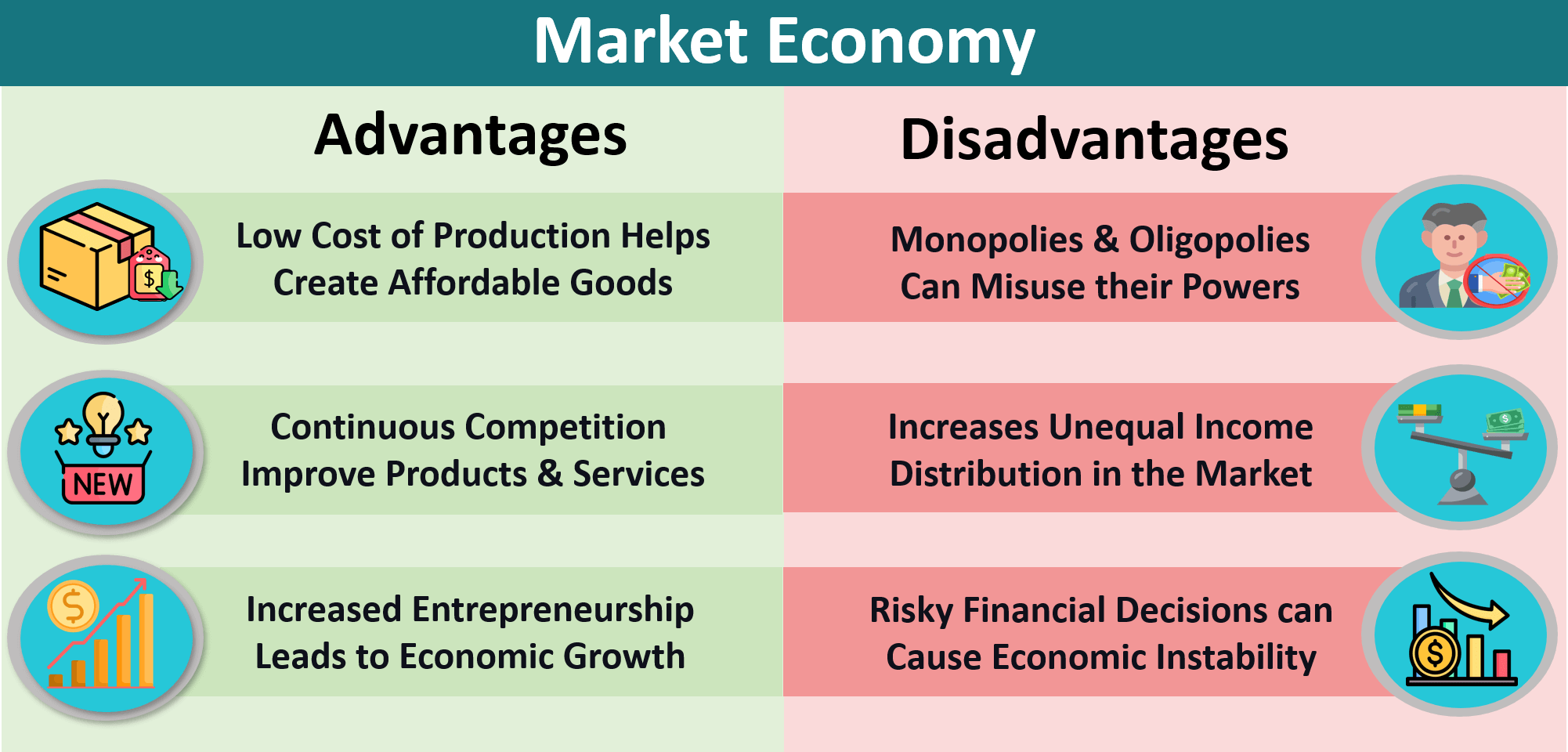
2. Continuous Competition Improves Products and Services
In a market economy, many businesses compete with each other to attract customers. This competition can lead to better products, lower prices, and innovation.
3. Low Cost of Production Helps Create Affordable Goods
In a market economy, businesses want to make products as cheaply as possible to attract more customers. This means that their products are usually less expensive for people to buy.
4. Adapting to Changes in the Market is Easier
In a market economy, businesses can often adapt more quickly to changes in demand or technology. This means that businesses can adjust their strategies to remain relevant and successful when there is a shift in what consumers want or the production process.
5. Consumer’s Choices Influence What Products are Sold in the Market
Businesses operate to make a profit. To achieve that, they produce goods and services that they believe consumers will demand. If consumers desire a certain product, businesses try to meet that demand by producing the product. In this way, consumer demand plays a crucial role in determining what products are available in the market.
6. Increased Entrepreneurship Leads to Economic Growth
Market economies provide an environment that encourages entrepreneurship. Individuals can start businesses and pursue opportunities. This unique initiative can lead to personal success and contribute to economic growth.
Disadvantages of the Market Economy
Let’s look at some disadvantages of the market economy in detail:
1. Short-Term Focus Leads to Negative Impact on Business Growth
Businesses in a market economy may prioritize short-term profits over long-term sustainability or societal well-being. However, this can result in decisions that benefit shareholders in the short term but may negatively affect the environment, employee well-being, or the broader community.
2. Monopolies and Oligopolies can Misuse their Powers
Market economies may develop monopolies or oligopolies without proper regulation. When this happens, such companies can use their power to control prices and limit consumer choices. This can lead to a situation where consumers have to pay more for products and services, and they have limited options.
3. Economic Downfalls Can Lead to Cyclical Unemployment
Market economies can experience economic cycles with periods of boom (when the economy is doing well) and bust (when the economy is not doing so well). During economic downturns, unemployment may rise as businesses cut costs to survive.
4. Increases Unequal Income Distribution in the Market
One of the most significant disadvantages of market economies is the potential for increasing income inequality. This means that a small percentage of the population may own most of the country’s wealth while many lower-income households struggle to make ends meet.
5. Risky Financial Decisions can Cause Economic Instability
When people make risky financial moves, they can backfire and cause losses, such as when the stock market crashes. One reason for this is that people often focus on making quick profits in the short term rather than thinking about the long-term consequences. This can lead to economic instability, where the economy becomes unpredictable and unstable.
6. Weak Labor Protection Result in Labor Market Exploitation
When labor protections are not strong, it can lead to businesses mistreating workers. This may include getting low wages, working in poor conditions, and facing job insecurity. Without proper protections, employers who only care about making money can take advantage of workers.
Final Thoughts
There are several advantages and disadvantages of market economy that can help us understand the market and its trends. Therefore, as we navigate the complexities of an ever-evolving global landscape, we need to consider the above aspects when shaping economic policies.
Recommended Articles
We hope you found this article on the advantages and disadvantages of market economy helpful. Refer to the following recommendations to view similar articles.

