


Updated October 12, 2026
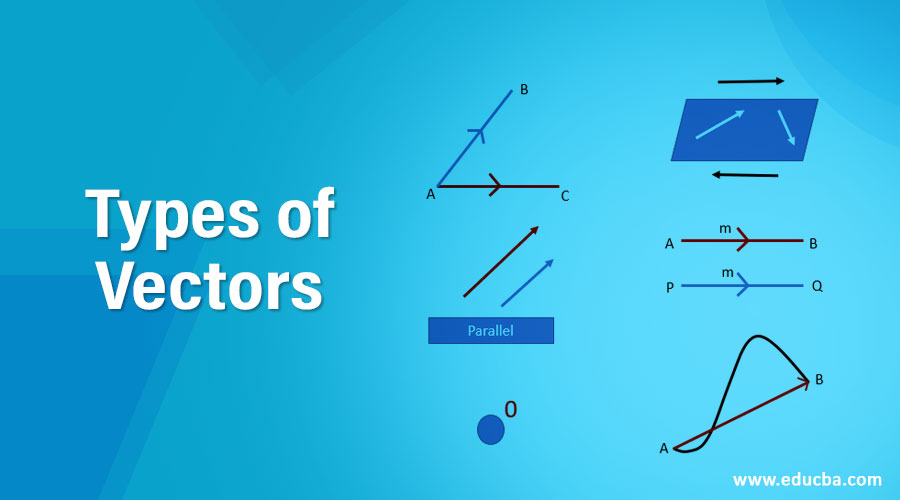
Introduction to Types of Vectors
Types of Vectors refer to mathematical quantities that have both magnitude and direction. A vector is commonly represented by a directed line segment, where its length indicates its magnitude and its orientation shows its direction. Vectors are widely used in mathematics, physics, and engineering. They are represented using bold letters or arrows (e.g., A or \vec{A}, while |A| denotes their magnitude.
Understanding the Types of Vectors helps explain their different properties and applications. You can add, subtract, and multiply vectors by scalars. Vectors are widely used in mathematics, physics, engineering, and geometry to represent quantities such as force, velocity, acceleration, and displacement. Common types include zero, unit, position, equal, negative, parallel, collinear, coplanar, like and unlike, coinitial, free, and displacement vectors.
Table of Contents
- Introduction to Types of Vectors
- Basic Properties of Vectors
- Top Types of Vectors
- Vector Operations
- Scalar vs Vector
- Applications of Vectors
- Difference Between
Key Takeaway
- Vectors represent quantities with both magnitude and direction.
- Vector types include zero, unit, position, equal, negative, parallel, collinear, coplanar, coinitial, free, and displacement vectors.
- Each vector type has its own properties and uses.
- Basic vector operations include addition, subtraction, scalar multiplication, dot product, and cross product.
- Vectors are widely used in mathematics, physics, engineering, and other fields.
- Understanding vector types and their properties helps solve mathematical problems and understand real-world applications.
Basic Properties of Vectors
Vectors have several basic properties that help describe their size, direction, and position. Understanding these properties makes it easier to work with different types of vectors.
Magnitude
Magnitude represents a vector’s length or size. For a vector A = (a₁, a₂, a₃), its magnitude is:
Direction
Direction shows a vector’s orientation. A vector can point in any direction depending on its components.
Initial Point
The initial point is a vector’s starting point. It is the point from which the vector begins.
Terminal Point
The terminal point is a vector’s ending point. The arrowhead of a vector indicates its terminal point.
Components
Components are the values that describe a vector along different coordinate axes. In a three-dimensional coordinate system, a vector is represented by:
Here, a₁, a₂, and a₃ represent the components along the x-, y-, and z-axes.
Vector Notation
Vectors are commonly represented using bold letters or arrows. For example, a vector can be written as A, 𝐀, or →A. Its magnitude is represented by |A|.
Top Types of Vectors
Vectors can be classified into several different types.
Zero Vector
The zero vector has magnitude zero, and its origin coincides with its terminal point. For example, if points A and B have the same coordinates, then vector AB is the zero vector. The zero vector has an indeterminate direction, and its magnitude is always zero. The zero vector has no direction, and all components are zero.
Key Features
- Magnitude = 0
- Initial and terminal points are the same
- It has no definite direction
For Example:
The zero vector is also called the null vector.
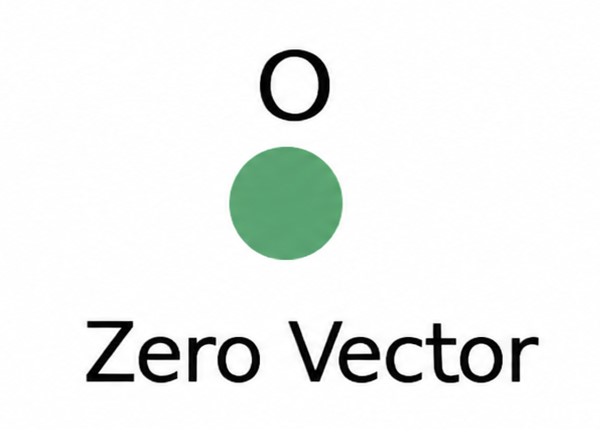
The diagram above shows the zero vector.
Unit Vector
A unit vector represents direction and has a length of exactly one unit. If x represents a vector with magnitude |x|, its unit vector is denoted by x̂ and has the same direction as x, with a magnitude of 1.
Key Features
- Magnitude = 1
- Represents direction
- Commonly used in vector calculations
Formula
Position Vector
The vector OA is known as the position vector, with the reference origin at 0. A position vector represents a point’s position relative to a fixed origin. If O is the origin and A is a point, the vector OA is called the position vector of point A.
Key Features
- Starts from the origin
- Represents the position of a point
- Depends on the coordinates of the point
For a point A(x, y, z), its position vector is:
Here, O is the origin, and A is the given point. Position vectors describe an object’s location in a coordinate system.
Equal Vectors
Vectors are considered equal when they have identical magnitudes and point in the same direction. Their initial and terminal points do not need to be the same. For example, vectors AB and PQ are equal if they have equal lengths and point in the same direction.
Key Features
- Same magnitude
- Same direction
- Initial and terminal points can be different
Therefore:
Equal vectors can have different positions while representing the same vector quantity.
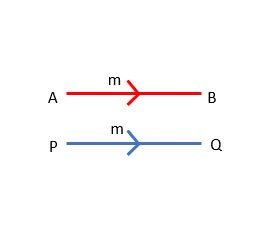
In the above diagram, vectors AB-> and PQ-> are equal because they have the same magnitude and direction.
Negative Vector
A negative vector has the same magnitude as another vector but the opposite direction. Suppose we have two vectors, a and b, which are negative vectors. If A is a vector, its negative vector is written as −A.
Key Features
- Same magnitude as the original vector
- Opposite direction
- Denoted by −A
Therefore:
but their directions are opposite. For example, if vector A points toward the right, vector −A has the same length but points toward the left.
Parallel Vectors
Parallel vectors have parallel lines of action. They can point in the same or opposite directions and may have different magnitudes. Two vectors are parallel when one is a scalar multiple of the other. For example, if vector A and vector B lie along parallel lines, they are considered parallel vectors.
Key Features
- Lines of action are parallel
- Can have the same or opposite directions
- Magnitudes can be different
- One vector can be a scalar multiple of another
Parallel vectors can be expressed using a scalar relationship such as:
B = kA
where k is a scalar. Parallel vectors are useful when comparing quantities that act along the same or parallel directions.
Collinear Vectors
Collinear vectors lie along the same straight line or on parallel lines. They can have the same or opposite directions and may have different magnitudes. Their corresponding components are proportional.
Key Features
- Lie along the same line or parallel lines
- Can have the same or opposite directions
- Their directions are related along one dimension
For example, if vector A is in the x-direction and vector B is in the same direction, they are collinear. The coordinates of both vectors are proportional. Another property of collinear vectors is that their cross product is always zero. Collinear vectors are also called parallel vectors.
For two collinear vectors, their cross product is zero:
Collinear vectors are closely related to parallel vectors because vectors lying along the same or parallel lines have the same line direction.
Coplanar Vectors
Coplanar vectors are vectors in which three or more vectors lie in the same plane or in parallel planes. For coplanar vectors, the scalar triple product of any three such vectors equals zero. Coplanar vectors are always linearly dependent vectors.
Key Features
- Lie in the same plane
- Three or more vectors can be coplanar
- Their scalar triple product is zero
For three vectors A, B, and C, the scalar triple product is zero when they are coplanar:
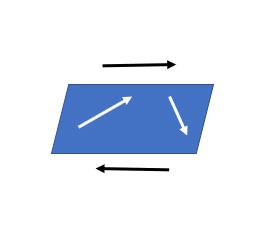
Coplanar vectors are important in geometry, mechanics, and three-dimensional vector problems.
Like and Unlike Vectors
Like vectors have the same direction. Unlike vectors have opposite directions. For example, two vectors pointing right are like vectors, even if their magnitudes differ. If one vector points right and another points left along the same line, they are unlike vectors.
Key Features
- Like vectors have the same direction
- Unlike vectors have opposite directions
- Their magnitudes do not need to be equal
| Type | Direction |
| Like vectors | Same direction |
| Unlike vectors | Opposite directions |
The magnitudes of like or unlike vectors do not necessarily have to be equal.
Coinitial Vectors
Coinitial vectors are two or more vectors that share the same initial point. In this type, all vectors originate from the same position.
Key Features
- Have the same initial point
- Can have different directions
- Can have different magnitudes
- Start from a common position
For Example, vectors AB→ and AC→ share the same initial point, A, so we call them coinitial vectors.
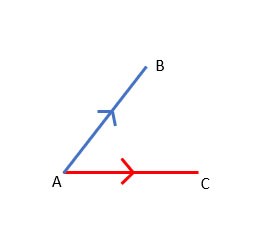
Coinitial vectors are often used to compare different directions and magnitudes starting from a common point.
Free Vectors
A free vector is a vector whose position does not affect its magnitude or direction. You can move it from one location to another without changing its properties. For example, a force represented by a free vector can be shifted parallel to itself while keeping the same magnitude and direction. Free vectors are useful when a vector’s position does not matter, and only its magnitude and direction do.
Key Features
- Position does not affect the vector
- Can be moved from one location to another
- Magnitude remains unchanged
- Direction remains unchanged
Displacement Vectors
A displacement vector represents an object’s change in position. It shows the shortest directed distance from the initial position to the final position. For example, if an object is at point A at time = 0 and, after some time, is at point B at time = t. The direction is from point A to point B.
Key Features
- Show the change in position
- Have both magnitude and direction
- Points from the initial position to the final position
- Represent the shortest directed distance
It can be represented as:
Displacement = Final position − Initial position
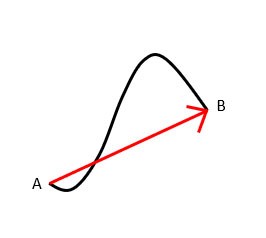
Unlike distance, displacement has both magnitude and direction, making it a vector quantity. For example, if a person walks 5 meters east and then returns 2 meters west, the total displacement is 3 meters east. The displacement vector has both magnitude and direction, unlike distance, which has only magnitude.
Vector Operations
You can combine and manipulate vectors using several basic mathematical operations.
- Vector Addition: Combines two or more vectors to find their resultant vector.
A + B = (a₁ + b₁, a₂ + b₂, a₃ + b₃) - Vector Subtraction: Finds the result of subtracting one vector from another.
A − B = (a₁ − b₁, a₂ − b₂, a₃ − b₃) - Scalar Multiplication: Scales a vector’s magnitude while keeping its direction, or reversing it, based on the scalar’s value.
kA = (ka₁, ka₂, ka₃) - Dot Product: Multiplies two vectors to produce a scalar value.
A · B = |A||B| cos θ - Cross Product: The cross product produces a new vector perpendicular to both original vectors.
A × B = |A||B| sin θ
Vector vs Scalar
Vectors describe quantities using both size and direction, whereas scalars describe quantities using size alone. The following table highlights the key differences between vector and scalar quantities.
| Vector Quantity | Scalar Quantity |
| Has magnitude and direction | Has magnitude only |
| Force | Mass |
| Velocity | Speed |
| Displacement | Distance |
| Acceleration | Time |
Applications of Vectors
Vectors represent quantities that involve both magnitude and direction. Their applications extend across mathematics, science, engineering, and technology.
- Physics and Mechanics: Used to represent force, velocity, acceleration, momentum, and displacement.
- Engineering: Helps analyze forces, motion, structures, and mechanical systems.
- Computer Graphics: Represents positions, directions, movement, and transformations of objects.
- Navigation: Helps determine direction, distance, and movement between locations.
- Robotics: Controls the position, movement, and direction of robotic systems.
- Geometry: Helps describe points, lines, planes, distances, and spatial relationships.
- Game Development: Used for character movement, object positioning, camera direction, and physics-based motion.
Difference Between Types of Vectors
The different types of vectors can be compared based on their main properties:
| Type of Vector | Main Property |
| Zero Vector | Magnitude is zero |
| Unit Vector | Magnitude is one |
| Position Vector | Shows the position of a point from the origin |
| Equal Vectors | Same magnitude and direction |
| Negative Vector | Same magnitude but opposite direction |
| Parallel Vectors | Lines of action are parallel |
| Collinear Vectors | Lie along the same or parallel lines |
| Coplanar Vectors | Lie in the same or parallel planes |
| Like Vectors | Have the same direction |
| Unlike Vectors | Have opposite directions |
| Coinitial Vectors | Have the same initial point |
| Free Vectors | Can be moved without changing magnitude or direction |
| Displacement Vectors | Show change from initial to final position |
Final Thoughts
Vectors are physical quantities with magnitude and direction. Vectors are a mathematical concept, and there are various kinds of vectors, such as collinear vectors, coplanar vectors, like and unlike vectors, displacement vectors, unit vectors, and many more defined above. Understanding these types provides a strong foundation in vector mathematics and helps solve problems in mathematics, physics, engineering, and related fields.
Frequently Asked Questions (FAQs)
Q1. What is a vector?
Answer: A vector is a mathematical quantity that has both magnitude and direction.
Q2. What are the main types of vectors?
Answer: The main types include zero, unit, position, equal, negative, parallel, collinear, coplanar, like, unlike, coinitial, free, and displacement vectors.
Q3. What is the difference between parallel and collinear vectors?
Answer: Parallel vectors have parallel lines of action, while collinear vectors lie along the same straight line or parallel lines.
Q4. What is a zero vector?
Answer: A zero vector is a vector whose magnitude is zero and whose components are all zero.
Q5. What are coplanar vectors?
Answer: Coplanar vectors are vectors that lie in the same plane or can be represented within a common plane.
Recommended Articles
We hope this comprehensive guide to Types of Vectors helps you understand their properties and applications. Check out these recommended articles for more insights into vector concepts and mathematical techniques.

