

Updated January 22, 2026
Monopolistic Competition Definition
Monopolistic competition is a market in which many businesses sell similar products, but each is slightly different and competes on quality, branding, price, and customer experience. This type of competition is common in everyday markets where consumers regularly interact.
From hair salons and bakeries to restaurants, clothing brands, and running shoe companies, monopolistic competition explains why businesses offering similar products can charge different prices and still attract loyal customers. These real-world examples show how firms differentiate themselves, gain limited pricing power, and operate in markets with low barriers to entry.
Understanding monopolistic competition becomes much easier when viewed through practical examples, which clearly highlight how product differentiation and consumer preferences shape competitive behavior in real markets.
Examples of Monopolistic Competition
Below are some examples of Monopolistic Competition:
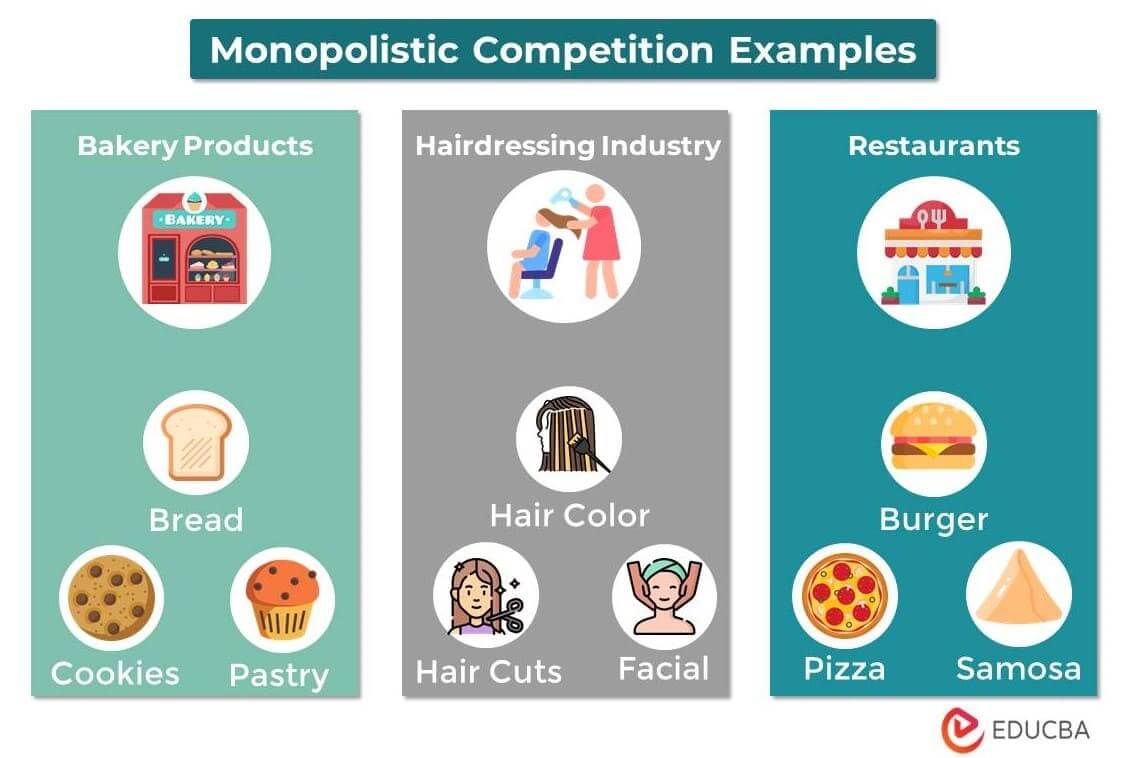
Example 1: Hairdressing Industry
The hairdressing industry provides a good example of monopolistic competition. There are many hairdressers in every city, and each has slightly different skills or service preferences. Also, they have various premises in different locations where they provide the services. This differentiation creates a distinct image in consumers’ eyes.
The hairdressing service is not a particularly big-brand industry. Thus, it is away from the oligopoly market structure, where specific brands dominate the industry. Moreover, hairdressers’ prices depend on the services they offer and the uniqueness of their services. This uniqueness gives them the power to charge more.
For instance, if a hairdresser is known for providing the best services, such as chemical-free hair coloring, they can charge a higher price because consumers may be willing to pay more for superior services. Thus, the service provides firms with a reputation for the quality of their offerings. Also, relatively speaking, there is a low barrier to entry and exit for setting up a new hairdresser shop, which is one of the important features of the monopolistic structure.
| Product Differentiation | Hairdressing Firm A | Hairdressing Firm B |
| Haircut Style | Classic hairstyles | Modern hairstyles |
| Hair Products | Organic and natural products | Premium products |
| Specialization | Hair Color | Hair extensions |
A fashion enthusiast may prefer modern hairstyles with premium products, while a normal person would choose classic hairstyles with no chemicals. Many places are available per preference, like Toni & Guy, Supercuts, Vidal Sassoon, Great Clips, Regis Salon, etc.
Example 2: Bakery Shop
Bakery shops are a classic example of monopolistic competition. In most towns, various bakeries sell similar products in slightly different ways. However, if there is only one bakery in a particular area of the town, then it can demand a slightly higher price for its products.
For instance, if a particular bakery is known for the best pastries and bread in town, it can raise its prices. Some bakeries may only focus on a certain type of product or flavor. They often leverage upselling strategies to stand out and maximize sales. It can leverage this to its advantage through its brand name and loyalty among consumers who are willing to pay slightly more for a better, unique product.
| Product Differentiation | Bakery A | Bakery B |
| Bread | Whole wheat | Sourdough |
| Cake | Dutch chocolate | Red velvet |
| Pastry | Croissant | Tart |
Every person has a different preference. One person may desire a red velvet cake, while their partner may want a Dutch chocolate cake. Many other options exist, such as Panera Bread, Cinnabon, Au Bon Pain, Baskin-Robbins, and Dunkin’ Donuts.
Example 3: Restaurants
In any city, many restaurants compete based on the quality of their food and prices. The basic concept of hospitality services changes when restaurants change their operations. It depends on factors such as location, service quality, and the amount charged.
For instance, one restaurant might charge $50 for a pizza-and-burger combo, while another might charge $80 for the same order. The price of the dish can also depend on factors such as the quality of the ingredients, the restaurant’s location, its popularity, and other services it offers. This product differentiation is a key element of the restaurant business. Additionally, there is a low barrier to entry and exit for setting up new restaurants, an important feature of the monopolistic structure. This situation is better explained as follows:
| Product Differentiation | Restaurant A | Restaurant B |
| Location | City Center | Suburban Area |
| Ingredients | Organic and locally sourced | Premium imported ingredients |
| Services | Friendly and attentive | Professional and personalized |
| Prices | Moderate | High |
Many factors affect a simple decision about where to eat pizza, given the many options and varieties available. Olive Garden, Applebee’s, Chili’s, Outback Steakhouse, and Red Lobster are popular restaurants with unique varieties.
Example 4: Clothing Industry
Monopolistic competition is detectable in the clothing industry, where multiple brands offer similar products with unique styles and target markets.
For instance, one brand targets a younger audience with its preppy clothing and marketing campaigns, while another offers trendy clothing at affordable prices. Brands differentiate themselves by their branding and store design. For example, Brand A stores have dim lighting and loud music, while Brand B stores are brightly lit and organized by color and style.
| Company | Product Differentiation | Advertising Differentiation |
| Brand A | Trendy clothing at affordable prices | “Fashion for all” slogan, eco-friendly initiatives |
| Brand B | Fast fashion, frequent new arrivals | Minimalist advertising campaigns, emphasis on the in-store experience |
The choice of purchase depends on the product specifications and the advertising techniques. Many local and renowned brands compete for market recognition, including Zara, H&M, Gap, Forever 21, and Nike.
Example 5: Running Shoes
In monopolistic competition, brands offer distinct features and characteristics in the running shoe market. Athletes and non-athletes prefer running shoes based on factors such as stability, weight, fashion, and price.
For instance, one brand of shoes may be lightweight thanks to its FlyteFoam technology, while another may be fashionable for street-style athletes. Companies can add new features to their products and charge consumers accordingly. If the consumer finds the new feature worth the price, they will buy it, but if not, they won’t.
| Product Differentiation | Brand A | Brand B |
| Fashion | Sturdy Design | Street Style Fashion |
| Texture | Soft | Rough |
| Popularity | Domestic | International |
One can choose running shoes from several brands, such as Nike, Adidas, New Balance, Reebok, Puma, etc. Each brand offers a unique feature that gives it the power to charge a price different from its competitors.
Terms like Monopolistic Competition, Monopoly, and Oligopoly can be confusing. Please check the table below to understand their notable differences.
| Market Structure | Monopolistic Competition | Oligopoly | Monopoly |
| Market Size | A large number of firms | A small number of dominant firms | Single dominant firm |
| Barriers to Entry | Relatively lower barriers to entry | High barriers to entry | Extremely high barriers to entry |
| Product Differentiation | Slightly differentiated products | May have differentiated or undifferentiated products | Unique product |
Final Thoughts
Monopolistic competition is a common market structure found in everyday industries, where many firms offer similar yet differentiated products. Businesses compete by creating unique value through branding, quality, features, location, and customer service rather than relying solely on price. While firms may earn higher profits in the short run due to product differentiation, the ease of market entry attracts new competitors over time. This increased competition gradually reduces profits to a normal level in the long run. Overall, monopolistic competition encourages innovation, variety, and consumer choice, making it one of the most dynamic and realistic market structures in modern economies.
Frequently Asked Questions(FAQs)
Q1. What is the difference between monopolistic competition and perfect competition?
Answer: In a perfect competition market, multiple firms produce identical products and have equal access to resources and technology. The sellers do not have any control over the market or the product price. Additionally, there are no barriers to entering or exiting the market.
On the other hand, in a monopolistic competition market, many firms produce similar yet differentiated products, each uniquely distinguished from the others. These firms have some control over the market and product prices. Furthermore, there may be barriers to entering a monopolistically competitive market, depending on the industry and market conditions.
Q2. How do firms in a monopolistic competition set their prices?
Answer: Various factors influence the determination of the price of a product in monopolistic competition, such as the level of product differentiation, demand, and market competition. Since each product is distinct from the others, firms have greater market power. While better product quality may lead to higher prices, tough market competition can lead to lower prices.
Q3. What is the role of advertising in monopolistic competition?
Answer: Advertising is the most crucial element in monopolistic competition, as it helps in product differentiation and brand building. Advertising can build brand awareness and inform the target audience about the product’s unique features. Firms use advertising to convince consumers that their products are of higher quality than competitors’, thereby charging a higher price.
Recommended Articles
This has been a guide to Monopolistic Competition Examples. Here, we discussed the top 3 Monopolistic Competition Examples and a detailed explanation. You can also go through our other suggested articles to learn more:


