
What is 7Ps Marketing Mix?
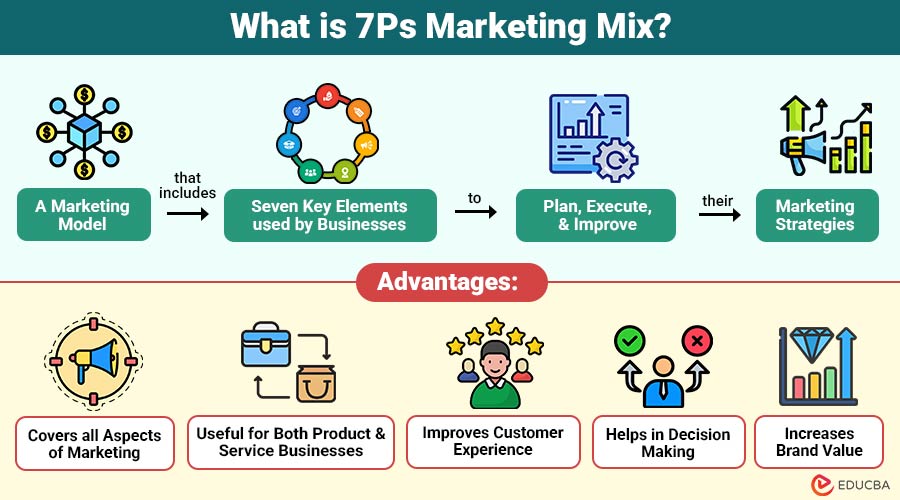
The 7Ps marketing mix is a marketing model that includes seven key elements used by businesses to plan, execute, and improve their marketing strategies. These seven elements help companies understand customer needs and deliver the right product or service at the right time, price, and place.
The 7Ps stand for:
- Product
- Price
- Place
- Promotion
- People
- Process
- Physical Evidence
This model is mainly used in service marketing, but it is also useful for product-based businesses.
Table of Contents:
- Meaning
- Evolution
- Elements
- 7Ps Marketing Mix Summary
- Importance
- Real-World Examples
- Advantages
- Disadvantages
- When to Use?
Key Takeaways:
- The 7Ps Marketing Mix helps businesses plan effective strategies by properly managing product, price, place, promotion, people, process, and physical evidence.
- It is widely used in both product and service industries to improve customer experience, marketing performance, and overall business growth.
- The model evolved from 4Ps to 7Ps to better support service businesses where customer interaction and experience are critical.
- Using the 7Ps correctly helps companies stay competitive, build strong brands, satisfy customers, and achieve long-term success in the market.
Evolution from 4Ps to 7Ps
The marketing mix evolved from 4Ps to 7Ps to better address the needs of service-oriented businesses and enhance customer experience:
The original marketing mix included only 4Ps:
- Product
- Price
- Place
- Promotion
These were introduced by marketing expert E. Jerome McCarthy. Later, marketing experts added three more Ps to support service industries, making it the 7Ps marketing mix.
Additional Ps:
- People
- Process
- Physical Evidence
This expanded model helps businesses manage the customer experience more effectively.
Elements of 7Ps Marketing Mix
Here are the elements of the 7Ps Marketing Mix given in detail:
1. Product
A product is a good or service that a company offers customers. It must meet customer needs and provide value.
Important factors in the product:
- Quality
- Design
- Features
- Branding
- Packaging
- Warranty
- Variety
A good product solves customer problems and satisfies their needs.
2. Price
Price is the amount customers pay to buy a product or service. Pricing affects sales, profit, and brand image.
Pricing factors include:
- Cost of production
- Competitor prices
- Customer demand
- Discounts and offers
- Payment methods
Correct pricing helps businesses stay competitive in the market.
3. Place
Place refers to where and how the product is sold. It includes distribution channels and locations where customers can buy the product.
Place includes:
- Retail stores
- Online websites
- Mobile apps
- Distributors
- Wholesalers
- Direct selling
Good distribution ensures customers can easily find and buy the product.
4. Promotion
It means communicating with customers to inform them about the product and encourage them to buy.
Promotion methods:
- Advertising
- Social media marketing
- Email marketing
- Sales promotion
- Public relations
- Influencer marketing
Promotion helps increase brand awareness and sales.
5. People
People refer to employees, staff, and anyone involved in customer service. In service businesses, people play a crucial role.
People include:
- Sales staff
- Customer support
- Managers
- Delivery staff
- Consultants
Well-trained employees improve customer satisfaction.
6. Process
The actions taken to provide the product or service to clients are referred to as the process. Workflow, systems, and processes are all included.
Process includes:
- Order process
- Payment system
- Delivery system
- Customer service process
- Complaint handling
A smooth process improves customer experience.
7. Physical Evidence
Physical evidence means the visible proof of the service or brand. It helps customers trust the business.
Physical evidence includes the following:
- Store design
- Website design
- Packaging
- Logo
- Office environment
- Uniform
- Receipts
- Reviews
Physical evidence makes the brand look professional and reliable.
7Ps Marketing Mix Summary
Here is a simple summary table that explains the meaning of each element of the 7Ps Marketing Mix, with examples.
| P | Meaning | Example |
| Product | What you sell | Mobile phone |
| Price | How much does the customer pay? | ₹20,000 with 10% discount or EMI option |
| Place | Where you sell | Online store |
| Promotion | How you advertise | Social media ads |
| People | Staff and employees | Customer support |
| Process | Steps to deliver service | Online order system |
| Physical Evidence | Visible proof | Packaging, store design |
Importance of 7Ps Marketing Mix
Here are the key reasons why the 7Ps Marketing Mix is important for business success and growth:
1. Helps in Better Marketing Planning
The 7Ps marketing mix helps businesses plan every part of their marketing strategy, rather than focusing only on product or price decisions.
2. Improves Customer Satisfaction
By effectively managing people, processes, and physical evidence, businesses can consistently improve service quality and deliver a better customer experience.
3. Useful for Service Industries
Service industries like banks, hospitals, hotels, and IT companies use the 7Ps model to manage customer service and operations efficiently.
4. Increases Competitive Advantage
Companies that use the 7Ps marketing mix correctly can create better strategies, attract more customers, and compete strongly in the market.
5. Supports Business Growth
A strong 7Ps marketing mix helps businesses increase sales, attract new customers, enhance brand value, and achieve long-term business growth.
Real-World Examples
Here are practical examples of how businesses apply the 7Ps Marketing Mix effectively in different industries:
1. Fast Food Company
- Product – Burgers and fries
- Price – Affordable combos
- Place – Restaurants + delivery apps
- Promotion – TV ads and offers
- People – Friendly staff
- Process – Quick service
- Physical Evidence – Clean restaurant
2. Online Shopping Website
- Product – Variety of items
- Price – Discounts
- Place – Website and app
- Promotion – Online ads
- People – Customer support
- Process – Easy checkout
- Physical Evidence – Good website design
3. Hotel Business
- Product – Rooms and services
- Price – Different room rates
- Place – Hotel + booking sites
- Promotion – Travel ads
- People – Reception staff
- Process – Booking system
- Physical Evidence – Building, rooms, uniform
Advantages of 7Ps Marketing Mix
Here are the key advantages of using the 7Ps Marketing Mix for businesses in different industries:
1. Covers all Aspects of Marketing
The 7Ps marketing mix covers all important areas of marketing, helping businesses create complete and effective marketing strategies successfully.
2. Useful for Both Product and Service Businesses
The 7Ps model is useful for both product-based and service-based businesses to plan marketing activities more efficiently and effectively.
3. Improves Customer Experience
By efficiently managing staff, processes, and concrete evidence, businesses may significantly improve the overall customer experience.
4. Helps in Decision Making
The 7Ps framework helps managers make better marketing decisions by considering multiple factors affecting product, price, promotion, and service quality.
5. Increases Brand Value
Using the 7Ps of the marketing mix correctly helps businesses build a strong brand image, earn trust, and increase overall brand value in the market.
Disadvantages of 7Ps Marketing Mix
Here are some disadvantages businesses may face when implementing the 7Ps Marketing Mix:
1. Can be Complex for Small Businesses
The 7Ps marketing mix can be difficult for small businesses because managing all seven elements requires time, effort, and resources.
2. Requires Proper Planning
The 7Ps model requires careful planning and coordination to ensure all marketing elements work together effectively for business success.
3. Needs Regular Updates
Businesses must regularly update their 7Ps marketing strategy to match changing customer needs, market trends, and the competitive business environment.
4. Time-Consuming to Manage
Managing all seven elements of the 7Ps marketing mix takes time, as each part requires attention, monitoring, and continuous improvement.
5. Not always Suitable for Digital-only Businesses
The 7Ps model may not always fit digital-only businesses, as some elements are designed primarily for traditional service environments.
When to Use 7Ps Marketing Mix?
Here are the situations where applying the 7Ps Marketing Mix can help businesses achieve better results:
1. Launching a New Product
The 7Ps marketing mix should be used when launching a new product to properly plan pricing, promotion, distribution, and the customer experience.
2. Starting a Business
When starting a business, the 7Ps model helps plan marketing, define target customers, set pricing, and design service strategy clearly.
3. Creating Marketing Strategy
Businesses use the 7Ps marketing mix when creating marketing strategies to ensure all important elements are included for better results.
4. Improving Customer Experience
The 7Ps model is useful for improving customer experience by adjusting people, processes, and physical evidence to deliver better service quality.
5. Entering a New Market
When entering a new market, the 7Ps of the marketing mix help businesses adjust product, price, promotion, and distribution to meet customer needs.
6. Managing Service Business
Service businesses use the 7Ps marketing mix to manage employees, service processes, pricing, and customer experiences more effectively every day.
Final Thoughts
The 7Ps marketing mix is one of the most important marketing models used by businesses to create effective marketing strategies. Businesses can enhance customer happiness, boost sales, create a strong brand value, and perform better in competitive marketplaces by concentrating on Product, Price, Place, Promotion, People, Process, and Physical Evidence.
Frequently Asked Questions (FAQs)
Q1. How does the 7Ps Marketing Mix help improve customer experience?
Answer: The 7Ps improve customer experience by ensuring smooth processes, well-trained people, and visible proof of quality alongside product, price, place, and promotion.
Q2. Is 7Ps used for services only?
Answer: No, it is used for both product and service businesses.
Q3. What is the difference between 4Ps and 7Ps?
Answer: 7Ps include People, Process, and Physical Evidence, which are not in 4Ps.
Recommended Articles
We hope that this EDUCBA information on “7Ps Marketing Mix” was beneficial to you. You can view EDUCBA’s recommended articles for more information.

