


Introduction
The Solar System comprises the Sun and all celestial objects gravitationally bound to it, including planets, moons, asteroids, and comets. Studying the Solar System is vital for understanding our cosmic neighborhood, Earth’s origins, and the potential for life elsewhere. It offers insights into planetary formation, climate, and the evolution of Earth, fostering curiosity and inspiring technological advances for space exploration.
Modern research, driven by missions such as the James Webb Space Telescope (JWST), the Perseverance rover, and planetary defense experiments, has significantly advanced our understanding of how planets form, how their climates evolve, and where life might exist. The Solar System continues to serve as a natural laboratory, driving scientific discovery and technological innovation.
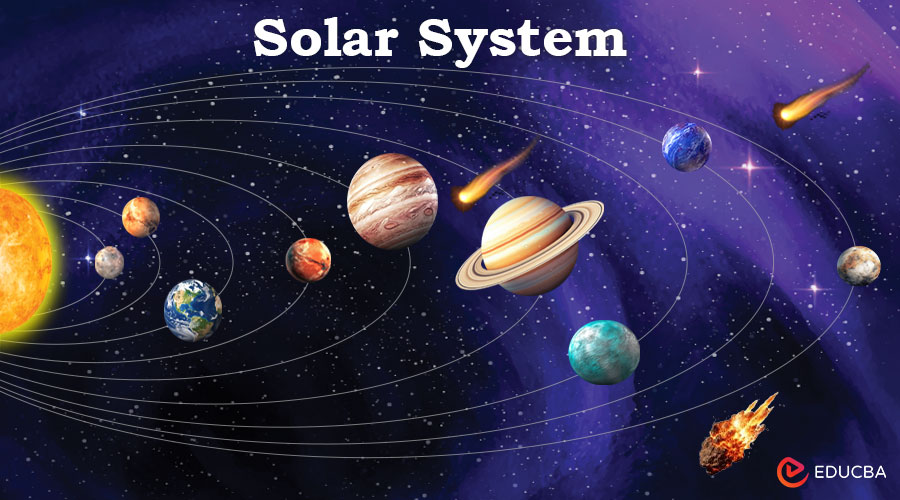
What is the Solar System?
The solar system is a vast cosmic system comprising the Sun and celestial bodies such as planets, moons, asteroids, and comets, held together by gravity. At its heart lies the Sun, a luminous star around which planets orbit in elliptical orbits. The solar system provides a home to Earth and other celestial bodies, each with unique characteristics and significance in the cosmic dance.
Historical Perspective
The historical perspective of our solar system is a journey through millennia of human curiosity, observation, and scientific discovery. Here’s a brief overview:
- Ancient Observations: Civilizations like the Mesopotamians, Egyptians, Greeks, and Chinese studied the Sun, Moon, planets, and stars, often for cultural or religious purposes.
- Geocentric Model: Ptolemy placed Earth at the center of the universe; this model dominated for centuries.
- Heliocentric Model: In the 16th century, Copernicus proposed that the Sun is at the center of the solar system, challenging the geocentric view.
- Galileo’s Observations: In the early 17th century, Galileo confirmed the heliocentric model, observing Jupiter’s moons, sunspots, and Venus’s phases through a telescope.
- Newton’s Laws: Isaac Newton formulated the laws of motion and universal gravitation, explaining how celestial bodies move.
- Space Exploration: 20th-century missions such as Voyager, Mariner, and Mars rovers explored planetary and lunar surfaces in detail.
- Modern Telescopes: Hubble and Kepler telescopes discovered exoplanets and expanded our understanding of the solar system.
- JWST Discoveries: In the 2020s, the James Webb Space Telescope revealed exoplanetary atmospheres and provided new insights into the outer planets.
- Mars Sample Return & Planetary Defense: NASA and ESA plan to return Martian samples to Earth, while the DART mission demonstrated asteroid deflection.
- AI in Astronomy: Advanced computing and AI now help analyze telescope data and efficiently predict solar activity.
- Exoplanet Count: As of 2026, over 5,600 exoplanets have been confirmed, showing the diversity of planetary systems.
Today, the solar system includes the Sun, eight planets, their moons, dwarf planets, asteroids, comets, and other celestial objects, with ongoing research revealing new insights into their formation, habitability, and solar dynamics.
Components of the Solar System
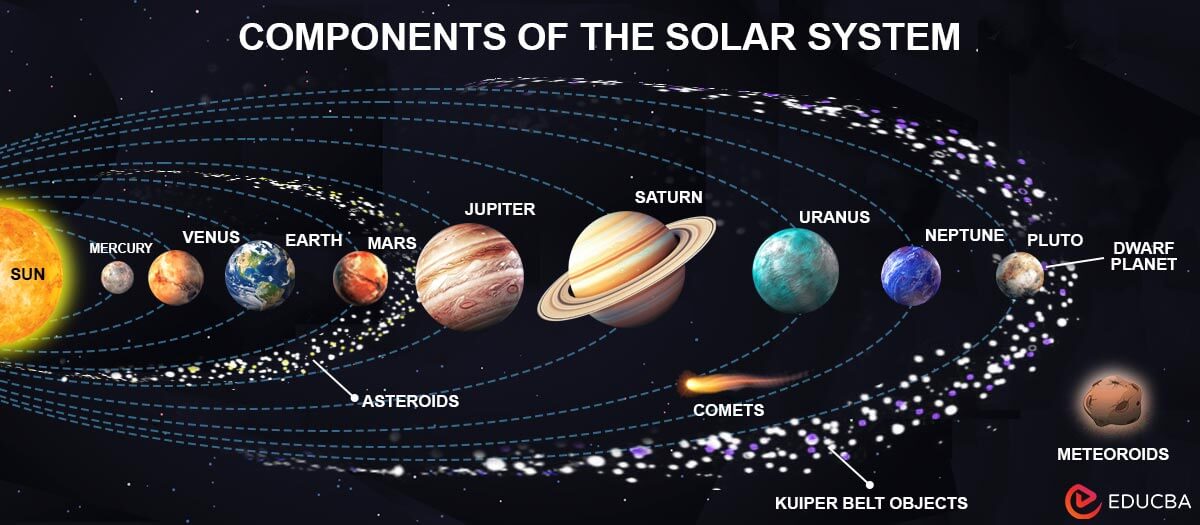
A. The Sun
1. Characteristics and Composition
- Size and Mass: The Sun is a massive star, accounting for about 99.86% of the Solar System’s total mass. Its diameter is approximately 1.4 million kilometers (870,000 miles), about 109 times Earth’s.
- Structure: Based on its structure, scientists can divide the Sun into several layers:
- Core: This is the central part where nuclear fusion occurs. Temperatures here can reach about 15 million degrees Celsius (27 million degrees Fahrenheit).
- Radiative Zone: Energy produced in the core moves outward through this zone as electromagnetic radiation.
- Convective Zone: Here, hot plasma rises and cools as it moves towards the surface, creating convection currents.
- Photosphere: The Sun emits sunlight from its visible surface. It is approximately 5,500 °C (9,932 °F).
- Chromosphere and Corona: The Sun’s outermost layers, such as the solar atmosphere, are visible during solar eclipses.
- Composition: The Sun primarily consists of hydrogen (about 74%) and helium (about 24%). The remaining percentage comprises oxygen, carbon, neon, and iron elements.
2. Solar Activity and Influence on Earth
- Solar Flares: These are intense bursts of radiation emitted from the Sun’s surface. They can release vast amounts of energy, equivalent to millions of hydrogen bombs.
- Coronal Mass Ejections (CMEs): Massive plasma and magnetic field expulsions from the Sun’s corona occur. When directed towards Earth, they can cause geomagnetic storms.
- Solar Wind: A continuous stream of charged particles that flows outward from the Sun at speeds of 300-800 km/s, interacting with planetary magnetic fields.
- Influence on Earth: Increased solar activity can increase the frequency and intensity of auroras, producing spectacular displays of the Northern and Southern Lights. However, this heightened activity can also lead to geomagnetic storms, disrupting Earth’s magnetosphere and posing risks to satellite communications, power grids, and GPS systems. Additionally, solar cycles influence Earth’s climate by modulating solar irradiance and magnetic activity, thereby affecting long-term temperature and weather patterns.
B. The Planets
1. Terrestrial Planets
- Mercury: The smallest planet in the solar system, orbits closest to the Sun at an average distance of 57.9 million km. With a diameter of 4,879 km and almost no atmosphere, its heavily cratered surface experiences extreme temperature swings, from about 430°C during the day to –180°C at night, making it one of the most thermally extreme worlds in the solar system.
- Venus: The second planet from the Sun, lies about 108.2 million km away and is nearly Earth-sized, with a diameter of 12,104 km. Its dense carbon dioxide atmosphere creates a runaway greenhouse effect, pushing surface temperatures to around 465°C, hotter than Mercury despite being farther from the Sun. Venus completes one orbit in 225 Earth days but rotates extremely slowly, with one day lasting 243 Earth days.
- Earth: Located 149.6 million km from the Sun, is the only known planet to support life. It has a diameter of 12,742 km, an orbital period of 365.25 days, and an average surface temperature of about 15°C. Water covers approximately 71% of Earth’s surface, and the planet’s strong magnetic field shields life from harmful solar radiation, thereby helping maintain stable conditions for diverse ecosystems.
- Mars: Often called the “Red Planet,” orbits the Sun at an average distance of 227.9 million km and has a diameter of approximately 6,779 km, making it roughly half the size of Earth. Its reddish color is due to iron oxides on its surface. Mars hosts Olympus Mons, the largest volcano in the solar system, standing about 22 km high, and shows evidence of ancient river valleys, indicating liquid water existed on its surface billions of years ago.
2. Gas Giants
- Jupiter: The largest planet in the solar system. It orbits the Sun at about 778.5 million km and has a diameter of roughly 143,000 km. Jupiter is mostly hydrogen and helium. It has the strongest magnetic field and over 95 moons. Its Great Red Spot is a colossal storm that has raged for over 300 years.
- Saturn: Famous for its extensive ring system, it lies approximately 1.43 billion km from the Sun and has a diameter of about 120,500 km. The planet is mostly made of hydrogen and helium and has such a low density that it could float in water. Saturn has more than 145 moons, including Titan, which has a thick atmosphere and lakes of liquid methane and ethane.
3. Ice Giants
- Uranus: Orbits the Sun at a distance of about 2.87 billion km and has a diameter of 50,724 km. It is unique for its extreme axial tilt of approximately 98 degrees, causing the planet to rotate on its side and experience seasons that last more than 20 Earth years. Methane in its atmosphere absorbs red light, giving Uranus its blue-green appearance.
- Neptune: The most distant planet orbits roughly 4.5 billion km from the Sun and has a diameter of 49,244 km. Neptune appears deep blue because of methane in its atmosphere, and it has the fastest winds in the solar system, reaching over 2,100 km/h. Neptune completes one orbit around the Sun in about 165 Earth years.
C. Minor Planets and Celestial Bodies
1. Pluto and the Kuiper Belt Objects
- Pluto: Astronomers classified Pluto as the ninth planet in our Solar System, but now they categorize it as a dwarf planet. Scientists place it in the Kuiper Belt, a region of icy bodies beyond Neptune’s orbit.
- Kuiper Belt Objects (KBOs): These small celestial bodies, mainly composed of ice and rock, orbit the Sun in the Kuiper Belt. They are remnants of the early solar system.
2. Asteroids and Meteoroids
- Asteroids: Found primarily in the asteroid belt between Mars and Jupiter. Asteroids are small objects that orbit the Sun. They vary in size from small rocks to large bodies several hundred kilometers across.
- Meteoroids: Dust grains to boulder-sized rocky or metallic objects in space. When a meteoroid enters Earth’s atmosphere and burns up, it produces a streak of light called a meteor or shooting star.
3. Comets
The Comets are icy bodies that orbit the Sun in elongated orbits. They comprise dust, rock, and frozen gases such as water, methane, and ammonia. When a comet approaches the Sun, solar radiation heats the frozen gases, causing them to sublimate and form a glowing coma and tail. Comets are often considered “dirty snowballs” or “icy dirtballs” due to their composition.
Formation and Evolution
1. Nebular Theory
The prevailing theory that explains the formation of the solar system is the nebular hypothesis. According to this:
- Initial Nebula: About 4.6 billion years ago, a massive cloud of molecular gas and dust known as a protosolar nebula formed the basis of our solar system.
- Gravitational Collapse: Some disturbance, possibly a nearby supernova or a passing star, caused the nebula to collapse under its gravity.
- Formation of the Protostar: As the nebula collapsed, it spun and flattened into a disk shape due to conservation of angular momentum. At the center, material accumulates to form the protosun or protostar.
- Accretion of Planetesimals: Planetesimals are bigger bodies formed by smaller dust particles colliding and adhering to one another within the disc. Over time, these planetesimals continued to grow through mutual gravitational attraction.
2. Planetary Formation Procedures
- Differentiation: As planetesimals grew, they differentiated into layers based on density. Heavy metals sank to the center to form cores, while lighter materials rose to the surface.
- Planet Formation: These planetesimals accreted to form protoplanets over millions of years. Some protoplanets grew massive enough to capture gas from the surrounding protoplanetary disk via gravitational accretion, becoming gas giants such as Jupiter and Saturn.
- Clearing of the Solar Nebula: Radiation pressure from the newly-formed Sun and solar wind eventually cleared away the remaining gas and dust from the solar nebula, leaving behind the planets, moons, asteroids, and comets we see today.
3. Evolutionary Phases and Transitions
- Early Bombardment: During the early stages of the solar system, known as the Heavy Bombardment period, the inner planets experienced intense impacts from leftover planetesimals and other debris. This period helped shape their surfaces and atmospheres.
- Planet Migration: Some evidence suggests that the giant planets may have migrated from their original positions due to interactions with the remaining gas in the disk or gravitational interactions with other planets, affecting the structure of the inner solar system.
- Stellar Evolution: The Sun went through its evolutionary stages, from a T Tauri phase as a young star to its current stable state as a main-sequence star. As the Sun aged, its energy output increased, thereby influencing the climates and potential habitability of the planets in the solar system.
- Current State: Today’s solar system comprises the Sun, eight planets (Mercury, Venus, Earth, Mars, Jupiter, Saturn, Uranus, and Neptune), numerous moons, asteroids, comets, and other small bodies. Each planet has undergone unique geological and atmospheric processes, resulting in diverse environments across the solar system.
The Search for Exoplanets
1. Techniques of Detection
Detecting exoplanets, or planets outside our solar system, challenges researchers due to the vast distances involved and the faintness of the observed objects. Researchers have developed various methods to identify these distant worlds:
- Transit Method: This technique observes a star’s brightness over time to detect periodic dips caused by a planet passing in front of it or transiting. The amount of light blocked can provide information about the planet’s size and orbit.
- Radial Velocity Method: By measuring the tiny tremble in a star’s surface brought on by a planet in orbit, astronomers can infer the presence of one or more planets around the star.
- Direct Imaging: Advanced telescopes can sometimes directly image exoplanets. This method is challenging because planets are much fainter than their host stars, and the stars’ glare often obscures them.
- Microlensing: This method utilizes the gravitational lensing effect produced by a star or planet to amplify the light from a distant background star. Any planets orbiting the lensing object can produce additional distortions in the light curve, revealing their presence.
- Astrometry: By measuring the tiny changes in a star’s position caused by an orbiting planet, astronomers can detect the planet’s gravitational influence.
2. Significance of Exoplanet Studies
Identifying exoplanets has fundamentally changed our perception of the cosmos and our role within it. Here are some key significances:
- Planetary Diversity: Exoplanet discoveries have revealed a staggering diversity of planetary systems, challenging our previous notions and theories about planet formation and evolution.
- Habitability: By studying the atmospheres and compositions of exoplanets, scientists can identify potential habitable worlds and assess their likelihood of supporting life.
- Astrophysical Understanding: Exoplanets provide valuable insights into stellar and planetary formation processes, enriching our knowledge of astrophysics and planetary science.
- Technological Advancements: The quest for exoplanets has driven advancements in telescope technology, instrumentation, and data analysis techniques, benefiting various fields of astronomy.
3. Possibility for Finding Habitable Worlds
The search for habitable exoplanets is one of the most exciting aspects of exoplanet research. Habitable worlds are planets that could support liquid water and, by extension, life as we know it. Several factors contribute to a planet’s habitability:
- Stellar Type: Stars similar to our Sun, known as G-type stars, are often targeted in searches for habitable planets because of their stability and longevity.
- Orbital Distance: Scientists sometimes refer to the range of distances from a star where conditions might be favorable for liquid water to exist on a planet’s surface as the Goldilocks or habitable zone.
- Atmospheric Composition: A planet’s atmosphere plays a crucial role in regulating its temperature and protecting it from harmful radiation. An atmosphere with a suitable composition is essential for maintaining habitable conditions.
- Geological Activity: Planets with active geology, such as volcanic activity and plate tectonics, could provide conditions conducive to a stable climate and recycle nutrients essential for life.
Role of the Solar System in the Universe
- Galaxy Context: The Milky Way is a barred spiral galaxy that contains the Solar System and billions of stars, including the Sun. It spans about 100,000 light-years in diameter and contains astronomical objects such as nebulae, star clusters, and black holes. Within this vast cosmic structure, the solar system occupies a relatively small but significant place, orbiting the galactic center at an average distance of about 27,000 light-years.
- Influence on Life and Habitability: The solar system, anchored by our Sun, a G-type main-sequence star, fosters Earth’s habitability. Positioned in the Sun’s “Goldilocks zone,” Earth experiences stable conditions vital for life, with the Sun driving photosynthesis and maintaining a climate conducive to liquid water. Furthermore, celestial bodies such as the Moon stabilize Earth’s axial tilt, thereby ensuring long-term climate regulation. The solar system’s diverse components collectively shape Earth’s geological and atmospheric evolution, enhancing its suitability for life.
- Interactions with Celestial Activity: The solar system undergoes internal phenomena, such as solar flares and geomagnetic storms, driven by the Sun’s influence on the planets, which affect Earth’s space environment, weather, and technology. Externally, gravitational forces from neighboring stars, galaxies, and dark matter affect the solar system’s motion and stability, sometimes causing events like asteroid impacts. Positioned within the Milky Way, the solar system is exposed to galactic cosmic rays and the interstellar medium, which influence planetary evolution and the formation of celestial bodies.
Current and Upcoming Research
1. Robotic Spacecraft and Missions
Current Status
- Mars Exploration: NASA’s Perseverance rover is actively exploring the Jezero Crater on Mars, searching for signs of ancient microbial life and collecting samples for potential return to Earth.
- Outer Solar System: Space probes like NASA’s Juno (Jupiter) and Cassini (Saturn) have provided valuable insights into the gas giants, their moons, and rings.
- Interstellar Exploration: As they approach interstellar space, the Voyager 1 and Voyager 2 spacecraft continue to transmit data from the periphery of the solar system.
Future Prospects
- Missions to Ocean Worlds: Explorers investigate subsurface oceans and potential habitability on moons like Europa around Jupiter and Enceladus near Saturn.
- Sample Return Missions: Efforts to return samples from asteroids, comets, and possibly Mars for detailed analysis on Earth.
- Advanced Robotic Explorers: Researchers are developing more sophisticated robotic missions capable of autonomous decision-making and performing complex tasks.
2. Space Colonization Goals
Current Status
- International Space Station (ISS): Humans are continuously present on the ISS for scientific research, technology development, and international cooperation.
- Commercial Spaceflight: Companies like SpaceX, Blue Origin, and Boeing are developing spacecraft for human spaceflight, with ambitions for tourism, research, and lunar missions.
Future Prospects
- Artemis Program: NASA’s initiative to return humans to the Moon by the mid-2020s, establish sustainable lunar exploration, and prepare for Mars missions.
- Mars Colonization: The long-term goal is to send humans to Mars, with plans for habitat construction, resource utilization, and potential colonization efforts.
- Space Tourism: Expansion of commercial spaceflight offerings, allowing private citizens to experience space travel.
3. Scientific Endeavors
Current Status
- Cosmology and Astrophysics: Advancements in understanding dark matter, dark energy, and the early universe through observatories like the Hubble Space Telescope and James Webb Space Telescope.
- Exoplanet Exploration: Detection and characterization of exoplanets using ground-based observatories and space telescopes like TESS and Kepler.
- Astrobiology: Investigations into the potential for life beyond Earth, studying extreme environments on Earth, and searching for biosignatures on other planets and moons.
Future Prospects
- Gravitational Wave Astronomy: Expansion of gravitational wave observatories like LIGO and Virgo to detect new sources and study fundamental physics.
- High-Energy Astrophysics: Exploration of black holes, neutron stars, and other high-energy phenomena using advanced telescopes and detectors.
- Interstellar Probes: Conceptual studies for interstellar missions using laser-propelled spacecraft to explore nearby star systems and exoplanets.
Final Thoughts
The solar system remains a dynamic field of study, revealing insights into planetary formation, evolution, and potential habitability. Ongoing research promises to uncover further mysteries, from exoplanet exploration to understanding solar dynamics. Future investigations will deepen our comprehension of cosmic phenomena, advancing scientific knowledge and technological innovation.
Frequently Asked Questions (FAQs)
Q1. What would happen if the Sun suddenly vanished?
Answer: If the Sun vanished, Earth would continue moving in a straight line for about 8 minutes before plunging into deep space, while temperatures would rapidly drop, and life would become impossible.
Q2. Why is Earth the only known planet with life?
Answer: Earth has the perfect combination of liquid water, a protective atmosphere, a stable orbit, and a magnetic field, creating conditions that allow life to thrive, something no other known planet matches exactly.
Q3. Could another planet replace Earth in the future?
Answer: No planet in our Solar System currently has Earth-like conditions. While Mars and some moons could support humans with technology, none can naturally replace Earth’s environment.
Q4. Is there a hidden ninth planet in the Solar System?
Answer: Scientists suspect a Planet Nine beyond Neptune based on the orbits of unusual objects, but no direct evidence has confirmed its existence yet.
Q5. Will the Solar System last forever?
Answer: The Solar System has been stable for billions of years. However, the Sun will eventually expand into a red giant and later become a white dwarf, dramatically altering the fate of its planets.
Recommended Articles
Explore more in-depth guides explaining what the Solar System is, its structure, and how it works, along with the latest discoveries in space science. These articles simplify complex cosmic concepts and share updated insights to help you better understand our universe.

