


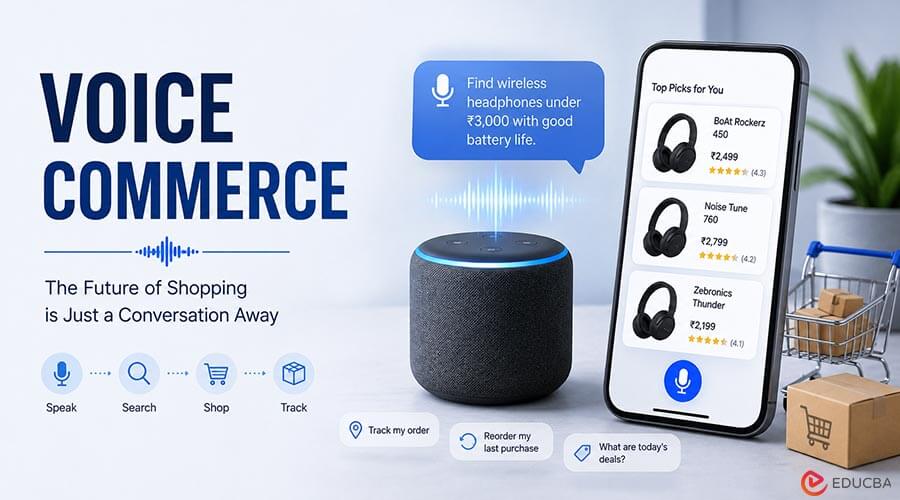
Voice technology has changed how people interact with digital devices. Consumers can now search for information, play music, control smart devices, make appointments, and perform many other tasks by speaking. This shift has also entered online shopping through voice commerce.
Traditional e-commerce requires customers to type search terms, browse product pages, apply filters, compare products, and complete checkout forms. Voice commerce simplifies some of these steps by letting customers communicate their requirements through spoken commands.
For example, a customer can say, “Find wireless headphones under ₹3,000 with good battery life.” A voice-enabled shopping system can understand the request, identify relevant products, and present suitable options. The customer can then ask additional questions before deciding what to purchase.
Voice commerce combines voice recognition, natural language processing, artificial intelligence, product search, recommendation systems, and payment technologies. These technologies allow businesses to create more conversational shopping experiences.
As more consumers adopt AI assistants and voice-enabled technology, businesses can use voice commerce to improve product discovery, personalized recommendations, repeat purchases, customer support, and other shopping activities.
Table of Contents
- Meaning
- How Does it Work?
- Importants
- Voice Commerce vs. Traditional E-Commerce
- How Do Businesses Use It?
- Benefits
- Challenges
- Best Practices
- Real-World Examples
- Voice Commerce and Personalization
- Voice Commerce and Conversational Search
- Role of Technology
- Future Trends
Key Takeaways
- Voice commerce allows customers to shop using spoken commands.
- It can support product discovery, recommendations, ordering, reordering, and order tracking.
- Speech recognition and natural language processing help systems understand customer requests.
- Artificial intelligence can make voice shopping more conversational and personalized.
- Voice commerce works particularly well for simple and repeat purchases.
- Visual interfaces remain important for product categories that require detailed comparisons.
- Businesses need accurate product information to provide useful voice responses.
- Privacy, security, speech recognition, and customer trust remain important challenges.
- Conversational SEO can help businesses prepare for voice-based product discovery.
- Future voice commerce experiences will increasingly combine AI, voice, visual search, and personalized recommendations.
What Is Voice Commerce?
Voice commerce lets shoppers use spoken commands to discover products, learn about features, place orders, reorder items, track deliveries, and manage other purchasing tasks.
Instead of typing a query into an e-commerce search box, customers can speak naturally to a voice-enabled device or application.
For example:
“Find a backpack for college under ₹2,500.”
The system can interpret the customer’s requirements and provide relevant products.
Customers can also use follow-up questions:
“Which one has the best reviews?”
The system can use the previous context to answer the question without requiring the customer to repeat the entire request.
Voice commerce therefore changes the shopping experience from a primarily screen-based process into a conversational interaction.
Examples of Voice Commerce Activities
Customers can use voice commands to:
- Search for products
- Ask about product features
- Compare selected products
- Check prices
- Find product availability
- Add products to a shopping cart
- Reorder previously purchased products
- Track deliveries
- Check order status
- Find nearby stores
- Ask for product recommendations
- Manage shopping lists
- Receive personalized suggestions
Voice commerce does not require every part of an online purchase to happen through voice. A customer can begin the shopping journey with voice and move to a website or mobile application when they need images, specifications, reviews, or detailed comparisons.
How Does Voice Commerce Work?
Voice commerce combines several technologies to understand spoken requests and connect them with shopping systems.
1. Voice Recognition
The process begins when the customer speaks into a microphone. Speech recognition technology converts spoken words into a format the system can process.
For example:
“Show me running shoes under ₹5,000.”
The system identifies the words and separates important information such as product category, budget, and shopping intent.
Modern speech recognition systems can understand natural speech, although background noise, accents, pronunciation, and unclear requests can still affect accuracy.
2. Natural Language Processing
Voice recognition identifies what the customer says, but the system must also understand what the customer means.
Consider this request:
“I need something comfortable for a long flight.”
The customer has not mentioned a specific product. The system needs to interpret the underlying shopping intent and determine which products may satisfy the requirement.
Natural language processing helps the system understand:
- Customer intent
- Keywords
- Context
- Product attributes
- Questions
- Preferences
- Conversational relationships
3. Product Search
The system connects the customer’s request with a product catalog or search database.
It can consider factors such as:
- Product category
- Price
- Brand
- Features
- Availability
- Customer ratings
- Location
- Previous purchases
- Customer preferences
The system then identifies products that best match the customer’s request.
4. Product Recommendations
Voice commerce can use recommendation engines to suggest suitable products.
For example, a customer might say:
“Recommend a laptop for online classes under ₹50,000.”
The system can consider the budget and intended use before presenting relevant options.
5. Conversational Context
A strong voice commerce system maintains context across multiple questions.
For example:
Customer: “Find black running shoes under ₹4,000.”
Assistant: “I found three suitable options.”
Customer: “Which one has the highest rating?”
The system should understand that “which one” refers to the previously presented shoes.
Context makes voice shopping more natural and reduces repetitive interactions.
6. Checkout and Payment
After selecting a product, customers can proceed to checkout through a voice-enabled process or switch to a visual interface.
The system may confirm:
- Product
- Quantity
- Price
- Delivery address
- Delivery date
- Payment method
Businesses should add suitable authentication and confirmation steps to protect customers from accidental or unauthorized purchases.
Why Is Voice Commerce Important?
Voice commerce matters because it changes how customers search for and interact with products.
Several factors contribute to its importance.
1. It Makes Shopping More Convenient
Customers can use spoken commands instead of typing and navigating multiple pages.
For routine tasks, this can reduce the steps needed to complete an action.
2. It Supports Natural Conversations
Customers do not always know the exact product name or technical specifications they need.
They can explain their requirements in everyday language.
For example:
“I want a phone with a good camera and battery that costs less than ₹30,000.”
Voice technology can interpret these requirements more naturally than a rigid command-based interface.
3. It Supports Hands-Free Shopping
Voice interaction lets customers complete certain shopping tasks while they are busy with other activities.
For example, a customer can add grocery items to a shopping list while cooking.
4. It Can Improve Personalization
Businesses can use customer preferences, previous purchases, and other permitted information to provide more relevant recommendations.
5. It Creates Another Customer Touchpoint
Voice adds another channel for customers to interact with a business.
Businesses can connect voice experiences with websites, apps, customer service systems, loyalty programs, and other digital channels.
Voice Commerce vs. Traditional E-Commerce
| Feature | Traditional E-Commerce | Voice Commerce |
| Main interaction | Typing and clicking | Speaking |
| Product discovery | Search and browsing | Conversational requests |
| Product display | Highly visual | Primarily audio or conversational |
| Product comparison | Easy to display side by side | More difficult through speech |
| Repeat purchases | Requires navigation | Can use direct reorder commands |
| Hands-free use | Limited | Strong |
| Personalization | Uses customer data and behavior | Can combine customer context with conversation |
| Best suited for | Detailed shopping | Quick, conversational tasks |
Traditional e-commerce remains highly effective for visual and complex purchases.
Voice commerce works especially well when customers want quick answers, simple recommendations, repeat purchases, or order updates.
The two approaches can work together instead of competing.
How Do Businesses Use Voice Commerce?
Businesses can apply voice commerce at different stages of the customer journey.
1. Product Discovery
Customers can describe what they need instead of searching for a specific product.
For example:
“Find a lightweight office chair under ₹10,000.”
The system can identify products that match the requirements.
2. Product Questions
Customers can ask questions about:
- Size
- Material
- Compatibility
- Features
- Price
- Availability
- Warranty
- Delivery
This approach can reduce friction during product research.
3. Product Recommendations
Voice systems can recommend products based on customer requirements.
For example:
“Suggest a birthday gift for someone who enjoys cooking.”
The system can ask follow-up questions about budget and preferences before providing recommendations.
4. Repeat Purchases
Voice commerce can make routine purchases easier.
A customer can say:
“Reorder the same coffee I bought last month.”
The system can retrieve the previous order and begin the reorder process.
5. Order Tracking
Customers can ask:
“Where is my order?”
The system can retrieve the latest order information and provide the available status.
6. Store Information
Customers can ask about:
- Store locations
- Opening hours
- Product availability
- Pickup options
- Delivery services
This can connect online and offline shopping experiences.
Benefits of Voice Commerce
Voice commerce offers several benefits for both customers and businesses:
- Improved Convenience: It simplifies routine shopping tasks by letting customers search, select, and manage purchases with voice commands without navigating multiple menus.
- Faster Product Discovery: Customers can describe their needs in a single conversational request, helping them find relevant products faster.
- Personalized Recommendations: Businesses can use customer preferences, purchase history, and conversational context to suggest products that match individual needs.
- Better Accessibility: Voice interfaces can make online shopping easier for people who have difficulty typing, reading, or navigating traditional digital platforms.
- Easier Repeat Purchases: Customers can quickly reorder frequently purchased products, making repeat purchases more convenient.
- Better Customer Engagement: Voice assistants can interact with customers, answer product questions, offer recommendations, and provide post-purchase assistance.
- Potential for Better Customer Retention: A convenient and personalized voice shopping experience can encourage customers to return, especially when businesses combine voice-enabled reordering with loyalty programs and personalized offers.
Challenges of Voice Commerce
Voice commerce also presents several challenges that businesses must address.
1. Limited Visual Information
Voice interfaces cannot show product images the way websites and mobile apps can.
This creates difficulties for categories such as:
- Fashion
- Furniture
- Home décor
- Cosmetics
- Accessories
Customers may want to see the product before purchasing it.
Businesses should therefore make it easy to transition from voice interaction to a visual shopping experience.
2. Product Comparison Is Difficult
A website can display several products side by side.
A voice assistant must describe each option one after another.
Listening to a long list of specifications can become frustrating.
Businesses should offer a small number of highly relevant options and let customers request additional information.
3. Speech Recognition Errors
Voice systems can misunderstand customers because of:
- Background noise
- Accents
- Pronunciation
- Unclear speech
- Similar-sounding words
- Technical product names
Businesses should allow customers to correct mistakes easily.
4. Privacy Concerns
Voice shopping may involve personal information such as account details, addresses, purchasing preferences, and payment information.
Customers may worry about how companies collect, store, process, and use voice-related information.
Businesses should explain their privacy practices clearly and implement appropriate security controls.
5. Customer Trust
Customers may hesitate to make expensive purchases through voice alone.
They may want to inspect reviews, images, product specifications, return policies, and warranty details.
Businesses should therefore avoid forcing customers to complete complex purchases exclusively through voice.
6. Dependence on Accurate Product Data
Voice systems need reliable information to provide useful answers.
Incorrect prices, outdated inventory, or incomplete specifications can lead to poor customer experiences.
Best Practices for Voice Commerce
Businesses can follow several practices to create effective voice shopping experiences.
1. Start With Simple Use Cases
Businesses do not need to convert their entire e-commerce platform into a voice interface immediately.
They can begin with:
- Product search
- Order tracking
- Reordering
- FAQs
- Store information
- Product recommendations
These use cases can provide a practical starting point.
2. Understand Customer Questions
Analyze customer support conversations, website searches, FAQs, and product questions to identify what customers naturally ask.
Use these insights to design voice interactions around actual customer needs.
3. Use Natural Language
Write answers in a conversational style.
Customers should receive direct and understandable responses instead of robotic or overly technical explanations.
4. Keep Voice Responses Concise
Customers do not want to listen to long product descriptions.
Lead with the most important information, then let customers ask for more details.
5. Maintain Accurate Product Data
Regularly update:
- Product prices
- Inventory
- Product specifications
- Availability
- Delivery information
- Discounts
- Product ratings
Accurate data improves the reliability of voice responses.
6. Provide Contextual Conversations
The system should remember relevant information within the current interaction.
This prevents customers from repeating the same requirements.
7. Combine Voice With Visual Experiences
Voice should complement visual commerce.
For example:
- Customer asks for products through voice.
- System recommends three options.
- Customer opens the results on a smartphone.
- Customer compares images and specifications.
- Customer completes checkout.
This approach combines conversational convenience with visual decision-making.
8. Confirm Important Actions
The system should clearly confirm purchases, cancellations, address changes, and other important actions.
This reduces the possibility of accidental transactions.
Real-World Examples of Voice Commerce
Example 1: Grocery Shopping
A grocery retailer can let customers add items to a shopping list by voice.
For example:
“Add one kilogram of rice, two packets of pasta, and olive oil.”
The system can add the items to the customer’s list.
The customer can later review the list visually and complete the purchase.
Example 2: Repeat Product Purchases
A customer who frequently buys household products can use voice to reorder them.
For example:
“Reorder my usual laundry detergent.”
The system can identify the previous product and present it for confirmation.
This creates a faster purchasing process.
Example 3: Product Recommendations
A customer can describe a requirement rather than a specific product.
For example:
“I need headphones for working in a noisy office under ₹5,000.”
The system can identify relevant products based on price and available product features.
Example 4: Order Tracking
Customers can use voice to check their order status.
For example:
“When will my order arrive?”
The system can retrieve the latest delivery information and provide an estimated update when available.
Example 5: Local Product Availability
A customer can ask:
“Is this product available at the store near me?”
If the retailer connects its voice system with store inventory, it can provide availability information and potentially suggest pickup options.
Voice Commerce and Personalization
Personalization represents one of the strongest opportunities in voice commerce.
Voice systems can combine customer requests with relevant information such as previous purchases, preferences, shopping history, and loyalty activity, subject to appropriate permissions and privacy controls.
For example, a shopper who regularly buys running gear might say:
“Recommend something useful for my next run.”
The system can use the customer’s previous interactions to provide more relevant recommendations.
Businesses can personalize:
- Product recommendations
- Offers
- Shopping lists
- Reorder suggestions
- Customer support
- Loyalty experiences
- Product discovery
However, personalization should remain useful and transparent.
Customers should not feel that the system uses personal information in unexpected ways.
Voice Commerce and Conversational Search
Voice commerce also affects how customers search for products.
Traditional search queries often contain short phrases.
For example:
“Best running shoes.”
A voice query may look more conversational:
“What are the best running shoes for beginners under ₹5,000?”
This difference matters for businesses that want to improve visibility across conversational search experiences.
Businesses can prepare by creating content that answers specific customer questions.
Useful content can include:
- FAQs
- Product guides
- Comparison pages
- How-to articles
- Product specifications
- Buying guides
- Conversational question-and-answer content
Businesses should focus on providing genuinely useful answers rather than simply inserting keywords into content.
Role of Technology in Voice Commerce
Technology underpins voice commerce. Key technologies include:
- Speech Recognition: Converts spoken words into machine-readable information.
- Natural Language Processing (NLP): Helps systems understand customer intent, context, and meaning.
- Artificial Intelligence (AI): Analyzes customer requests, generates responses, personalizes recommendations, and enables conversational interactions.
- Recommendation Engines: Suggest products based on customer preferences, requirements, and shopping behavior.
- E-Commerce Platforms: Manage product catalogs, pricing, inventory, customer accounts, and transactions.
- Customer Relationship Management (CRM) Systems: Provide relevant customer information and interaction history.
- Payment Systems: Enable secure transactions through authentication and purchase confirmation.
- Analytics Platforms: Help businesses monitor voice interactions, understand customer behavior, and identify areas for improvement.
Businesses should integrate these technologies based on specific customer needs, not add voice features without a clear purpose.
Future Trends in Voice Commerce
Voice commerce will continue to evolve as AI and conversational interfaces become more capable.
Increased Use of Generative AI
Generative AI can help voice assistants understand complex requests and respond more naturally.
Customers may be able to describe a broader shopping goal instead of searching for individual products.
For example:
“Help me set up a home office under ₹40,000.”
An AI-powered shopping assistant could ask follow-up questions and suggest suitable products.
More Conversational Shopping
Future systems may support longer conversations in which customers can naturally refine their requirements.
Customers could change their budget, preferred brand, color, or features without restarting the search.
Integration With Visual Search
Voice and visual search can work together.
A customer could describe a product through voice and then use a camera to identify a similar item.
This combination can create a more flexible shopping experience.
Greater Personalization
AI systems may increasingly combine customer preferences, shopping history, context, and real-time requests to generate more relevant recommendations.
Voice Shopping Across Connected Devices
Voice commerce may extend beyond smartphones and smart speakers.
Customers could interact with shopping services through connected cars, televisions, wearable devices, and smart home systems.
Stronger Privacy and Security
As voice commerce handles more sensitive activities, businesses will need stronger authentication, consent management, data protection, and transaction controls.
More Omnichannel Experiences
Voice will increasingly become one part of an integrated customer journey.
A customer could start with voice, continue on a mobile application, visit a physical store, and complete the purchase through another channel.
Frequently Asked Questions (FAQs)
Q1. What is the difference between voice commerce and conversational commerce?
Answer: Voice commerce uses spoken commands to complete shopping activities, while conversational commerce includes broader text- or voice-based interactions through chatbots, messaging platforms, and AI assistants. Voice commerce represents one part of conversational commerce.
Q2. Can voice commerce help customers discover new products?
Answer: Yes. Voice commerce can recommend products based on a customer’s stated requirements, preferences, purchase history, budget, and other relevant information. For example, a customer can describe a specific need and receive suitable product suggestions without searching for individual products.
Q3. How does voice commerce affect the customer journey?
Answer: Voice commerce can reduce friction across several stages of the customer journey. Customers can use voice to discover products, ask questions, receive recommendations, reorder items, and track purchases. This creates a more direct, conversational shopping experience.
Q4. What role does customer intent play in voice commerce?
Answer: Customer intent helps a voice commerce system understand what the shopper actually wants to accomplish. For example, “I need a gift for a coffee lover under ₹2,000” expresses a shopping goal rather than a specific product query. Understanding this intent allows the system to provide more relevant recommendations.
Q5. How can small businesses start using voice commerce?
Answer: Small businesses can begin with simple applications such as voice-enabled FAQs, product discovery, store information, order tracking, and repeat purchases. They can then expand their voice capabilities as they collect customer feedback and understand which voice interactions provide the most value.
Final Thoughts
Voice commerce is reshaping how customers shop online. Instead of relying on traditional search and navigation tools, users can describe what they need in natural language and receive guided, conversational support.
This approach can make everyday shopping faster and more convenient by supporting discovery, recommendations, repeat purchases, and customer service. However, it is not a complete replacement for traditional e-commerce experiences, which still play an important role in browsing and visual decision-making.
As the technology evolves, voice commerce will move toward more intelligent, goal-driven conversations with personalized recommendations and deeper product understanding. Businesses that invest in strong product data, seamless omnichannel experiences, and customer-focused design will be better prepared for this shift.
Recommended Articles
We hope this guide on Voice Commerce helps you understand how conversational technology is changing online shopping. Explore these recommended articles for more insights into e-commerce, digital marketing, and emerging technologies.


