


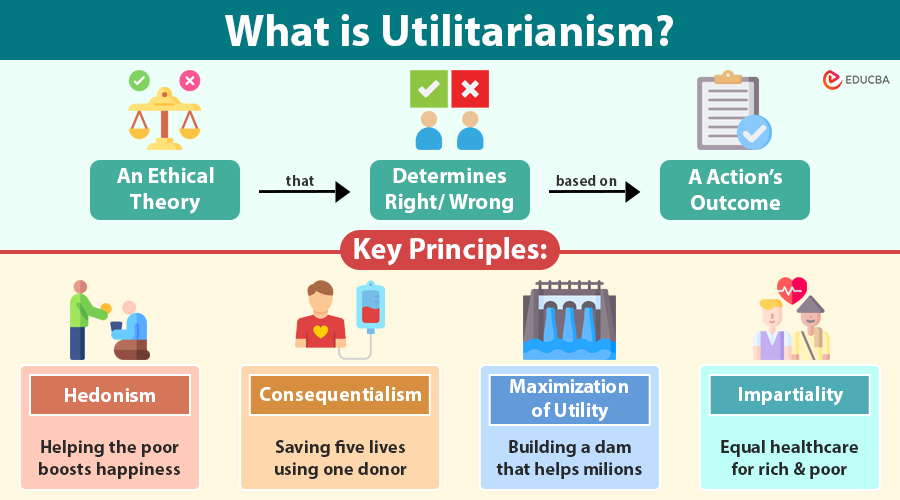
Definition of Utilitarianism
Utilitarianism is an ethical theory that judges whether an action is right or wrong based on its results. It follows the “Greatest Happiness Principle,” which means that an action is right if it creates the most happiness or benefits for the greatest number of people.
Imagine you have ₹1,000 and must choose between buying a luxury item for yourself or donating it to feed 10 hungry children. Utilitarianism would consider the consequences of both actions and conclude that donating the money is the morally better choice, as it creates greater overall happiness by addressing urgent needs and reducing suffering for multiple individuals, rather than providing temporary personal pleasure to just one person.
Table of Contents
- Definition of Utilitarianism
- Key Principles of Utilitarianism
- Types of Utilitarianism
- Utilitarianism vs Other Ethical Theories
- Strengths of Utilitarianism
- Criticism and Limitations
- Famous Utilitarian Thinkers
- Utilitarianism in Real Life
- Modern Adaptations and Applications
Key Principles of Utilitarianism
Utilitarianism rests on several core principles that guide its application:
1. Hedonism (Pleasure as the Ultimate Good)
The theory assumes that all humans naturally seek pleasure and avoid pain. Therefore, we consider actions that increase overall pleasure to be ethically good.
2. Consequentialism
Utilitarianism cares about results. Whether an action is good or bad depends on its impact, not on whether it breaks a rule or aligns with tradition.
3. Maximization of Utility
The goal is to achieve the maximum net benefit—the highest amount of good over harm. Even if some people suffer, the overall gain should outweigh the loss.
4. Impartiality
Every individual’s happiness is equally important. One person’s joy does not outweigh another’s simply because of wealth, power, or status.
Types of Utilitarianism
There are different interpretations of how to apply utilitarian thinking. The two most widely discussed are:
1. Act Utilitarianism
Act utilitarianism evaluates each action based on whether it maximizes happiness in that specific context. It offers flexibility but demands much real-time moral calculation.
Advantages:
- Allows adaptation to unique situations.
- Justifies exceptions when the result is better.
Disadvantages:
- Hard to predict all the consequences.
- Can lead to inconsistent moral judgments.
2. Rule Utilitarianism
This version looks at the consequences of everyone following a rule. A rule is morally acceptable if, when generally adopted, it promotes the most good.
Advantages:
- Provides consistency.
- Respects laws and moral traditions.
Disadvantages:
- May lead to rigid rules that do not fit every scenario.
- Less adaptable in emergencies.
Utilitarianism vs Other Ethical Theories
Utilitarianism contrasts with other major ethical systems, particularly in its reliance on outcomes.
| Theory | Focus | Key Idea |
| Utilitarianism | Consequences | Right = action that maximizes happiness |
| Deontology (Kant) | Moral duties/rules | Right = action aligned with duty, regardless of outcome |
| Virtue Ethics | Moral character | Right = what a virtuous person would do |
| Ethical Egoism | Self-interest | Right = action that benefits the self |
This comparison highlights utilitarianism’s strength in public ethics, where measuring impact on groups or societies is crucial.
Strengths of Utilitarianism
Utilitarianism remains popular for many reasons:
- Clear Moral Guidance: It provides a straightforward method: choose the action that creates the most good.
- Promotes Social Welfare: Encourages actions that help the many, not just the few. Useful in policymaking, healthcare, and environmental protection.
- Adaptability: Unlike rigid ethical systems, utilitarianism can adapt to context and consequences.
- Equality: It treats everyone’s well-being with equal weight, supporting fairness and justice.
Criticism and Limitations
Despite its usefulness, utilitarianism is not without flaws:
- Overlooks Justice and Rights: If harming a few helps the majority, utilitarianism might support it, even if it is unfair or unjust.
- Difficulty in Calculating Consequences: Long-term results are hard to predict. Measuring happiness or suffering is a subjective and context-sensitive process.
- Too Demanding Ethically: It may expect people to always act in ways that maximize utility, even at great personal cost.
- Moral Dilemmas: In some cases, utilitarianism justifies disturbing actions if they lead to better outcomes, raising deep ethical concerns.
Famous Utilitarian Thinkers
1. Jeremy Bentham
Jeremy Bentham was an English philosopher who introduced the concept of utilitarianism in the 18th century. He believed that we should judge human actions by the amount of pleasure or pain they cause. To make this measurable, he developed the Hedonic Calculus—a method that considers factors such as intensity, duration, certainty, and proximity of pleasure or pain. Bentham’s approach sought to provide a rational and systematic method for making moral decisions that maximize happiness.
2. John Stuart Mill
John Stuart Mill, a follower and critic of Bentham, refined utilitarian theory by emphasizing the quality of pleasures rather than just the quantity. He argued that intellectual and moral pleasures—such as those gained from learning, creativity, or helping others—are more valuable than mere physical enjoyment. Mill’s version of utilitarianism added depth to the theory by recognizing that some forms of happiness contribute more meaningfully to human well-being.
3. Peter Singer
Peter Singer is a contemporary philosopher known for applying utilitarianism to modern ethical issues, including animal rights, global poverty, and effective altruism. He argues that if we can prevent suffering or help others without sacrificing anything of significant moral importance, we are morally obligated to do so. Singer’s work has sparked global conversations about living ethically and using resources wisely to alleviate suffering worldwide.
Utilitarianism in Real Life
- Healthcare Triage: Doctors often face the difficult choice of treating one critically ill patient or many less severely ill ones. Utilitarian ethics guide decisions to treat patients in a way that maximizes survival and recovery rates.
- Public Policy: Governments often employ cost-benefit analysis—a utilitarian concept—to assess policies such as environmental laws, tax reforms, or welfare programs.
- Technology and AI: Self-driving cars may be programmed to make decisions based on minimizing harm, a direct application of utilitarian logic.
- Workplace Decisions: Leaders may downsize a department to save the company and protect more jobs overall—a controversial move, but one aligned with utilitarian thinking.
Modern Adaptations and Applications
Utilitarianism has evolved with modern needs:
- Effective Altruism: A worldwide movement that focuses on using facts and logic to help people in the best and most effective ways.
- Environmental Ethics: Utilitarian thinking promotes actions like reducing carbon footprints because they benefit the planet and future generations.
- Global Health: Organizations direct funding toward treatments that save the most lives per dollar spent, such as malaria prevention.
Final Thoughts
Utilitarianism is a powerful and practical ethical theory that encourages us to think about the broader impact of our actions. Whether you are a student, leader, policymaker, or entrepreneur, understanding this framework can help you make more informed, fairer, and socially beneficial decisions.
Although it has limitations, utilitarianism’s core focus—promoting the greatest good for the greatest number—remains a guiding principle in the complex world. It challenges us to look beyond ourselves and consider what is best for everyone involved.
Frequently Asked Questions ( FAQs)
Q1. Is utilitarianism a form of moral relativism?
Answer: Not exactly. While utilitarianism considers context and consequences, it still applies a consistent moral principle—maximizing happiness. Moral relativism, on the other hand, suggests that right and wrong depend entirely on cultural or personal beliefs, without a universal guiding rule.
Q2. Does utilitarianism support capitalism or socialism?
Answer: Utilitarianism itself is neutral on political systems. It supports whichever economic or political system delivers the greatest good for the greatest number of people. In some cases, this may align with social welfare programs (socialism), and in others, it may support free-market efficiency (capitalism).
Q3. Can utilitarianism be misused or manipulated?
Answer: Yes. Because it relies on predicting outcomes, people can justify harmful actions by claiming they serve a greater good, often without sufficient evidence to support their claims. This makes it vulnerable to misuse in politics, war, or corporate ethics.
Q4. How do utilitarians handle uncertainty in outcomes?
Answer: Utilitarians often rely on probabilistic reasoning or the expected utility approach. When outcomes are uncertain, they choose the action most likely to lead to the greatest good based on available evidence and reasonable assumptions.
Recommended Articles
We hope this comprehensive guide to utilitarianism has helped you understand its core principles, types, and real-world relevance. Check out these articles to learn more about ethical ideas, how people make decisions, and how these affect the world.


