


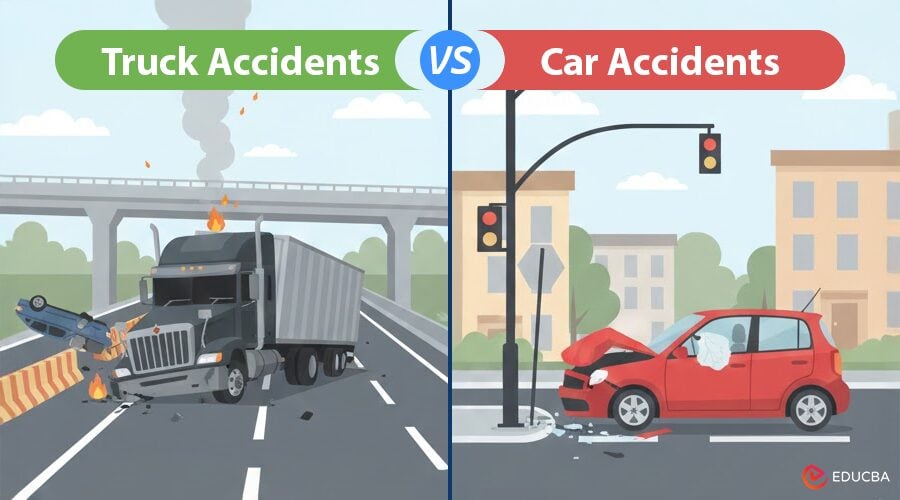
Introduction to Truck Accidents vs Car Accidents
When you think about car accidents, what do you picture? Maybe you imagine fender benders, insurance claims, and small repairs. However, when comparing truck accidents vs car accidents, the difference is dramatic. Truck accidents involve commercial vehicles that are much larger, heavier, and more complex than passenger cars, resulting in far more severe consequences.
Even at lower speeds, collisions involving trucks often result in severe injuries or fatalities. The physics of impact, combined with legal and operational complexities, make truck accidents vs. car accidents a comparison in which the risks are rarely equal.
Truck Accidents vs Car Accidents: Key Differences
Here are some key differences between Truck Accidents vs Car Accidents:
The Size and Weight Difference Changes Everything
One of the biggest reasons truck accidents vs car accidents differ in severity is size and weight. A loaded truck can weigh 80,000 pounds, but most cars weigh just 3,000 to 4,500 pounds.
Even at moderate speeds, a truck’s impact can crush a passenger car’s safety features beyond their design limits. Manufacturers design airbags, crumple zones, and seat belts to protect occupants from other cars, not from vehicles that weigh twenty times as much. This difference greatly raises the risk of serious injuries or death for people in smaller vehicles.
Higher Centers of Gravity Lead to More Violent Crashes
Commercial trucks are much taller than passenger vehicles. That height difference plays a major role in how accidents unfold. In many truck crashes, the front or side of the truck strikes above the car’s protective frame, allowing the truck to override it. This can result in underride accidents, where a car slides beneath a truck’s trailer.
These crashes are highly dangerous because the car’s safety features are less effective when impacts occur above the hood and windshield. Occupants often suffer catastrophic injuries in underride crashes, even when properly restrained.
Truck Accidents Commonly Cause Catastrophic Injuries
Because of the force involved, truck accidents are far more likely to cause serious, permanent injuries. Traumatic brain injuries, internal organ damage, multiple fractures, and spinal cord injuries are common outcomes. Spinal injuries, in particular, are devastating and often life-changing.
“The spinal cord is a tube-like structure composed of nerves and cells that begins at the base of the skull and runs down the entire length of the back,” Fanelli, Evans & Patel explains. “Any damage to the spinal cord can result in a loss of strength and function. Common symptoms of a spinal cord injury may include loss of movement, muscle weakness, loss of bladder control, breathing problems, and muscle spasms.”
These injuries do not affect mobility alone. They can impact breathing, independence, employment, and overall quality of life. Recovery is usually measured in years, not months, and some damage may be permanent.
Longer Stopping Distances Increase Impact Severity
Trucks need much more distance to stop than cars. Even with well-maintained brakes, a large truck traveling at highway speeds may need several hundred feet to come to a complete stop.
When traffic suddenly slows or a driver makes an unexpected maneuver, a truck may not be able to stop in time. Rear-end collisions involving trucks tend to occur at higher speeds and with much greater force than similar crashes between cars. The result is usually extensive vehicle damage and serious injuries.
Driver Fatigue and Long Hours Raise the Risk
Truck drivers often work long hours and may feel pressure to meet tight delivery deadlines. While federal regulations limit driving hours, fatigue remains a major factor in truck accidents.
Fatigue slows reaction time, impairs judgment, and increases the likelihood of drifting between lanes or failing to respond to hazards. When a tired driver makes a mistake behind the wheel of a commercial truck, the consequences are way more severe than when the same error occurs in a passenger vehicle.
Truck Accidents Often Involve Multiple Contributing Factors
Truck accidents typically involve multiple parties, unlike most car accidents, which involve only one or two drivers. Maintenance issues, improper loading, mechanical failures, and company policies that encourage unsafe driving can all contribute to unsafe driving.
For example, cargo that shifts during transit can destabilize a truck, increasing the risk of rollovers or jackknife accidents. You must also account for factors such as brake failures or tire blowouts in a large truck, which can instantly create chaos on the road. A fairly normal scenario can quickly turn deadly or catastrophic without much notice.
Emergency Response and Recovery Are More Complicated
Truck accidents almost always require more extensive emergency response efforts. Extrication can take longer due to vehicle damage, and hazardous materials may be involved. Road closures and traffic backups delay medical treatment, potentially worsening injuries.
Recovery after a truck accident is also more complex. Victims often face multiple surgeries and ongoing medical care. The financial and emotional toll of this can be overwhelming, especially when injuries prevent you from returning to work and cashing in a paycheck.
Why Truck Accident Cases Are Different?
Because injuries are more severe and liability is more complex, truck accident cases are so much different than typical car accident claims. Medical costs are higher, recovery times are longer, and the impact on daily life is often permanent.
Understanding the differences between truck accidents vs car accidents helps you protect your health, finances, and future after a serious crash.
Recommended Articles
Explore additional insights on vehicle safety, accident prevention, and road risk management to stay informed and drive more safely. These articles break down common causes, safety strategies, and expert tips for reducing the likelihood of serious collisions.

