


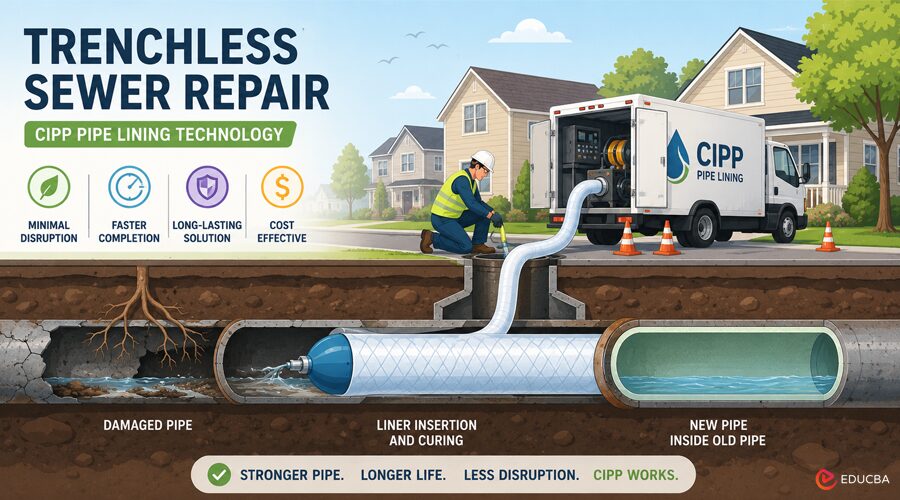
When people picture sewer repair, they picture a backhoe in the front yard, a trench cutting through the driveway, and a bill that arrives with bad news on top. Most trenchless sewer repair projects look nothing like that. The pipes get fixed from the inside, the lawn stays intact, and the crew leaves the same day.
So why does this matter to anyone who is not a plumber? The underground network that keeps cities functional is aging quickly, and trenchless sewer repair technology has quietly become one of the most useful applied engineering case studies around. If you study infrastructure, civil engineering, project management, or even procurement, cured-in-place pipe (CIPP) is worth understanding in detail.
The Scale of the Problem Underground
Sewer infrastructure is one of those systems nobody notices until it fails. The numbers behind it are larger than most people assume. According to HomeServe, the U.S. has more than 800,000 miles of public sewer lines. That is a service network longer than the federal highway system, buried out of sight, and quietly degrading.
Failure is not rare either. According to HomeServe, the EPA estimates that 23,000 to 75,000 sanitary sewer overflows occur in the United States each year. Each overflow incurs a public-health, environmental, and municipal liability cost. The pressure to rehabilitate aging pipes without tearing up streets has pushed trenchless sewer repair methods from novelty to industry standard.
How Cured-in-Place Pipe Actually Works?
CIPP is a textbook example of a process innovation that solves an old problem in chemistry and logistics without brute force. A flexible liner saturated with thermosetting resin is inserted into a damaged pipe, inflated to fit the host pipe’s interior, and then cured using hot water, steam, or UV light. Once it hardens, you have a new pipe inside the old one, structurally sound and continuous across the joints where most leaks begin. According to Kimley-Horn, CIPP makes up about 50% of sewer line rehabilitation projects and typically lasts over 50 years.
The technology is not new. It has been refined for decades. Since the 1970s, CIPP has been used in trenchless sewer repair projects to rehabilitate gravity sanitary, and stormwater sewer systems, providing engineers with 5 decades of field data to draw on when specifying projects. A clear municipal-level explainer of the install sequence is published by Portland’s environmental bureau, which walks through the prep work, root removal, and resident-facing steps in plain language. It is a useful reference for anyone trying to understand the full workflow without a contractor’s sales pitch attached.
Why Trenchless Sewer Repair Matters for Cost and Risk?
Studying trenchless sewer repair as a procurement decision is more interesting than it sounds. Open-cut excavation carries direct costs (machinery, labor, restoration) and indirect costs (traffic disruption, business interruption, environmental remediation). Trenchless methods reshape that math. The capital cost per linear foot can be higher, but the avoided costs almost always tip the balance.
A few practical advantages stand out:
- Speed of Execution: A single CIPP installation can reach up to half a mile in length as a single continuous segment, dramatically compressing the project timeline compared to open-cut work.
- Documented Lifespan: NASSCO states that a properly designed, installed, and tested renewed lateral pipe using CIPP technology has a minimum life expectancy of 50 years, which simplifies lifecycle cost analysis.
- Verified Performance: Liner samples are tested according to ASTM standards, such as ASTM F1216, to extrapolate performance over decades of use and provide repeatable lab data to back specifications.
- Minimal Surface Disruption: Roads, sidewalks, mature landscaping, and building foundations remain intact, making trenchless sewer repair an attractive solution for municipalities and property owners alike.
What Causes the Damage in the First Place?
Pipes do not fail at random. Understanding the failure modes is half of any good rehabilitation plan. Tree roots are the quiet culprit behind a large share of residential sewer problems. Roto-Rooter says tree roots often damage sewer lines by entering through joints and cracks, attracted by warm, nutrient-rich wastewater. Once they enter, they expand, catch debris, and create the blockages most homeowners notice first – this is the point at which blocked drains plumbers are usually called in.
Septic systems add another layer of complexity. For properties not connected to municipal sewer, the EPA’s SepticSmart program offers practical guidance on how systems work, why maintenance matters, and what to do when a system fails. Companies that operate in this space, such as the trenchless pipelining team at American Sewer Specialist, often combine CIPP rehabilitation with diagnostic camera inspections to identify the failure mode at play before recommending a fix.
Skills Worth Building Around This Topic
For students and working professionals, trenchless sewer repair sits at the intersection of several disciplines worth understanding deeply.
- Civil and Environmental Engineering: Hydraulics, material science, and resin chemistry all show up in a CIPP project. Understanding how flow capacity shifts after lining is a small specialty in itself.
- Project Management: The project team needs to sequence bypass pumping, traffic control, public notifications, and curing schedules precisely. Mistakes are expensive and public.
- Procurement and Finance: Evaluating bids means reading specifications against ASTM testing, warranty terms, and lifecycle assumptions rather than picking the lowest number.
- Regulatory Literacy: Compliance touches the EPA, state environmental agencies, and local permitting bodies, each with its own learning curve.
Final Thoughts
Trenchless sewer repair is no longer just a niche construction technique. It is a multidisciplinary field where engineering, finance, chemistry, and operations meet underground. As aging infrastructure continues to demand rehabilitation, professionals who understand both CIPP technology and the economics behind trenchless sewer repair will remain in high demand for years to come.
Recommended Articles
We hope this guide on Trenchless Sewer Repair helps you understand how CIPP technology restores aging pipelines with minimal disruption while reducing long-term repair costs and environmental impact. Explore these recommended articles for more insights on civil engineering, underground infrastructure, wastewater management, construction technologies, and sustainable utility rehabilitation.

