


What is a Transverse Example in Physics?
You can find waves in many places around us in the ocean, in light, and even in vibrations along a rope. A transverse example in physics helps students understand how particles move in a direction perpendicular to the direction of wave travel. Transverse waves are different from longitudinal waves, which move particles in the same direction as the wave.
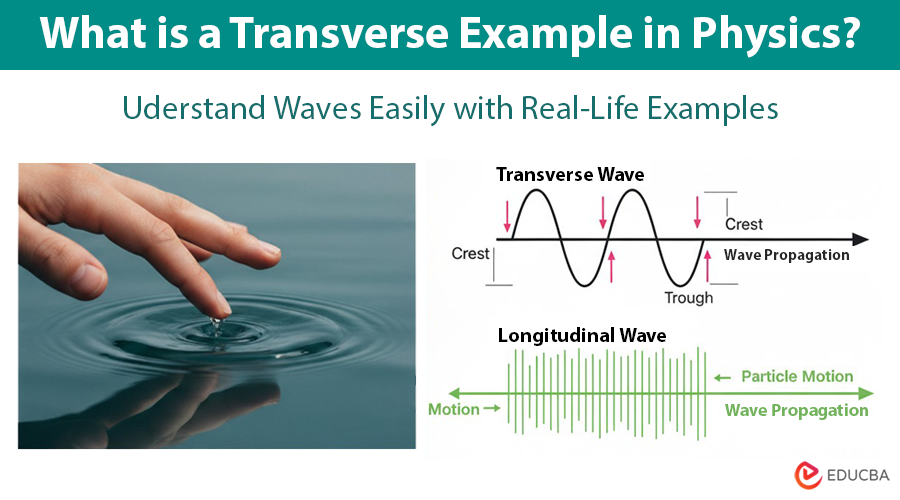
Knowing the difference between longitudinal and transverse waves is essential in physics for understanding wave behavior and energy transfer. Good examples and clear explanations make learning easier. Students greatly appreciate assistance from online tutoring platforms like Mixt Academy, which provides a step-by-step breakdown of the different topics in the physics syllabus, with clear, simple illustrations.
What is a Transverse Wave?
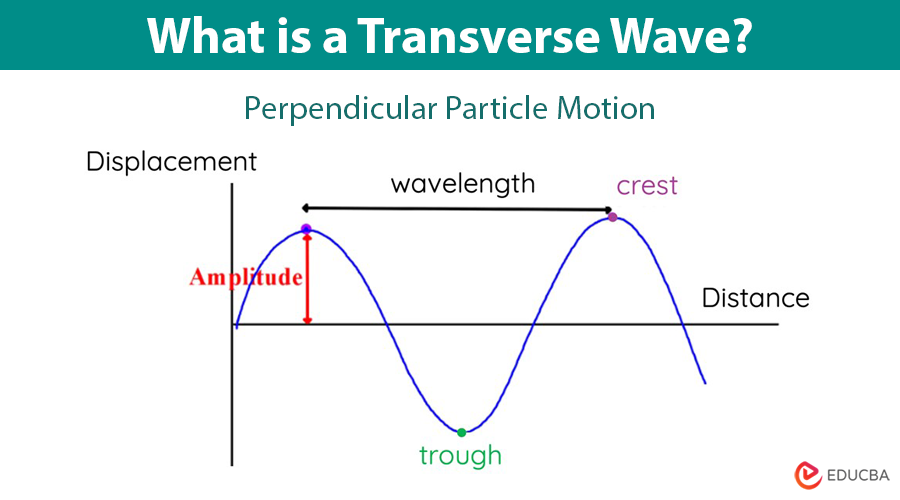
Transverse waves are periodic disturbances where particles move perpendicular to the direction of energy transfer. This perpendicular motion is the reason we can see wave patterns with crests and troughs.
Key Characteristics
- Perpendicular particle motion occurs when particles vibrate perpendicular to the direction the wave is travelling.
- Crests and troughs are distinctive peaks and valleys in wave diagrams and real-world wave examples.
- No compression occurs in transverse waves. Unlike longitudinal waves, there are no areas that are compressed or stretched.
- Up and down along the wave, and forward, all particles still transfer energy during the wave.
The study of transverse waves is a fundamental part of physics, applied across many branches, including electromagnetic, mechanical, and oscillatory phenomena.
A Clear Transverse Example in Physics
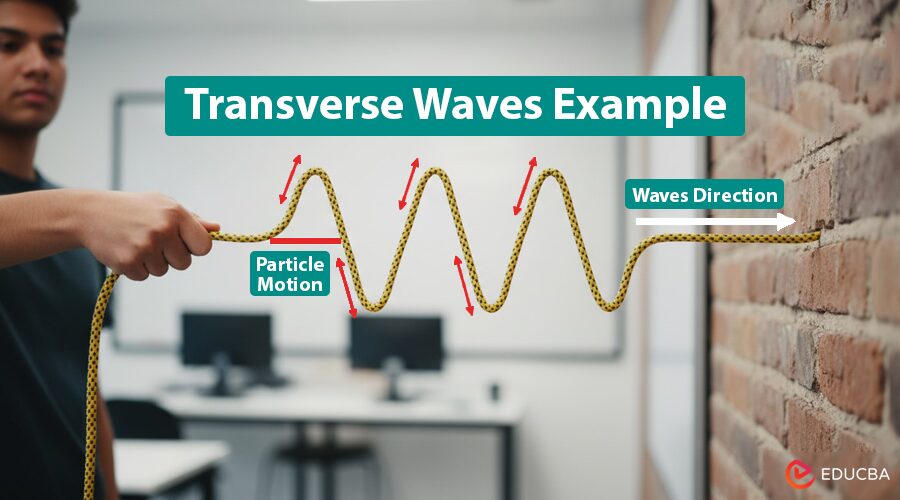
A good real-world transverse example in physics makes learning straightforward and practical. Here are some common examples:
- Waves on a String: If you shake one end of a rope tied to a wall, a wave travels along the rope, and the rope moves up and down. This is a perfect example of transverse motion.
- Waves on the Surface of Water: When you drop a pebble into a still pool of water, the water moves up and down in a transverse motion, and it does not move sideways as the waves travel outward.
- Electromagnetic Waves (Light): Light is made up of oscillating electric & magnetic fields. Even though light is a transverse wave, it does not require a physical medium to generate the electric and magnetic fields.
- S‑waves in Earthquakes: Earthquakes caused by S-seismic waves aid seismologists. These types of waves cause the ground to move either upward or sideways, and, in turn, allow the study of Earth’s geologic layers.
The Science Behind Transverse Waves
Transverse waves can generate internal forces acting on the medium through which they propagate. As an example:
- In a solid string, tension pulls particles back toward equilibrium, causing an up‑and‑down motion.
- In water, restoring forces from gravity and surface tension shape the wave motion you see on the surface.
Both solids and liquids can create transverse waves that displace particles in the medium at right angles to the wave direction. It is important to create transverse waves.
Transverse vs Longitudinal Waves: What is the Difference?
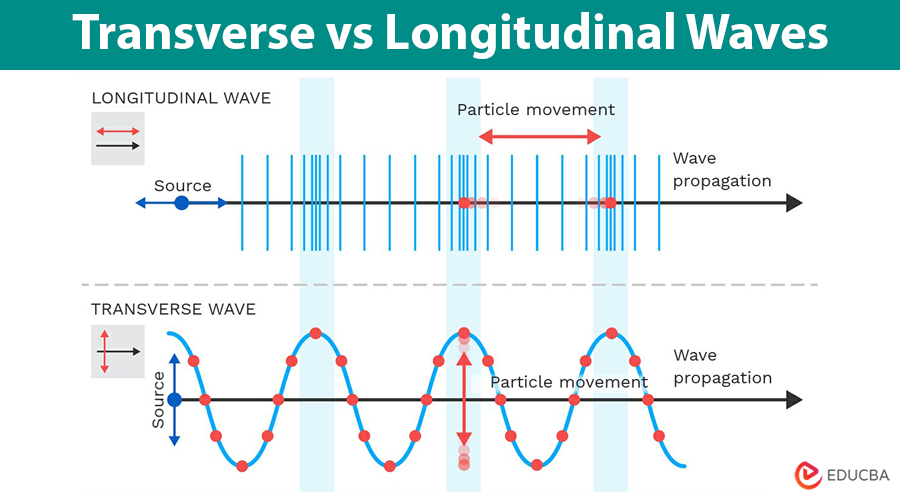
Two main types of waves, such as transverse and longitudinal waves, must be compared to understand the nature of waves fully, and these are:
| Feature | Transverse Waves | Longitudinal Waves |
| Particle Motion | ⟂ (Perpendicular) | ‖ (Parallel) |
| Examples | Water waves, light, string waves | Sound waves |
| Crests & Troughs | Yes | No |
| Compressions & Rarefactions | No | Yes |
In longitudinal sound waves, wave particles compress and expand along the direction of the wave. In contrast, transverse waves cause particle motion perpendicular to the wave direction (i.e., forward and backward motion) while the energy moves forward. Transverse waves have two distinct visual patterns when compared to longitudinal waves. They have crests (high points) and troughs (low points), while longitudinal waves have compressions (high points) and rarefactions (low points).
Wave Properties
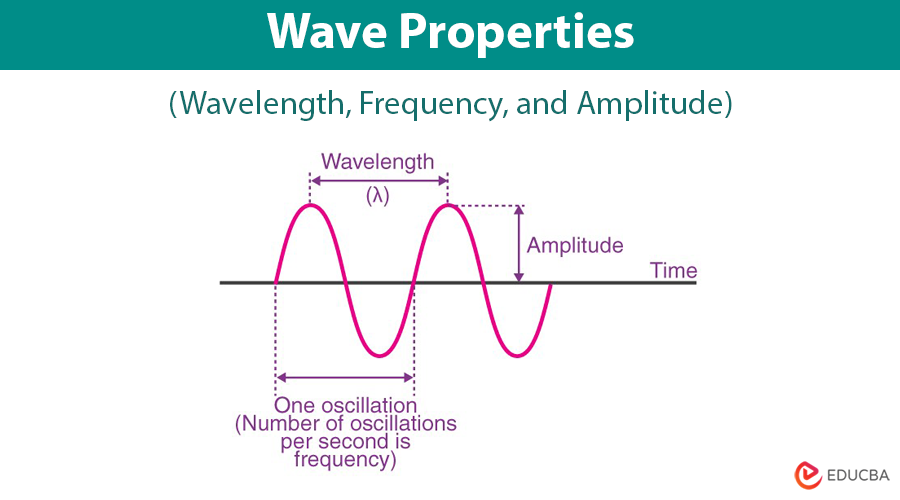
Key properties for transverse waves include:
- Wavelength: The distance between two consecutive crests (high points) or troughs (low points) in a wave. It measures one complete cycle of the wave.
- Frequency: Frequency is the number of complete waves passing a specific point in one second, and we measure it in Hertz (Hz).
- Amplitude: The maximum distance a wave rises or falls from its equilibrium position, i.e., the rest position of the wave. It is a measure of the wave’s energy.
These terms apply to all kinds of waves. Although waves differ in motion, longitudinal and transverse waves share properties.
Why Study a Transverse Example in Physics?
The benefits of studying transverse waves examples in Physics include:
- Helps in Learning Basic Physics: It prepares you for higher-level topics in physics, such as resonance, wave interference, sound, and light.
- Useful for Exams: Basic transverse wave physics is relevant in GCSE and A-level syllabuses. Thus, they are useful for academic qualifications.
- Important in Technology: Medical imaging, microwaves, and radios utilise transverse waves.
- Foundation for Advanced Physics: To understand higher-level concepts in electromagnetism, quantum mechanics, and optics, one must understand transverse waves.
Common Misconceptions Students Have
Some students make the mistake of treating transverse waves as longitudinal waves and thinking in terms of particle motion rather than wave motion. The following illustrates the point:
- Some students mistakenly believe that transverse waves can only exist in fluids.
- Students incorrectly believe that transverse waves are only backward.
- Some students also choose to disregard wave properties, such as amplitude and wavelength, when studying wave motion.
Understanding examples clearly, with professional explanations from online platforms like Mixt Academy, helps eliminate these misconceptions.
How Tutors Explain Wave Motion?

Online Physics tutors use a variety of demonstrations to help students understand the concepts. These tools help you learn the theory and apply physics more practically.
- You can use it in class to demonstrate the four transverse waves.
- Trends and animations help students understand particle motion and energy flow, improving their understanding of the concepts.
Practice Questions to Test Your Understanding
These practice questions are to test your understanding:
- What kind of waves occur when a rope is shaken? Are they longitudinal or transverse?
- One diagram shows both amplitude and wavelength. What are the definitions of both?
- In what ways are the particle movements in sound waves different from the particle movements in water waves?
You should answer these questions before looking up the definitions or searching for the answers. It will help you build your knowledge about the topic and confidence for the upcoming exams.
How to Master Wave Concepts Faster?
Students often make faster progress when they:
- Start with visual examples
- Practice regularly by using diagram practice and question-answering.
- Review examples that cover both transverse and longitudinal waves.
- Use online explanations and simulations
- Get guided feedback from experts.
Students who use the Mixt Academy learning system understand concepts more clearly, build exam confidence, and combine learning with practice.
Final Thoughts
A transverse example in physics provides a concrete understanding of perpendicular motion. Examples such as string waves, water ripples, and light radiation help students understand wave behavior and how energy travels. Considering the guidance, the practice, and the visuals, especially the structured tutoring and guides on the waves on platforms such as Mixt Academy, helps students learn these concepts easily. A thorough, solid understanding of waves and how they behave will be simple and a great way to build confidence and prepare for more complex wave motions in Physics.
Frequently Asked Questions (FAQs)
Q1. How do transverse waves differ from longitudinal waves?
Answer: In transverse waves, particles move at right angles to the direction of the wave, whereas in longitudinal waves, particles move parallel to the direction of the wave.
Q2. Are light waves transverse?
Answer: Yes, light waves and all the waves that are part of the electromagnetic spectrum are transverse waves. They do not need a medium to propagate (i.e., travel through). They have perpendicular oscillations of electric and magnetic waves.
Q3. Where do we see transverse waves in real life?
Answer: We encounter transverse waves in ripples on water, in vibrations of guitar strings, and in S-waves that occur during earthquakes.
Q4. Can learning platforms help better understand wave examples?
Answer: Yes, platforms like Mixt Academy, which have animation, step-by-step lessons, and expert help, are designed to help you understand and master wave concepts.
Q5. Are light waves transverse waves?
Answer: Yes, all electromagnetic waves, including light, are transverse because their oscillations are perpendicular to the direction of travel.
Recommended Articles
We hope this guide on a transverse example in physics has strengthened your understanding of wave motion. Explore these recommended articles for more insights and explanations to deepen your physics knowledge.


