


Train Staff to Book More Patients: Overview
Every healthcare practice wants more new patients. Practices invest in websites, social media, and reputation management to get the phone ringing, but what staff do once they answer the call is often the most important factor of all.
Too many practices overlook the single biggest growth lever available: learning how to train staff to book more patients. A friendly, confident, and well-trained front desk team turns inquiries into bookings, rather than letting patients walk away.
Here is how to train staff to book more patients and ensure your practice gets the most from every call.
Why Staff Training Is Essential?
Patients today have endless options. If they call your practice and do not feel valued, informed, or reassured, they will move on to the next provider. First impressions matter, and in healthcare, the initial impression is often made during the phone call.
Staff training is not just about courtesy. It is about:
- Building trust quickly.
- Guiding the conversation toward a booking.
- Handling objections without losing confidence.
- Reinforcing the professionalism of the practice.
Even the best digital marketing efforts will be ineffective if your staff cannot effectively convert calls into scheduled appointments. This is why it is so important to train staff to book more patients with confidence and empathy.
The Hidden Cost of Poor Phone Skills
Imagine your practice receives 50 calls from new patients in a month. If your team books only 30% of them, that is 15 appointments. However, if they improve their conversion rate through training to 60%, that is 30 appointments, doubling the growth without spending a single additional marketing dollar.
Now consider the lifetime value of a patient. In dentistry, for example, one new patient may be worth thousands of dollars over the years. Each missed booking is more than a lost call; it is a major lost opportunity. Learning how to train staff to book more patients can literally double your practice growth.
The Most Common Mistakes Staff Make
When reviewing calls from healthcare practices, the same mistakes tend to come up again and again:
- Not asking for the appointment: Staff answer questions but never actually invite the patient to schedule an appointment.
- Sounding rushed or distracted: Patients sense when they are not the priority, and trust immediately erodes.
- Failing to handle objections: When patients hesitate about cost, timing, or insurance, staff often freeze.
- Overloading with details: Instead of guiding the call, some staff overwhelm patients with too much information.
- Lack of empathy: Patients want to feel heard. A cold or transactional tone pushes them away.
These are not failures of intent; they are failures of training. The practice has not equipped staff with the right tools and techniques.
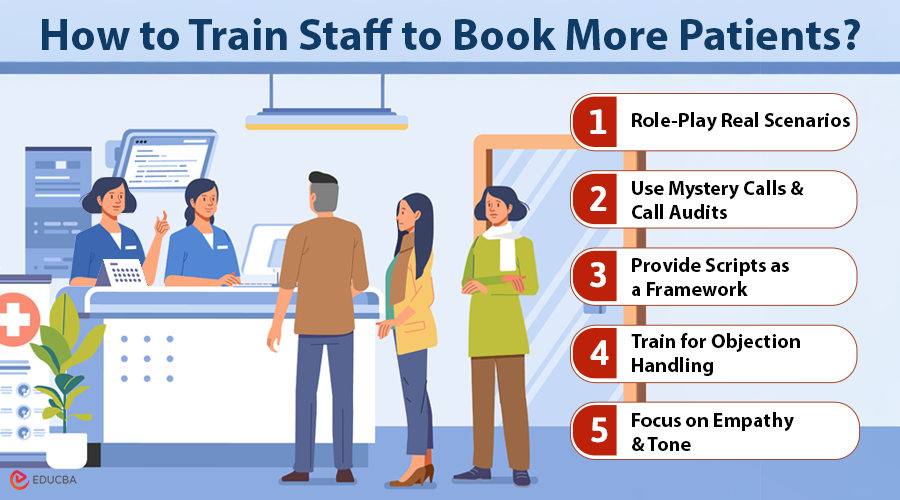
How to Train Staff to Book More Patients?
Effective training builds confidence and consistency. Here are proven methods to develop a front desk team that converts more calls:
1. Role-Play Real Scenarios
Set aside time to practice common patient situations. For example:
- A patient is calling nervously about a first appointment.
- A parent asking questions about a child’s treatment.
- Someone concerned about cost or insurance coverage.
Role-playing is one of the most practical ways to train staff to book more patients in real-world settings.
2. Use Mystery Calls and Call Audits
Listening to real calls is one of the most effective ways to identify areas that need improvement. Mystery calls where someone pretends to be a patient reveal how staff actually respond under pressure. Call audits, whether live or recorded, help identify specific coaching opportunities.
3. Provide Scripts as a Framework
Scripts should not make staff sound robotic, but they provide a reliable structure. A good script ensures staff:
- Collect the caller’s information.
- Highlight the benefits of scheduling.
- Ask directly for the appointment.
Think of scripts as scaffolding. Once staff are comfortable, they can adapt naturally while still following best practices.
4. Train for Objection Handling
Patients will always have concerns about price, insurance, timing, or fear of treatment. Staff must acknowledge concerns and redirect patients toward booking. For example:
- Patient: “I’m not sure if my insurance covers this.”
- Staff: “Let’s get you scheduled, and we can help verify your coverage before the appointment.”
This keeps the conversation moving forward without dismissing the concern, a critical skill when training staff to book more patients.
5. Focus on Empathy and Tone
Patients do not just want information; they want reassurance. Staff should be trained to:
- Speak slowly and clearly.
- Smile while speaking (yes, it is audible).
- Use empathetic phrases like, “I understand that can feel overwhelming. Let’s take it step by step.”
Tone is as important as content. A warm, patient-centered tone builds trust in seconds.
The Compounding Benefits of Training
The payoff from staff training goes far beyond booking more new patients:
- Stronger reputation: Patients who feel cared for are more likely to leave positive reviews.
- Higher retention: A good first impression can lead to patients being more loyal in the long term.
- Increased referrals: Satisfied patients are quick to recommend providers to family and friends.
- Team confidence: Staff who feel equipped to succeed are happier and more motivated.
These benefits build on each other over time, creating a cycle of growth. In dentistry, for instance, many practices that invest in training not only learn how to get more dental patients but also how to keep them for years.
Dentistry as an Example
Dental practices offer a clear illustration of the importance of staff training. Patients calling to schedule an appointment may be anxious about the pain, worried about the cost, or embarrassed about the condition of their teeth.
A trained receptionist who responds with empathy, provides reassurance, and confidently guides the patient toward scheduling can turn that anxiety into relief. On the other hand, a rushed or dismissive tone can permanently deter the patient.
This is why many dentists choose to train staff to book more patients as one of their most effective growth strategies. This is why training receptionists is often one of the most effective growth strategies for dental practices.
Final Thoughts
In healthcare, the patient experience does not start in the chair; it begins on the phone. Every call is an opportunity to build trust, demonstrate professionalism, and turn a curious caller into a loyal patient.
Practices that train staff to book more patients see measurable improvements in booking rates, patient satisfaction, and long-term growth. Whether you manage training internally or work with a digital marketing agency that includes coaching as part of their services, the goal is the same: empower your staff to succeed.
When your team knows how to handle calls with empathy, confidence, and skill, your practice will not only attract more patients, but it will also keep them coming back.
Recommended Articles
We hope this guide on how to train staff to book more patients was helpful. Explore related articles on patient communication, healthcare marketing, and front desk training strategies to maximize practice growth.

