


What Is a Traditional Economy?
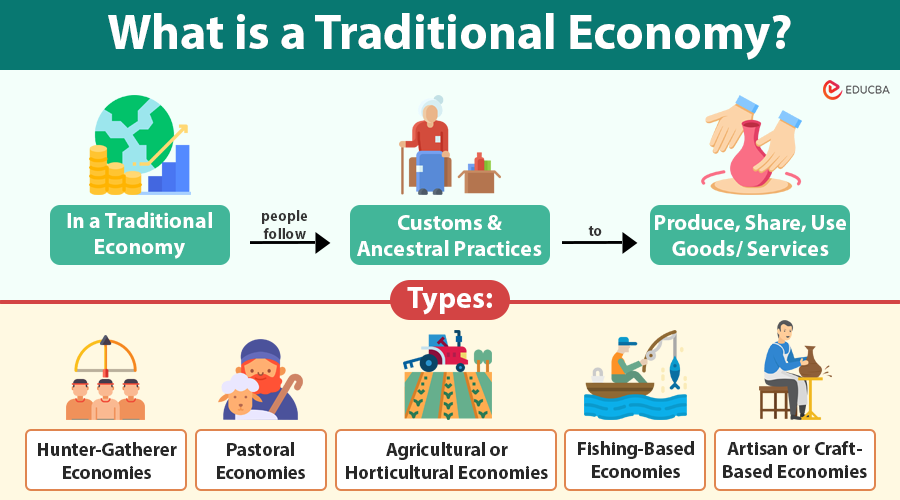
In a traditional economy, people follow customs and ancestral practices to produce, share, and use goods and services. Communities typically pass down economic roles through generations and rely on bartering, subsistence farming, fishing, or hunting instead of using money or responding to market-driven decisions.
A traditional economy promotes sustainability and low environmental impact by using natural resources only as needed for survival.
According to the United Nations, over 370 million people worldwide (including many indigenous groups) still participate in traditional economies.
Table of Contents
- What Is a Traditional Economy?
- How Does a Traditional Economy Work?
- Key Characteristics of a Traditional Economy
- Types of Traditional Economic Systems
- Examples of Traditional Economies
- Advantages of a Traditional Economy
- Disadvantages of a Traditional Economy
- Comparison with Other Economic Systems
- Relevance in the Modern World
Key Takeaways
- People base economic roles and activities on customs, ancestral knowledge, and cultural practices.
- People swap goods and services instead of using money.
- Communities engage in subsistence farming, fishing, or hunting to meet basic needs.
- Roles are passed down through generations, offering stability but limiting individual freedom.
- Traditional economies often promote harmony with nature and minimal resource exploitation.
- While they preserve culture and community bonds, these systems struggle with innovation, healthcare, education, and adapting to modern economic pressures.
How Does a Traditional Economy Work?
Here is how it functions:
1. Production Based on Tradition
In a traditional economy, what to produce and how to produce it is determined by ancestral knowledge and customs:
- Agriculture, hunting, fishing, and gathering are the most common activities.
- People grow crops, raise animals, or hunt and fish using methods passed down through generations.
- There is little to no mechanization—tools are often handmade, and labor is manual.
2. Barter and Non-Monetary Exchange
People typically do not use money; instead, they trade goods and services directly based on perceived value:
- This is known as the barter system.
- Families or neighboring communities exchange goods and services directly.
- People sometimes exchange help through mutual support, such as helping someone today in exchange for receiving help during harvest time.
3. Subsistence Living
Most production is for personal or community use, not for profit:
- Families grow or hunt just enough to meet their daily needs.
- Any surplus is shared, traded, or stored for emergencies.
- The focus is survival, not the accumulation of wealth or goods.
4. Fixed Social and Economic Roles
Tradition often determines people’s roles, linking them to:
- Family lineage (e.g., “sons of blacksmiths become blacksmiths”),
- Gender (e.g., men hunt, women cook or craft),
- Age or social status.
This reduces choice but provides clarity and stability in roles.
5. Collective Ownership and Community Decision-Making
Communities often hold resources like land, water, and forests collectively:
- No individual “owns” land in the modern legal sense.
- Decisions are made collectively, often by elders or community leaders.
- Economic activities are guided by what is best for the group, not individual profit.
6. Interdependence and Social Obligations
A traditional economy thrives on mutual support and cooperation:
- People help each other during harvest, construction, or festivals.
- Social norms compel individuals to share resources, especially in times of need.
- People intertwine economic relationships with kinship and social ties.
Key Characteristics of a Traditional Economy
- Custom-Based Decision Making: Economic roles and production methods are passed down through generations, often unchanged.
- Barter System: People trade goods and services directly without using money.
- Subsistence Activities: Most production is for personal or community use—farming, hunting, fishing, and gathering are common.
- Little to No Industrialization: Technological development is limited. Tools and techniques are often primitive.
- Close-Knit Communities: Families or tribes are the central units of economic organization, fostering cooperation and shared responsibilities.
- Stability Over Innovation: Change is slow, and the primary goal is sustainability rather than growth or profit.
Types of Traditional Economic Systems
Traditional economies are not one-size-fits-all. They vary widely based on geography, culture, climate, and available resources. Below are the major types, each with its way of organizing production and sustaining life:
1. Hunter-Gatherer Economies
These are among the oldest forms of traditional economies, where communities survive by hunting animals and gathering wild plants.
Key Features:
- Nomadic or semi-nomadic lifestyle
- Deep ecological knowledge and respect for nature
- Minimal tools and possessions
- High reliance on the seasonal availability of resources.
Examples:
The San people of the Kalahari Desert live by tracking game and gathering edible plants.
2. Pastoral Economies
Centered around the domestication and herding of animals, these systems are common in regions where farming is difficult.
Key Features:
- Herding of cattle, sheep, goats, camels, etc.
- Seasonal movement (nomadism or transhumance)
- Communities measure wealth in livestock
- Heavy dependence on grazing land and water.
Examples:
The Maasai of East Africa herd cattle across semi-arid lands as their main livelihood.
3. Agricultural or Horticultural Economies
These systems focus on small-scale farming, usually for personal or community consumption rather than trade.
Key Features:
- Use of traditional tools (e.g., hand plows, hoes)
- Family- or clan-based land ownership
- Crop rotation, shifting cultivation, or slash-and-burn methods
- Reliance on seasonal rains and local knowledge.
Examples:
Many rural villages in Nepal practice terraced farming using hand tools and family labor.
4. Fishing-Based Economies
In coastal or river-based regions, fishing becomes the main economic activity, often supplemented with trade or small-scale farming.
Key Features:
- Use of handmade boats, nets, traps, and basic fishing tackle crafted using traditional knowledge
- Knowledge of tides, migration patterns, and weather
- Sometimes integrated with barter trade or fish-for-goods exchanges
- Communities tie strong traditions to the sea or a river.
Examples:
The Inuit of northern Canada rely heavily on fishing and hunting marine animals for survival.
5. Artisan or Craft-Based Economies
These economies rely on manual production of tools, clothing, ornaments, and other essential items, often passed down as family or caste trades.
Key Features:
- Specialized craftsmanship (e.g., pottery, weaving, blacksmithing)
- Intergenerational skill transmission
- Goods made primarily for local use or barter
- Deep integration with cultural rituals and festivals.
Examples:
In rural India, traditional blacksmiths create farming tools using skills passed down through generations.
Examples of Traditional Economies
1. The Maasai of Kenya and Tanzania
Cattle are the central asset in Maasai life. Herding is both a livelihood and a cultural identity. People share land communally and measure wealth by livestock rather than money.
2. Inuit Tribes in the Arctic
Inuit people hunt whales, seals, and caribou. They base their economy on cooperation and sharing, especially during harsh winters when the community relies on joint effort for survival.
3. Rural India and Nepal
Many villages still follow traditional agricultural practices, with minimal use of machines. Bartering, caste-based roles, and festivals determine work patterns.
4. Amazonian Tribes (e.g., Yanomami)
These indigenous groups hunt, fish, and gather for survival, and their spiritual beliefs guide how much they harvest from nature.
5. Aboriginal Communities in Australia
Aboriginal Australians practice “Dreamtime economics” based on storytelling, stewardship of the land, and rituals tied to natural cycles.
Advantages of a Traditional Economy
1. Sustainability and Harmony with Nature
Traditional economies often emphasize conservation. People take only what they need, ensuring minimal waste and environmental degradation. Natural resources are respected, not exploited.
2. Social Cohesion and Cultural Identity
The entire community works together, fostering trust, cooperation, and shared values. Communities actively preserve cultural heritage and traditions, which create a strong sense of belonging.
3. Simplicity and Low Stress
There is less emphasis on competition, materialism, and financial success. People prioritize basic needs like food and shelter over pursuing economic growth.
4. Self-Reliance
Communities produce everything locally, making them less dependent on global markets or political systems.
5. Stable Roles and Expectations
Everyone knows their place and duty, reducing social confusion or conflict. People often tie their work to their personal and spiritual identity.
Disadvantages of a Traditional Economy
1. Resistance to Change and Innovation
Due to the reliance on customs, introducing new technologies or methods can be difficult. This limits growth, efficiency, and adaptation to modern problems.
2. Vulnerability to Environmental Shocks
A drought, flood, or disease outbreak can wipe out food sources or livestock, leading to starvation and hardship.
3. Limited Access to Modern Services
Education, healthcare, transportation, and communication are often unavailable or underdeveloped in traditional economic areas.
4. Inequality and Rigid Social Roles
Some roles may be gender-specific or hereditary, restricting individual freedom. For example, some communities exclude women from decision-making or certain occupations.
5. Lack of Economic Mobility
There is no clear path to financial progress. Opportunities to expand production, enter new markets, or accumulate wealth are extremely limited.
Comparison with Other Economic Systems
| Feature | Traditional Economy | Market
Economy |
Command Economy |
Mixed Economy |
| Basis | Customs & traditions | Supply & demand | Government planning | Combination |
| Innovation | Very limited | High | Moderate | Moderate to high |
| Trade | Barter system | Currency-based | State-controlled | Mixed methods |
| Control | Community or elders | Individuals & businesses | Central government | Both public & private |
| Examples | Amazon tribes, rural Asia | USA, Australia | North Korea, Cuba | India, France |
Relevance in the Modern World
Though traditional economies are limited in scale and influence, they offer important lessons in sustainability, cultural preservation, and community resilience. As environmental concerns rise, modern societies are revisiting some traditional practices like organic farming, community trade, and minimalist living.
Global organizations such as the UN and NGOs also work to support these communities by respecting their autonomy while improving access to basic health, education, and rights.
Final Thoughts
A traditional economy represents a deep connection between people, culture, and nature. While it may not match the complexity or growth potential of modern systems, it offers a model rooted in balance, cooperation, and time-tested wisdom. Understanding how traditional economies work can broaden our perspective on what development, success, and sustainability truly mean.
Frequently Asked Questions (FAQs)
Q1: Is money used in a traditional economy?
Answer: No, most traditional economies rely on bartering or direct exchange of goods and services.
Q2: What kind of jobs exist in a traditional economy?
Answer: Roles include farmers, hunters, gatherers, fishermen, and artisans—often inherited from family or tribe.
Q3: Can a traditional economy exist in a modern country?
Answer: Yes. In remote or rural areas, even within developed countries, traditional economic practices may persist.
Q4: What are the biggest threats to traditional economies?
Answer: Globalization, climate change, loss of land, and modern economic pressures are major challenges.
Q5: How does a traditional economy affect the environment?
Answer: Positively, in most cases, since it promotes the sustainable use of natural resources.
Recommended Articles
We hope this article has helped you understand how a traditional economy functions and why it remains significant. Take a look at these related articles to learn more about other economic systems and how global trade has developed.


