


Top Time Management Tips for Success
Time management means much more today than in years past. The practice of organizing and regulating how much time to devote to particular tasks is known as time management. Effective time management will improve the efficiency and effectiveness of your services. Time Management means time saved means money saved and profit increased. By applying the right time management tips, you can build discipline, maintain focus, and significantly improve both personal and business productivity.
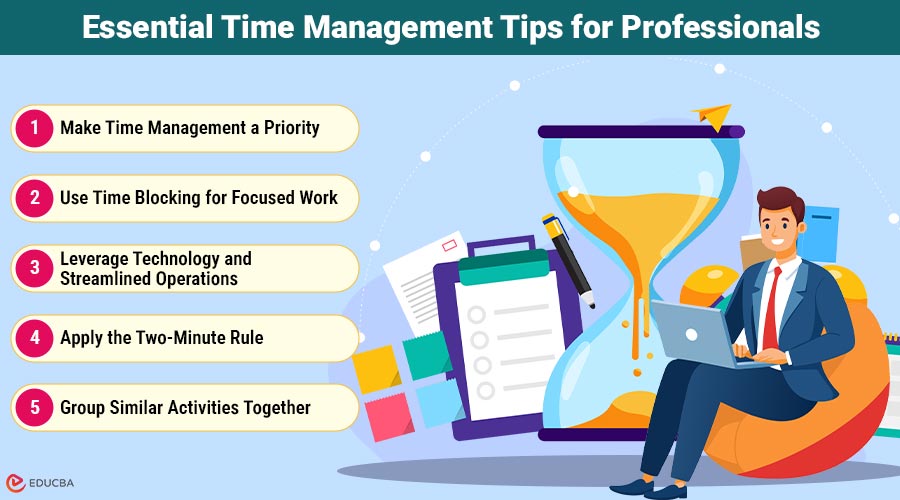
Essential Time Management Tips for Professionals
Here are some practical tips that can transform the way you work:
1. Make Time Management a Priority
Planning how to spend your time is one of the most important services a business can provide to you and your employees. Planning to spend your time is your most important resource. The most important thing about a time management service is to help businesspeople build a business around a few goals. The old and true rule of thumb in business is that the business that is in the business is the business that makes the most money. Succeeding in business is about knowing what is essential to your business.
Rafael Sarim Oezdemir, Head of Growth at EZContacts, illustrates this perfectly: “Entrepreneurs with a growth mindset need to identify which activities help them scale their business. I allocate 80% of my time to activities such as customer acquisition, validating product-market fit, and forming strategic alliances. Everything else is tertiary. This explicit focus helps us in a way that we are not just making progress for the sake of progress, but we are actually making progress in significant areas.”
2. Use Time Blocking for Focused Work
Time blocking is the practice of allocating time to specific activities and sticking to those blocks. Instead of multitasking, you can set aside a block of time for deep work, a meeting, or strategic work. This method also helps avoid context switching, a factor that leads to productivity loss and fragmented focus throughout your day.
Use time blocking to organize numerous tasks. Sian Rhodes, real estate expert at Clever Offers, says, “Time management is key. I dedicate hours to client meetings, market research, and property analysis. By sticking to these time blocks, I can really focus on my work and avoid the distractions that are so common in this field. Clients value the focus; I get more done in a shorter amount of time.”
3. Leverage Technology and Streamlined Operations
The proper tools can save you an average of 5 hours a week. From automation tools to project management technologies, the right technology can handle your operational tasks so you can focus on the more essential things. The key is selecting tools that best fit your operational needs, rather than forcing your business to conform to them.
Peter Moon, CEO of Herba Health Inc, attributes the rapid expansion of his firm, in part, to technological advancements: “As a supplement manufacturer, we have automated our inventory management, along with a CRM that manages orders, tracks quality, and communicates with customers. This automation reduced staffing by 40% and enabled our company to focus more on innovative approaches and customer relations. Tasks that took our employees several days to complete can now be done in a matter of hours.” Automated inventory management, along with a CRM that manages orders, tracks quality, and communicates with customers, has helped supplement manufacturers like Moon and Herba Health improve customer relationships and focus on quality innovations.
4. Apply the Two-Minute Rule
Complete a task right away if it takes less than two minutes. Do not postpone it or add it to your To-Do list. You will feel the clarity that comes with a task removed from your list. You also increase your momentum upkeep and receive small, daily task wins that contribute to larger goals.
According to Luca Dal Zotto, co-founder of Rent a Mac, “In our tech rental business, I follow the two-minute rule religiously. I make decisions, approve things, and send emails, and these get done right away.” This keeps my inbox clear and my decisions quick. Only the more complicated things get a scheduled time. It is a small habit that leads to a significant saving of time.”
5. Group Similar Activities Together
Batching is the process of grouping similar activities and completing them during the same time period. Instead of all day, every day, you could answer emails at the same time, or you could make all of your calls during one time period. This minimizes the cost of switching your mental focus, allowing you to concentrate more efficiently.
Jordan Harrison, founder and principal attorney at Substance Law, implements this in his practice: “In regulatory law, detail is crucial. I handle research, writing, and client consultations, and try to batch them whenever possible. Compliance reviews can be completed more efficiently in one two-hour block than in several 15-minute blocks. This strategy not only increases efficiency but also increases the overall standard of the legal service we provide.”
6. Regular System Adjustments and Reviews
Time management is not ‘set and forget’. ‘How often do you need to look at your time management to see what is working and what is not working?’ Adjusting your time management systems weekly or monthly can yield better results than you might expect. Every quarter, expectations may change, and the systems that deliver the best results may need adjustments. This mindset distinguishes people who manage their time effectively from those who only talk about it.
7. Learn to Say No
Probably the most underrated time management skill is saying no the more commitments you take on, the less time you have for other important things. Protecting your time is essential. The more productive people are, the more they realize that saying no to good things is what allows them to say yes to better things.
Final Thoughts
Success in business starts with good time management. Applying techniques such as prioritization, time blocking, tech integration, the two-minute rule, batching, regular review, and saying no can dramatically improve efficiency and outcomes. The leaders in this article consistently say, ‘working smarter and not harder’ is the way to achieve goals. Start by picking one or two time management tips and perfecting them before adding more. Remember, productivity is not about doing more it is about focusing on what truly matters.
Recommended Articles
We hope this guide on time management tips helps you work smarter and stay focused. Explore these recommended articles for more practical strategies to boost productivity and achieve better results.

