


What is Tidal Energy?
Tidal energy is a renewable source of energy that produces electricity by using the natural movement of ocean tides caused by the pull of the moon and the sun.
Tidal energy is becoming popular as a clean and dependable energy source because tides move in regular, predictable patterns, unlike solar or wind power. This consistency allows tidal energy systems to produce clean electricity with minimal environmental impact, helping reduce dependence on fossil fuels and supporting a more secure and sustainable energy future.
History of Tidal Energy
The history of tidal energy demonstrates how humans have long recognized the power of ocean tides and gradually transformed it into a reliable source of electricity.
- Ancient Uses: Harnessing tidal energy dates back to ancient times. Early civilizations, such as the Romans, used tidal mills to grind grain. These mills used the natural rise and fall of tides to turn waterwheels, demonstrating early practical applications of tidal motion.
- 17th–18th Centuries: Tidal mills advanced further in Europe, particularly in France and England. The rise and fall of tides were used to operate mechanical processes such as milling and pumping.
- Early 20th Century Innovations: Scientific studies and experiments on tidal energy began in the early 1900s. In 1920, French engineer Georges Lespes proposed using tidal power for electricity generation, marking the start of systematic exploration of its potential.
- Mid-20th Century Developments: Significant progress was made in the construction of the first tidal power plants. The La Rance Tidal Power Station in France, operational in 1966, demonstrated the feasibility of large-scale tidal range electricity generation.
- Late 20th Century Research: Concerns about fossil fuel depletion and climate change renewed interest in tidal energy. Research focused on improving turbine efficiency and exploring new systems such as tidal stream and tidal lagoon technologies. The Annapolis Royal Generating Station in Canada, commissioned in 1984, became North America’s first operational tidal power plant.
- Early 21st Century Advancements: Modern tidal energy projects, such as the MeyGen tidal stream array in Scotland and the Sihwa Lake Tidal Power Station in South Korea, demonstrated the scalability of tidal energy. Advances in materials, turbine design, and engineering have made these systems more efficient and cost-effective.
- Current Trends: Today, tidal energy is an area of active research and investment worldwide. Innovative solutions such as floating tidal turbines and integrated tidal energy systems are being explored, with a focus on reducing costs, minimizing environmental impacts, and expanding applications for sustainable electricity generation.
How Tidal Energy Works?
Tidal energy makes electricity using the movement of ocean tides. The Moon and the Sun’s gravity cause these tides.
Step 1: Gravitational Forces Create Tides
The Moon’s gravity pulls ocean water toward it, creating a high tide on the side of Earth facing the Moon. At the same time, another high tide forms on the opposite side due to Earth’s rotation. Areas between these experience low tides.
This predictable cycle happens roughly twice a day, making tidal energy highly reliable.
Step 2: Water Builds Up Potential Energy
As tides rise and fall, massive volumes of water move in and out of coastal areas, estuaries, and bays. This moving water contains both kinetic and potential energy, as in a river.
Step 3: Tidal Energy Systems Capture the Motion
There are three main technologies used to capture tidal energy:
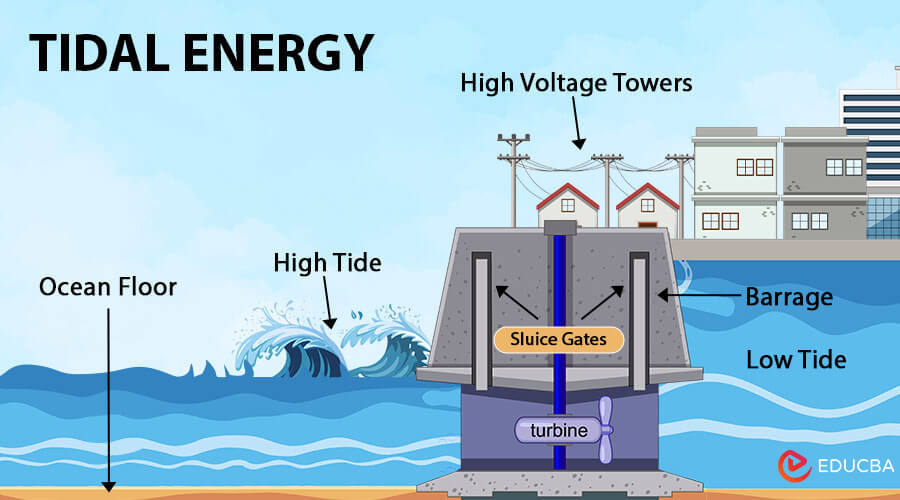
- Tidal Barrages: Dams built across estuaries that trap water during high tide.
- Tidal Stream Turbines: Underwater turbines placed in fast-moving tidal currents.
- Tidal Lagoons: Artificial enclosures that store water at high tide and release it later.
Each system channels tidal water in a controlled way.
Step 4: Flowing Water Spins Turbines
As water flows through turbines, either entering or exiting a barrage, lagoon, or stream, it spins the turbine blades. This mechanical motion is similar to how wind turns a wind turbine.
Step 5: Turbines Drive Generators
The spinning turbines turn generators, which convert mechanical motion into electricity.
Step 6: Electricity Is Transmitted to the Grid
The generated electricity travels through underwater cables to shore-based substations. From there, it is stepped up in voltage and fed into the power grid for homes, businesses, and industries.
Step 7: Continuous, Predictable Power Generation
Because tidal cycles are predictable years in advance, tidal power provides a stable and reliable source of renewable energy, unlike solar or wind, which depend on weather conditions.
Types of Tidal Energy
Tidal energy can be harnessed in several ways, each using the natural movement of tides to generate electricity. The main types include tidal stream systems, tidal range systems, tidal lagoons, and dynamic tidal power.
1. Tidal Stream Systems
Tidal stream systems, also called underwater turbines or tidal stream generators, work like wind turbines but are placed underwater. They capture the kinetic energy of moving water as tides flow past, turning turbines to generate electricity.
Advantages:
- Can be set up in locations where the tidal currents are strong
- Minimal environmental impact compared to large-scale barrages
- Scalable and relatively easy to maintain.
Examples:
- MeyGen Project (Scotland)
- Seagen Tidal Stream Generator.
2. Tidal Range Systems
Tidal range systems use the difference in water levels between high and low tides. They typically involve building tidal barrages or fences that trap water during high tide and release it through turbines to generate electricity.
Advantages:
- Can generate power continuously if the tidal range is sufficient
- Provides predictable and reliable energy.
Examples:
- La Rance Tidal Power Station (France)
- Sihwa Lake Tidal Power Station (South Korea).
3. Tidal Lagoon Systems
Tidal lagoons involve creating a man-made reservoir or lagoon along the coast. Water is captured during high tide and released through turbines at low tide, converting the water’s potential energy into electricity.
Advantages:
- Offers flexibility in energy generation
- Potentially lower environmental impact than tidal barrages
- Can be designed for local community energy supply.
Examples:
- Swansea Bay Tidal Lagoon (UK)
- Cardiff Tidal Lagoon (UK).
4. Dynamic Tidal Power (DTP)
Dynamic Tidal Power is an emerging technology that involves constructing long, dam-like structures perpendicular to the coastline across tidal channels. These structures create a large difference in water levels, driving turbines to produce energy from both incoming and outgoing tides.
Advantages:
- Can generate energy continuously throughout the tidal cycle
- Suitable for areas with moderate tidal ranges
- Has high potential for large-scale energy production.
Examples:
- Currently in research and development; no commercial projects yet.
Benefits of Tidal Energy
- Renewable and Sustainable: It harnesses the natural and predictable movements of tides driven by celestial forces. Unlike fossil fuels, it is a continuous and renewable source of energy.
- Predictable Power Generation: Tidal cycles are highly predictable, offering reliable energy generation. This predictability contrasts with the variability of solar and wind power, enabling a more consistent energy supply.
- Low Environmental Impact: Its systems generally have a lower environmental impact than other renewable sources. They produce no greenhouse gases or pollutants during operation and have minimal visual impact.
- High Energy Density: It has a higher energy density than other renewable energy sources. The energy potential of moving water can be substantial, leading to efficient power generation.
- Long-Term Potential: With advancements in technology, tidal energy has significant potential for large-scale implementation. It can substantially reduce reliance on fossil fuels and support global energy needs.
- Potential for Local Energy Supply: Its systems can provide localized power, reducing transmission losses and increasing energy security for coastal communities.
Challenges and Limitations
- High Initial Costs: Installing and constructing tidal energy systems, including tidal stream turbines, barrages, and lagoons, requires high upfront costs. This includes expenses for research, development, and infrastructure.
- Environmental Impact: Although generally low, tidal energy systems can still affect marine ecosystems. Barrages and lagoons can alter water flow patterns, impacting local habitats and wildlife.
- Technical and Engineering Challenges: Tidal environments are harsh and challenging for technology. Equipment must withstand strong currents, saltwater corrosion, and shifting sediments, which can lead to higher maintenance costs and technological hurdles.
- Limited Suitable Locations: Optimal sites for tidal energy installations are limited to regions with strong tidal flows or significant tidal ranges. This geographic restriction can limit the widespread adoption of tidal energy.
- Potential Disruption to Navigation: Its installations, especially large barrages and lagoons, may interfere with shipping routes and recreational boating, potentially requiring adjustments to marine traffic patterns.
- Energy Storage and Integration: Its intermittent nature requires effective energy storage solutions or integration with other renewable sources to ensure a steady energy supply during low tide periods.
Tidal Energy vs Other Renewables
| Feature | Tidal Energy | Solar Energy | Wind Energy | Hydropower |
| Source | Ocean tides (gravitational pull of Moon & Sun) | Sunlight | Wind | Flowing rivers or reservoirs |
| Predictability | Very high – tides are predictable years in advance | Medium – depends on weather & daylight | Medium – depends on wind patterns | High – river flow can be managed |
| Energy Density | High – moving water is heavy and powerful | Low – sunlight spreads over large areas | Medium – depends on wind speed | High – large volumes of water |
| Environmental Impact | Low emissions, but may affect marine life | Low emissions | Low emissions | Can affect ecosystems and fish habitats |
| Reliability | Very reliable, twice daily cycles | Intermittent – only when sunny | Intermittent – only when windy | Reliable, but depends on water availability |
| Cost | High initial cost, long-term investment | Moderate, decreasing | Moderate, decreasing | High initial cost, long-term payback |
| Lifespan | Long – 50+ years for barrages/turbines | 25–30 years | 20–25 years | 50–100 years |
Case Studies
1. The La Rance Tidal Power Station (France)
- Overview: Commissioned in 1966, La Rance is the world’s first large-scale tidal power plant, located on the Rance River in Brittany, France.
- Technology: The plant uses a tidal barrage system with 24 bulb-type turbines, harnessing the tidal range to generate electricity.
- Output: It has an installed capacity of 240 MW and produces approximately 540 GWh of electricity annually.
- Impact: La Rance has provided a reliable renewable energy source for over five decades, demonstrating the long-term viability of tidal power.
2. The MeyGen Project (Scotland)
- Overview: Situated in the Pentland Firth, the MeyGen project is the world’s largest planned tidal stream energy project.
- Technology: The project uses underwater turbines to capture the kinetic energy of fast-moving tidal streams.
- Output: It can generate up to 398 MW of electricity when fully operational, enough to power about 175,000 homes.
- Impact: MeyGen represents a significant advancement in tidal stream technology and contributes to Scotland’s renewable energy goals.
3. The Sihwa Lake Tidal Power Station (South Korea)
- Overview: Located on the west coast of South Korea, Sihwa Lake Tidal Power Station is the world’s largest tidal power installation.
- Technology: This tidal barrage system utilizes a seawall built for flood mitigation, incorporating 10 turbines to generate power.
- Output: The station has an installed capacity of 254 MW and generates about 552.7 GWh of electricity per year.
- Impact: Sihwa Lake has successfully combined flood control and renewable energy production, highlighting the multifaceted benefits of tidal power projects.
4. The Annapolis Royal Generating Station (Canada)
- Overview: Located on the Annapolis River in Nova Scotia, this tidal power plant has been operational since 1984.
- Technology: It employs a single-effect barrage system with a Straflo turbine to capture the potential energy of the tidal range.
- Output: The plant has a capacity of 20 MW and produces about 50 GWh of electricity annually.
- Impact: Annapolis Royal is a pioneer in North American tidal energy, demonstrating the technology’s feasibility in the region.
Future Prospects
- Technological Advancements: Continuous innovation is driving improvements in tidal energy technology. Advanced materials, more efficient turbine designs, and improved energy conversion methods make tidal systems more effective and cost-competitive.
- Increased Global Interest: Governments and private companies worldwide recognize tidal energy’s potential. Increased investment and supportive policies will spur further development and deployment of tidal energy projects.
- Integration with Other Renewables: Integrating tidal energy with other renewable sources, such as wind and solar, can yield a more stable, diverse energy blend. This integration helps to mitigate the intermittency issues of each individual source.
- Emerging Markets: Developing countries with suitable tidal conditions are beginning to explore tidal energy as a means to enhance their energy security and diversify their energy sources. This expansion into new markets is a positive indication for the future of tidal energy.
- Environmental Innovations: Its systems are developing new designs and approaches to minimize their environmental impact. These include fish-friendly turbines and systems that have minimal impact on water flow and marine life.
- Cost Reductions: As technology improves and more projects get implemented, economies of scale will reduce the costs associated with tidal energy. This cost reduction will make tidal energy more competitive with traditional energy sources.
- Potential for Large-Scale Projects: Large-scale tidal energy projects, such as tidal lagoons and extensive tidal stream arrays, hold significant potential for substantial energy generation. These projects could play a key role in meeting the growing global energy demand.
- Research and Collaboration: Ongoing research and international collaboration are essential for overcoming the current challenges of tidal energy. Shared knowledge and joint ventures can accelerate technological progress and address common obstacles.
Final Thoughts
It stands out as a promising and reliable renewable energy source, leveraging the natural and predictable movements of ocean tides. Despite challenges such as high initial costs, environmental concerns, and technical difficulties, technological advancements and increased global interest are paving the way for broader adoption. The potential for integration with other renewable sources, ongoing research, and emerging markets highlights the growing relevance of tidal energy in the renewable energy landscape. As technology advances and costs decline, tidal energy has the potential to play a significant role in reducing reliance on fossil fuels and advancing a sustainable energy future. Tidal energy can become a cornerstone of global renewable energy strategies by addressing current challenges and capitalizing on its unique advantages.
Frequently Asked Questions (FAQs)
Q1. Does tidal energy affect marine life?
Answer: While tidal energy is generally eco-friendly, large tidal barrages and lagoons can impact local ecosystems, including fish migration and sediment flow. Modern designs focus on fish-friendly turbines and minimal disruption.
Q2. Is tidal energy reliable during storms or extreme weather?
Answer: Yes, tidal energy is generally reliable because celestial forces, not weather, drive the tides. However, extreme storms can temporarily affect operations or maintenance schedules.
Q3. How much electricity can tidal energy provide globally?
Answer: Tidal energy could supply up to 10% of the world’s electricity if we implement large-scale projects in optimal coastal regions.
Q4. Can tidal energy be combined with other renewable sources?
Answer: Yes, tidal energy can actively integrate with wind, solar, or wave energy to deliver a more consistent and stable power supply, reducing reliance on fossil fuels.
Q5. Are there any emerging technologies in tidal energy?
Answer: Yes, innovations include floating tidal turbines, dynamic tidal power systems, and hybrid tidal-wind platforms. These aim to increase efficiency and reduce environmental impact.
Q6. How expensive is tidal energy compared to solar or wind energy?
Answer: Tidal energy has a high initial cost due to construction and infrastructure. However, its long lifespan and predictable output can make it cost-effective over the long term compared to intermittent sources like solar and wind.

