


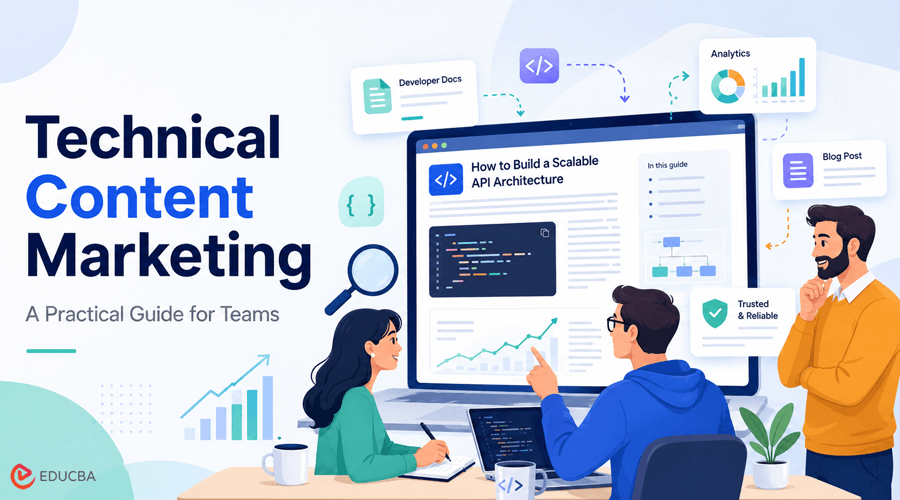
Technical content marketing is the practice of publishing material that solves a real engineering problem accurately enough that a reader can act on it without leaving the page. Commercial attention is the byproduct, not the pitch. It differs from general content marketing in one way that governs every other decision: this audience verifies claims by running them.
That verification habit shows up in where technical attention lands. In a census of every Hacker News story that scored 100 points or more in the 12 months to August 2026, the 15,366 qualifying stories came from 7,590 distinct domains, and 79.5% of those domains appeared exactly once. The ten biggest domains together accounted for only 14.8% of the stories. Technical attention is not gated by brand size.
This guide covers what the discipline is, why technical readers behave differently, which formats travel, how to build a program, where programs fail, and how to measure one honestly.
Key Takeaways
- Technical content marketing targets readers who test claims before believing them, so accuracy is a distribution strategy, not a compliance step.
- 5% of domains that produced a 100-point Hacker News story in the past year did it exactly once; distribution here is not brand-gated.
- Stack Overflow’s 2025 Developer Survey found that 46% of developers actively distrust AI tool output, compared with 33% who trust it.
- The formats that travel are the ones a competitor cannot rewrite from a search result: measurements, postmortems, migration accounts, and teardowns.
- Measure technical content on product behavior, not impressions.
What is Technical Content Marketing?
It is content produced for an audience that evaluates the product itself: engineers, data scientists, platform teams, and the managers who buy on their recommendation. The defining constraint is that the reader can check the work. If a tutorial does not run, the reader finds out in four minutes.
The category is often confused with technical writing, which documents a product for someone who has already chosen it. Technical content marketing addresses someone who has not chosen anything yet.
How it Differs From General Content Marketing
| Dimension | General Content Marketing | Technical Content Marketing |
| Primary Reader | Buyer or non-practitioner | Practitioner who will implement it |
| Proof Standard | Testimonial, case study | Reproducible steps, measured numbers, code |
| Failure Mode | Reader is unpersuaded | Reader tries it, it breaks, brand is discredited |
| Useful Metric | MQLs, time on page | Activated accounts, SDK installs, docs depth |
The usual funnel model fits poorly here because technical evaluation isn’t linear. A staff engineer might read a teardown eighteen months before a purchase, then recall it when a specific failure appears in production. Content works as a durable reference, not a sequenced nurture path.
Why do Technical Readers Respond Differently?
Because they carry a professional cost for being wrong. An engineer who recommends a tool that fails in production owns that failure at the next incident review, so the reader always looks for the constraint you did not mention.
Stack Overflow’s 2025 Developer Survey reported that 84% of developers use or plan to use AI tools, up from 76% the year before, while favorable sentiment fell from above 70% in 2023-2024 to 60%. 46% actively distrust the accuracy of AI tool output, against 33% who trust it. Adoption rose, and trust fell together, and readers have adjusted by discounting anything that reads as generated.
The practical rule: every claim should name the system it holds on, the condition under which it holds, and the point at which it stops holding. Specificity is expensive to fabricate and cheap to verify.
What Does the Data Say About Who Wins Technical Attention?
Incumbency matters less here than in almost any other content category, and format matters more. We grouped the 15,366 qualifying stories carrying an external URL by domain.
The top 10 domains produced 14.8% of stories, the top 50 produced 26.2%, and the top 500 produced 45.5%. More than half came from outside the top 500. For a company with no audience, the ceiling on a piece is set by the piece, not the domain.
The single largest domain was github.com, with 1,118 stories (7.3%), ahead of every news publication and every corporate blog. For technical audiences, the repository and the documentation are load-bearing marketing surfaces, and the blog is secondary.
Which Technical Content Formats Actually Travel?
The formats that earn technical distribution share one property: they contain information that could only come from having done the thing.
| Format | Why it travels |
| Measurement Writeup | Competitors cannot copy your test conditions |
| Postmortem | Readers treat published failure as evidence of honesty |
| Migration Account | Every reader considering the same move needs the cost estimate |
| Architecture Teardown | Becomes a durable reference and gets cited for years |
| Deep Integration Guide | Ranks well and converts because it does the trial for the reader |
| Honest Comparison | Buyers distrust one-sided comparisons |
Roundups, glossary posts, and product announcements dressed as thought leadership rarely travel; none give a technical reader a reason to send the link to a colleague.
Start with whichever format your team can produce from existing knowledge, usually a migration account or postmortem, since that material already lives in incident tickets.
How Do You Build a Technical Content Marketing Program?
The sequence assumes a small team and access to engineers for review. Skipping step two is the most common reason a program produces accurate content nobody reads.
- Audit your documentation first: Run your quickstart guide on a clean machine and document every point where users may get stuck. Fix these issues before creating new content.
- Map problems instead of chasing keywords: Review support tickets, community discussions, sales questions, and customer feedback to identify recurring technical challenges. Use the language customers and developers actually use when describing those problems.
- Assign a dedicated technical reviewer: Give each piece a named reviewer who understands the product and can challenge technical claims, examples, and instructions before publication.
- Create one flagship piece each quarter: Focus on original measurements, architecture teardowns, migration stories, or data-driven analysis that provides information competitors cannot easily reproduce.
- Publish where technical audiences already look: Extend beyond the company blog by publishing or linking content through documentation, repository READMEs, developer communities, and other relevant technical channels.
- Measure the path to product adoption: Track whether content helps readers reach their first successful API call, integration, deployment, or other meaningful product milestone, rather than focusing only on scroll depth or page views.
- Refresh content alongside product changes: Align content updates with release cycles so tutorials, code examples, screenshots, and technical instructions remain accurate. Outdated technical content can turn a potential trial into a failed experience.
Steps one through three are unglamorous, and that is where the quality gap is actually created.
Where do Technical Content Programs Usually Fail?
Five failure modes account for most programs that produce competent output and no results.
- Accurate but generic: The content is technically correct but offers little original value. If readers can find the same information in competitor articles or search results, they have no reason to trust, bookmark, or share it.
- Reviews become a rubber stamp: Technical reviews often get delayed, rushed, or reduced to a quick skim. Assigning one dedicated technical reviewer with a fixed review schedule helps maintain both accuracy and publishing consistency.
- Neglecting key product surfaces: Many teams invest heavily in blog content while overlooking essential technical assets like the README, API documentation, and quickstart guides. For developer audiences, these resources often create a stronger first impression than the blog itself.
- Assuming distribution will happen naturally: Publishing great content is not enough. Technical content spreads when engineers and practitioners find it valuable enough to share with colleagues, communities, and internal teams.
- Measuring the wrong outcomes: Rising page views can create the illusion of success while product adoption remains unchanged. Focus on meaningful metrics such as activated users, documentation engagement, repository traffic, and reduced sales objections to understand what truly works.
If two or more of those describe your setup, the constraint is the operating model, not writing talent; it is worth being honest about before hiring, and it is the main thing to probe when choosing a technical content marketing agency rather than adding another writer.
How Should Technical Content be Measured?
Impressions tell you almost nothing here: the audience is small, senior, and reads without engaging. A hundred correct readers can outweigh fifty thousand incidental ones.
| Metric | What it tells you |
| Time to First Successful Call | Whether content plus docs get someone working |
| Documentation Depth Per Session | Whether readers are evaluating or bouncing |
| Repository Traffic and Clones | Whether content drives genuine technical interest |
| Assisted Pipeline | Which pieces appear in the histories of accounts that convert |
| Sales Objection Frequency | Whether content is pre-answering evaluation questions |
The single most useful metric is sales objection frequency: a working piece makes a specific objection stop appearing on sales calls within two quarters.
Running this well takes an operating rhythm most in-house teams lack the capacity to build, which is the gap a specialist technical content marketing partner is meant to close: engineer-written drafts, a fixed review path, and measurement tied to product activation rather than traffic.
What To Do First?
You now have the distinction between technical content marketing and adjacent disciplines, the distribution evidence, the formats that travel, a build sequence, the failure modes, and a measurement set that does not rely on impressions.
Start with step one this week: open your own quickstart on a machine that has never run your product, follow it exactly, and write down every point where it fails.
Frequently Asked Questions (FAQs)
Q1. What is the difference between technical content marketing and technical writing?
Answer: Technical writing documents a product for people who have already adopted it. Technical content marketing targets people who have not adopted anything yet.
Q2. Do I need engineers to write technical content, or can writers be trained?
Answer: Either works; the deciding factor is access to the product, not job title.
Q3. How long does technical content marketing take to show results?
Answer: Expect two to three quarters for pipeline effects; documentation depth moves within one quarter if it is working.
Q4. How much technical content should we publish?
Answer: Volume is the wrong variable. One flagship piece per quarter, plus six to eight practical pieces, outperforms weekly publication assembled from search results.
Q5. Is technical content marketing worth it for a small team?
Answer: Disproportionately so: 79.5% of domains that produced a 100-point Hacker News story last year did it exactly once.
Q6. Should technical content live on the blog or in the documentation?
Answer: Both. Documentation carries what a reader needs while implementing; the blog carries measurements, postmortems, migrations, and comparisons.
Recommended Articles
We hope this guide helps you understand how effective technical content marketing can build trust, engage technical audiences, and support product adoption. Explore these recommended articles for more insights into technical content, B2B marketing, SaaS marketing, developer marketing, content strategy, and business growth.


