
Introduction
In today’s data-driven world, organizing information in a logical and meaningful way is essential for search, analytics, artificial intelligence, and knowledge management. Two foundational concepts help structure information inside enterprise systems: taxonomy and ontology. Taxonomy classifies information hierarchically, while ontology defines deeper semantic relationships. Knowing their differences improves data governance, metadata modeling, knowledge graphs, and AI systems. This blog delves into the details of taxonomy vs ontology, covering definitions, differences, examples, use cases, pros, and cons.
Table of Contents:
- Introduction
- What is a Taxonomy?
- What is an Ontology?
- Key Differences
- How they Work Together?
- Use Cases
- Pros and Cons
- When to Choose What?
What is a Taxonomy?
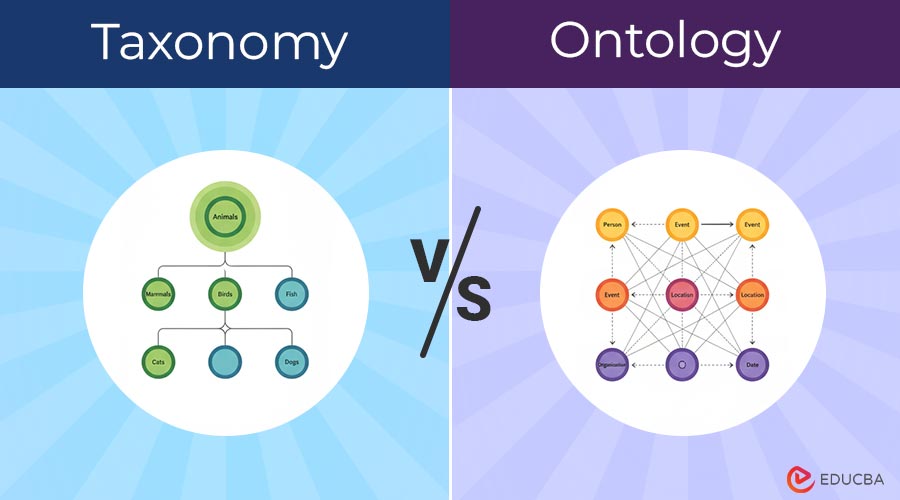
A taxonomy is hierarchical classification system used to group items into parent–child structures. It organizes information into categories and subcategories based on shared characteristics.
Key Characteristics:
- Hierarchical (top-down tree)
- One parent per item (mostly strict hierarchy)
- Labels and categories only (no advanced relationships)
- Simple classification
- Easy to maintain and understand
Examples:
- Website content categories (Home → Blogs → Technology → AI)
- Product catalog structure (Electronics → Mobiles → Smartphones → Android)
When Used:
- Content management
- Navigation and menu design
- Product categorization
- Document management systems
- Search and filtering
What is an Ontology?
An ontology is a semantic knowledge model that represents concepts, their properties, and the rich relationships between them. It extends far beyond hierarchical classification to describe how concepts interact, depend on, relate to, or constrain each other.
Key Characteristics:
- Network-like structure (graph-based, not strictly hierarchical)
- Multiple relationship types (is-a, part-of, owned-by, created-by, uses, interacts-with, etc.)
- Attributes and properties for each concept
- Inference and reasoning ability
Examples:
- RDF/OWL ontologies in the Semantic Web
- Finance ontologies describing entities, transactions, regulations, roles, risks
When Used:
- Artificial intelligence
- Semantic search
- Data integration and interoperability
- Recommendation systems
- Regulatory compliance mapping
Taxonomy vs Ontology: Key Differences
Below is a structured comparison highlighting the major distinctions.
| Aspect | Taxonomy | Ontology |
| Structure Type | Hierarchical tree | Semantic network/graph |
| Purpose | Classify and organize | Describe meaning and relationships |
| Depth of Relationships | Only “is-a” hierarchy | Many relationships (“part-of”, “depends-on”, “owned-by”, etc.) |
| Flexibility | Rigid, fixed | Highly flexible and complex |
| Data Modeling | Simple | Advanced |
| Use in AI | Limited | High |
| Attributes & Properties | Minimal | Extensive |
| Reusability | Moderate | High |
| Learning Capability | None | Supports reasoning/inference |
| Best For | Categorization | Knowledge representation |
How they Work Together?
Taxonomies and ontologies are not mutually exclusive.
In fact, every ontology includes a taxonomy as its foundation.
- A taxonomy gives the basic hierarchical categories
- An ontology extends it with:
- Rich relationships
- Properties
- Rules
- Semantic meaning
Together, they build the foundation of enterprise knowledge graphs and AI-driven reasoning systems.
Use Cases of Taxonomy and Ontology
Here are some practical use cases showing where taxonomies and ontologies are best applied:
Where Taxonomies are Right Choice:
- Website organization: Taxonomies structure website content into clear hierarchical categories, improving navigation, search, and overall user experience.
- Library and archive classification: Libraries use taxonomies to categorize books and documents systematically, ensuring consistent organization and faster information retrieval.
- Data catalog categories: Data catalogs utilize taxonomies to logically group datasets, simplify discovery, enforce metadata consistency, and support governance.
- Product grouping: Retailers classify products using taxonomies for easier browsing, filtering, inventory management, and improved customer recommendations.
- Employee directory hierarchy: Taxonomies group employees by their department and job role. This makes it easier to find people, understand reports, improve communication, and better understand how the organization works.
Where Ontologies are Right Choice:
- AI reasoning and inferences: Ontologies define concepts and rules, enabling machines to infer new knowledge and perform intelligent rationale.
- Knowledge graph development: Ontologies provide semantic structure for knowledge graphs, defining entities, relationships, properties, and logical connections.
- Semantic data integration: Ontologies unify diverse datasets by mapping shared meanings, resolving inconsistencies, and enabling seamless cross-system integration.
- Chatbots and virtual assistants:Ontologies help chatbots understand context, connect related ideas, follow rules, and give more accurate answers.
- Regulatory mapping: Ontologies relate regulatory terms and requirements, enabling automated compliance analysis, consistency in interpretation, and assessment of impact.
Pros and Cons of Taxonomy and Ontology
Here are the pros and cons of taxonomies and ontologies:
Pros of Taxonomy:
- Simple to create and maintain: Taxonomies are easy to build and manage and require minimal expertise.
- Easy to understand: Users can quickly grasp hierarchical structures without prior technical knowledge.
- Widely used in content management: Commonly applied in CMS for categorizing content efficiently and consistently.
- Useful for search, navigation, and filtering: Makes it easier for users to browse, filter, and find what they are looking for.
Cons of Taxonomy:
- Limited relationship types: Taxonomies support only hierarchical relationships, restricting complex connections between items.
- Cannot support complex semantics: Cannot capture meaning, rules, or advanced relationships beyond simple hierarchies.
- Not good for AI thinking: A basic hierarchy cannot help machines understand or make smart connections.
- Rigid structure: Difficult to adapt or extend when information evolves or grows dynamically.
Pros of Ontology:
- Rich semantic relationships: Ontologies define multiple relationship types, attributes, and constraints between concepts.
- Helps smart AI tasks: Allows AI to understand, reason, and make better decisions.
- Helps AI figure things out: Machines can learn new facts by understanding the links and rules between things.
- Highly flexible: Ontologies adapt easily to evolving concepts, domains, or knowledge structures.
Cons of Ontology:
- Time-consuming to build: Creating ontologies requires significant planning, design, and validation effort.
- Requires expert modeling: It necessitates the involvement of domain experts and knowledge engineers to define accurate semantic structures.
- More complex to maintain: Updating and managing ontologies is more difficult than simple taxonomies.
- Requires specialized tools: Ontology development and maintenance necessitate dedicated software and technical expertise.
When to Choose What?
The following guide shows when to choose Taxonomy and Ontology:
Choose Taxonomy If:
- You want simple categorization
- Your system only needs basic filtering
- You are designing a content or product structure
- Your goal is organization, not reasoning
Choose Ontology If:
- You need to understand how concepts relate
- Your organization requires semantic search or knowledge graphs
- You are building an AI or ML system
- Data comes from multiple sources, needing integration
Final Thoughts – Taxonomy vs Ontology
Taxonomies and ontologies serve complementary purposes in organizing and understanding information. Taxonomies are like a clean, step-by-step list that helps you organize and find things easily. Ontologies are more advanced — they show how things are connected, helping computers understand meaning, make smart guesses, and search better. Choosing between them depends on how simple or smart you want your system to be.
Frequently Asked Questions (FAQs)
Q1. Is taxonomy part of ontology?
Answer: Yes. Ontologies often include a taxonomy layer as the basic classification structure.
Q2. Do all organizations need ontologies?
Answer: No. Ontologies are useful for complex, large-scale systems. Smaller systems may function well with taxonomies alone.
Q3. Are taxonomies easier to maintain?
Answer: Yes. They are simpler compared to the extensive rule-based structures of ontologies.
Recommended Articles
We hope that this EDUCBA information on “Taxonomy vs Ontology ” was beneficial to you. You can view EDUCBA’s recommended articles for more information.

