
What is Tail Spend Management?
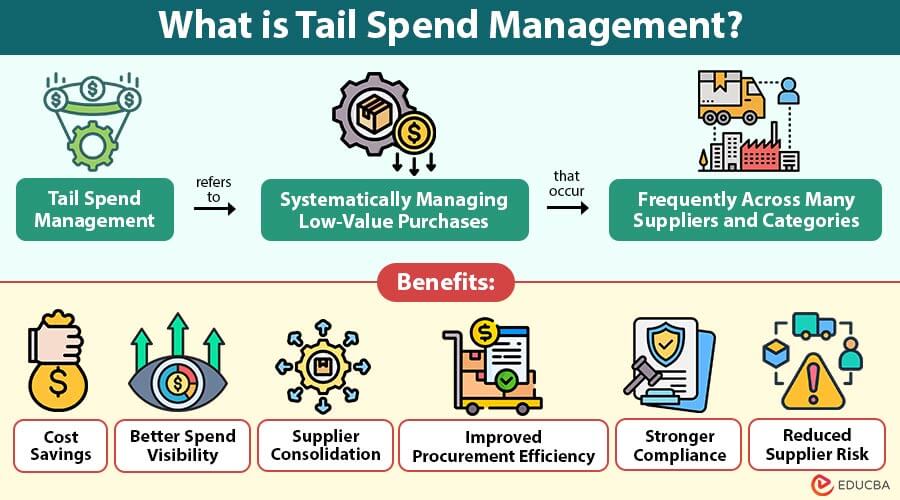
Tail spend management refers to systematically managing low-value purchases that occur frequently across many suppliers and categories. These purchases are often hard to manage because they involve many transactions and suppliers.
For example, a company may work with 50 main suppliers and thousands of small suppliers. Each purchase may cost little, but together they can add up to high costs.
Table of Contents:
- Meaning
- Importance
- Working
- Benefits
- Challenges
- Strategies
- Technology
- Best Practices
- Key Metrics
- Use Cases
Key Takeaways:
- Tail spend management gives organizations better visibility into scattered purchases, helping them find savings and control procurement costs.
- Supplier consolidation reduces the number of suppliers, makes buying easier, and helps organizations get better prices.
- Automation and guided buying make regular purchases easier and help employees use approved suppliers and buying methods.
- Effective tail spend management improves compliance, reduces supplier risks, and supports better procurement performance.
Why is Tail Spend Management Important?
How Does Tail Spend Management Work?
A structured tail spend management process generally involves several stages.
1. Collect Spend Data
2. Analyze Spending
After collecting the data, procurement teams group purchases by supplier, product, department, location, category, value, and frequency. This helps find duplicate suppliers, extra purchases, price differences, and ways to combine purchases.
3. Identify Tail Spend
Organizations then set criteria to identify tail spend. These criteria may include transaction value, supplier volume, purchase frequency, and strategic importance. For example, purchases below a specific spending threshold may be classified as tail spend.
4. Consolidate Suppliers
Companies can find suppliers that offer similar products or services and decide whether to use fewer suppliers. Fewer suppliers can help get better prices, make supplier management easier, and reduce paperwork.
5. Introduce Procurement Controls
Organizations can establish preferred supplier lists, purchasing policies, approval workflows, catalogs, and spending limits. These controls encourage employees to purchase through approved channels.
6. Monitor and Optimize
Tail spend management is not a one-time exercise. Organizations should continuously monitor spending, supplier performance, compliance, and savings opportunities.
Benefits of Tail Spend Management
Below are the key benefits of managing tail spend effectively:
1. Cost Savings
Reduces procurement costs by consolidating suppliers, negotiating better prices, and eliminating unnecessary spending across numerous transactions.
2. Better Spend Visibility
Provides clear insight into fragmented purchases, helping procurement teams understand spending patterns and align purchases with business requirements.
3. Supplier Consolidation
4. Improved Procurement Efficiency
Automates small purchases and reduces manual work with approved catalogs, easy buying tools, and automatic processes.
5. Stronger Compliance
Encourages employees to follow procurement policies by consistently directing purchases to approved suppliers and authorized purchasing channels.
6. Reduced Supplier Risk
Improves supplier risk management by enabling organizations to evaluate financial stability, compliance, cybersecurity, quality, and delivery performance.
Common Challenges in Tail Spend Management
Despite its benefits, managing tail spend can be challenging.
1. Fragmented Data
Procurement data may exist across multiple systems, departments, subsidiaries, and locations. Inconsistent data makes it difficult to identify the true size of tail spend.
2. Large Number of Suppliers
Organizations may have thousands of suppliers involved in low-value transactions. Reviewing every supplier manually is inefficient.
3. Employee Buying Behavior
Employees may prefer familiar suppliers or buying methods instead of approved channels. Clear rules and easy buying options can help change these habits.
4. Limited Procurement Resources
5. Lack of Standardization
Different departments may purchase similar products at different prices or use different suppliers. This makes it harder to achieve consistent procurement outcomes.
Tail Spend Management Strategies
Organizations can use the following simple strategies to manage tail spend effectively.
1. Use Spend Analytics
2. Use Guided Buying
Guided buying helps employees choose approved suppliers, products, and buying methods. It reduces purchases made outside company agreements and makes buying easier.
3. Create Preferred Supplier Programs
Preferred supplier programs encourage employees to buy from selected suppliers. These suppliers can offer better prices and terms for regular purchases.
4. Automate Low-Value Purchases
Automating small purchases can make requests, approvals, purchase orders, invoices, and payments easier. It also saves time and reduces manual work.
5. Set Clear Procurement Policies
Clear procurement policies explain which suppliers employees can use, spending limits, approval rules, and buying methods. This helps employees follow the same purchasing process.
6. Review Supplier Performance Regularly
Regular supplier reviews check price, quality, delivery, service, and rule-following. This helps businesses replace poor suppliers and reduce the number of suppliers when needed.
Technology in Tail Spend Management
Organizations can use these simple ways to manage tail spend better:
1. Set Clear Tail-Spend Rules
Set simple rules for tail spend based on purchase value, how often items are bought, purchase type, and number of suppliers.
2. Keep Spend Data in One Place
Put buying data from different systems and teams in one place. This makes it easier to see and check company spending.
3. Group Suppliers
Group suppliers by spending, importance, risk, and performance. This helps find suppliers that can be combined or removed.
4. Find Big Savings
Look for areas where the company can save money. This can include better supplier prices, fewer suppliers, and simpler buying methods.
5. Automate Regular Tasks
Use procurement software to handle regular tasks such as buying, approvals, and invoices. This saves time, reduces manual work, and lowers errors.
6. Make Buying Easy for Employees
Make buying process simple and easy to follow. This helps employees use approved suppliers and follow company buying rules.
7. Check Buying Rules
Regularly check purchases made outside approved suppliers, contracts, or buying methods. This helps find problems, save money, and follow company buying rules.
Key Metrics for Measuring Tail Spend Management
Organizations can use these simple metrics to check and improve tail spend management:
1. Tail Spend as a Percentage of Total Procurement Spend
Shows how much of the total spending comes from small and scattered purchases.
2. Number of Active Suppliers
Shows how many suppliers the company currently uses. A high number may mean some suppliers can be combined or removed.
3. Supplier Consolidation Rate
Shows the percentage of suppliers that have been reduced or combined. This can help lower costs and make supplier management easier.
4. Maverick Spending Rate
Shows how much employees spend without using approved suppliers, contracts, or buying methods. A high rate may show that employees are not following company buying rules.
5. Procurement Savings
Shows how much money the company saves by getting lower prices, using fewer suppliers, buying better, and avoiding extra purchases.
6. Contract Compliance Rate
Shows how often employees use approved contracts when buying products or services. This helps check whether company buying rules are being followed.
7. Purchase Order Processing Costs
Shows how much it costs to create, approve, and manage purchase orders. Lower costs mean the buying process is more efficient.
Use Cases
Tail spend management can be used in many areas of a business.
1. Office Supplies
2. IT Products and Services
Companies can manage small software plans, computer items, cloud services, and technical support. This helps control spending and avoid extra costs.
3. Marketing
Businesses can manage small buys like printing, ads, design work, and event items. This helps save money and makes buying easier.
4. Facilities Management
Companies can manage cleaning items, repair work, maintenance services, and equipment purchases. Using fewer suppliers can help control costs.
5. Professional Services
Final Thoughts
Tail spend management helps companies control small and scattered purchases by improving spending visibility, reducing suppliers, automating tasks, and following buying rules. It can help lower costs, make purchasing easier, reduce supplier risks, and support better business decisions.
Frequently Asked Questions (FAQs)
Q1. Who is responsible for managing tail spend in an organization?
Answer: Procurement teams usually lead tail spend initiatives, while finance, operations, IT, and employees also contribute through purchasing and supplier decisions.
Q2. Can small suppliers still be valuable despite being part of tail spend?
Answer: Yes. A low-spend supplier may provide specialized products, local services, emergency support, or capabilities that larger suppliers cannot easily replace.
Q3. How can companies determine whether a tail spend initiative is successful?
Answer: Evaluate success by comparing savings, purchasing efficiency, supplier quality, employee adoption, process costs, and compliance improvements before and after implementation.
Q4. Should every small supplier be removed from the supplier base?
Answer: No. Supplier reduction should consider business necessity, risk, service quality, uniqueness, and replacement options rather than focusing only on transaction value.
Recommended Articles
We hope that this EDUCBA information on “Tail Spend Management” was beneficial to you. You can view EDUCBA’s recommended articles for more information.


