


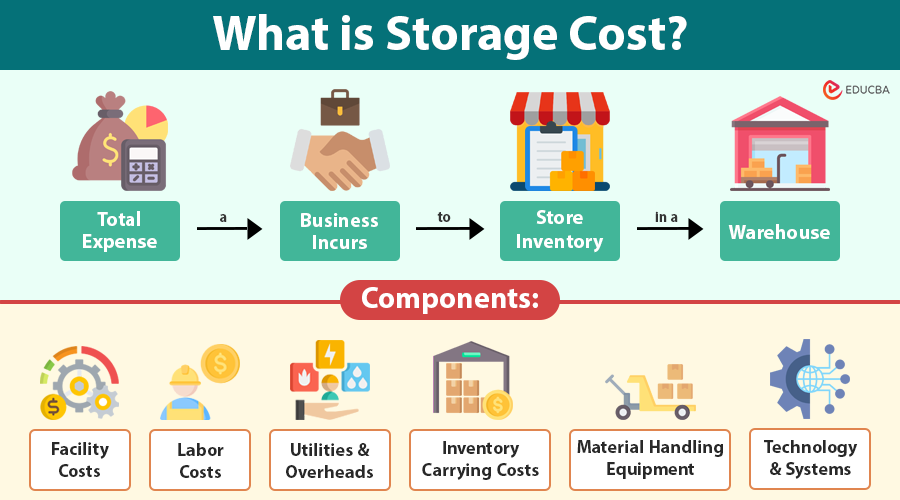
What Is Storage Cost?
Storage cost refers to the total amount a business spends to maintain its inventory, raw materials, or finished products in a warehouse or storage facility. It is a crucial part of inventory management and the overall supply chain process, impacting both operational efficiency and profitability.
Every business that handles physical goods, from manufacturers and wholesalers to retailers and e-commerce companies, must allocate a portion of its budget to storage costs. These costs cover not only the physical space but also the associated resources required to maintain that space, including labor, equipment, and utilities.
For example, a company spends $1,200 per month to rent a warehouse and $800 on labor, utilities, and insurance. If it stores 10,000 products, the storage cost per product is:
($1,200 + $800) ÷ 10,000 = $0.20 per
Table of Contents
- Meaning
- Components
- How to Calculate?
- Factors Affecting
- Strategies to Reduce Cost
- Importance of Managing Cost
- Example
Components of Storage Cost
Storage costs comprise several interrelated components. Breaking them down helps identify which areas can be optimized or reduced.
1. Facility Costs
These are the direct costs of owning or renting warehouse space. They include:
- Rent or lease payments: Regular monthly or annual payments for warehouse premises.
- Property taxes and insurance: Compulsory payments that protect against property-related risks.
- Building maintenance: Repairs, cleaning, pest control, and upkeep of the premises.
- Depreciation: For owned facilities, this represents the gradual reduction in the building’s value over time.
Facility costs often make up the largest portion of total storage costs, especially for businesses with multiple or large warehouses.
2. Labor Costs
Labor costs cover the wages, salaries, and benefits paid to employees working in the warehouse, including:
- Warehouse managers and supervisors.
- Forklift operators and loaders.
- Quality control and packaging staff.
- Administrative personnel oversee inventory systems.
Labor efficiency has a major impact on overall storage cost. Poor workflow, lack of training, or excessive overtime can quickly drive up these costs. Many businesses are turning to automation and process optimization to reduce manual dependency and enhance productivity.
3. Utilities and Overheads
Warehouses consume significant amounts of electricity, water, and gas. These expenses include:
- Electricity for lighting and equipment
- Heating, cooling, and ventilation systems (HVAC)
- Water and sanitation
- Security and surveillance systems.
Energy-efficient systems, solar panels, and motion-activated lighting can help reduce these recurring costs. For temperature-sensitive goods, maintaining ideal conditions is essential, but it can be expensive.
4. Inventory Carrying Costs
Inventory carrying cost (also known as holding cost) represents the cost of storing unsold goods. It includes:
- Insurance premiums to protect inventory.
- Shrinkage or damage from theft, spoilage, or mishandling.
- Obsolescence costs due to outdated or expired products.
- Opportunity cost refers to the value of the money invested in inventory instead of using it for other profitable purposes.
Carrying costs typically account for 20% to 30% of the total value of inventory each year. Reducing excess inventory through accurate forecasting can significantly lower this expense.
5. Material Handling Equipment
This includes all tools and machinery used for moving and storing goods, such as:
- Forklifts, cranes, and conveyors.
- Pallets, shelving, and racking systems.
- Barcode scanners and labeling machines.
- Repair and maintenance costs for the equipment.
Although automation and modern systems can have high upfront costs, they often pay off through long-term savings and improved accuracy.
6. Technology and Systems
Technology is an increasingly vital part of warehouse management. Costs in this category include:
- Warehouse Management Systems (WMS) and ERP integrations.
- Cloud-based inventory tracking and reporting software.
- IoT devices and sensors for monitoring stock and conditions.
- Cybersecurity and IT maintenance.
Investing in smart technology enhances efficiency, reduces human errors, and provides real-time data, all of which contribute to lower long-term storage costs.
How to Calculate Storage Cost?
Calculating storage cost helps businesses understand how much they spend per product or per unit of space, allowing for better budgeting and pricing decisions.
Basic Formula:
Example:
If your monthly warehouse expenses total $20,000 and the average number of units stored is 10,000, then:
$20,000÷10,000=$2 per unit
This means each unit incurs a storage cost of $2 per month.
Factors Affecting Storage Cost
Several factors influence how high or low your storage costs are:
- Warehouse location: Urban or prime areas have higher rent and utility expenses.
- Storage duration: The longer goods are stored, the higher the total cost will be.
- Inventory turnover rate: Slow-moving inventory ties up space and capital.
- Seasonality: Temporary spikes in demand during peak seasons may require additional storage.
- Product characteristics: Bulky or perishable goods demand special conditions.
- Technology level: Automation can reduce labor costs but involves initial setup costs.
- Energy efficiency: Modern, eco-friendly systems lower long-term operating costs.
Understanding these factors helps businesses decide the best and most cost-effective way to store their goods. In practice, businesses also monitor external space-market conditions and storage demand trends when evaluating warehousing or overflow options; industry resources such as StorageCafe’s market data can provide useful context.
Strategies to Reduce Storage Cost
Reducing storage costs requires a mix of strategic planning, technology, and operational efficiency. Here are proven methods businesses can adopt:
1. Optimize Inventory Levels
Implement inventory control methods such as Just-in-Time (JIT), ABC analysis, or Economic Order Quantity (EOQ) to balance supply and demand efficiently. This reduces overstocking and minimizes carrying costs.
2. Improve Warehouse Layout and Design
Maximize available space through vertical storage, narrow-aisle shelving, and smart layout planning. Efficient layouts reduce travel time for workers and enhance workflow efficiency.
3. Leverage Third-Party Logistics (3PL)
Partnering with a 3PL provider allows you to outsource storage and distribution functions. This eliminates the need to maintain your own facility and offers scalability as your business grows.
4. Automate Warehouse Operations
Use automated picking systems, barcode scanners, robots, and WMS tools to reduce human error and increase efficiency. Automation can significantly cut long-term labor and operational costs.
5. Negotiate Better Contracts
Negotiate long-term rental agreements for lower rates or explore shared warehousing arrangements with other companies to minimize costs associated with unused space.
6. Regularly Audit Inventory
Conduct periodic audits to identify obsolete, slow-moving, or damaged items. Liquidating such stock frees up space and reduces carrying costs.
7. Implement Energy-Efficient Solutions
Switch to LED lighting, install smart thermostats, and optimize energy usage. These small changes can substantially reduce overhead expenses.
Importance of Managing Storage Cost
Effective management of storage costs provides multiple business benefits:
- Enhances profitability: Lower costs mean higher profit margins.
- Improves cash flow: Reduces capital tied up in unsold goods.
- Boosts competitiveness: Enables better pricing strategies.
- Supports scalability: Efficient storage management facilitates smooth growth.
- Improves customer satisfaction: Effective inventory control ensures timely order fulfillment, which in turn boosts customer satisfaction and loyalty.
Well-managed storage costs ensure a business remains lean, flexible, and resilient in a dynamic marketplace.
Example of Storage Cost
A mid-sized e-commerce retailer dealing in consumer electronics faced rising storage costs due to increased returns and overstocking. By adopting a Warehouse Management System (WMS) and partnering with a 3PL provider for certain operations, the company achieved:
- 25% reduction in storage space usage.
- 30% decrease in labor costs.
- 15% faster order fulfillment rate.
This transformation not only reduced expenses but also improved overall supply chain efficiency.
Final Thoughts
Storage costs are more than just warehouse rent; they encompass a blend of facility, labor, technology, and capital expenses that directly impact business performance. Understanding and managing these costs is crucial to achieving supply chain optimization, effective cost control, and sustainable profit growth.
By leveraging technology, meticulous planning, and streamlined operations, businesses can reduce storage costs while maintaining high service quality and ensuring timely deliveries.
Frequently Asked Questions (FAQs)
Q1. What is the difference between storage cost and warehousing cost?
Answer: Storage cost refers to the overall expense of holding inventory, including rent, labor, and utilities, while warehousing cost typically focuses on the physical space and facility expenses. In short, warehousing cost is a component of the total storage cost.
Q2. How do storage costs impact product pricing?
Answer: Storage costs increase the total cost of goods sold (COGS). Businesses often factor these expenses into their pricing strategies to maintain profit margins. Higher storage costs may lead to higher product prices.
Q3. Are storage costs considered fixed or variable expenses?
Answer: Storage costs can be both. Rent and insurance usually remain fixed, while labor, utilities, and equipment maintenance vary based on inventory volume and warehouse activity levels.
Q4. What are some hidden storage costs businesses often overlook?
Answer: Commonly overlooked costs include equipment maintenance, inventory shrinkage, disposal of obsolete stock, and software subscription fees for warehouse management tools.
Q5. How do seasonal fluctuations affect storage costs?
Answer: During peak seasons, businesses often require additional space or temporary warehousing, resulting in short-term spikes in storage expenses. Effective demand forecasting can help reduce such seasonal cost variations.
Recommended Articles
We hope this guide on storage cost helps you understand how businesses calculate, manage, and optimize their warehouse expenses for better efficiency. Explore these articles for deeper insights into inventory management, supply chain optimization, and cost control strategies in business operations.


