
What is Statutory Merger?
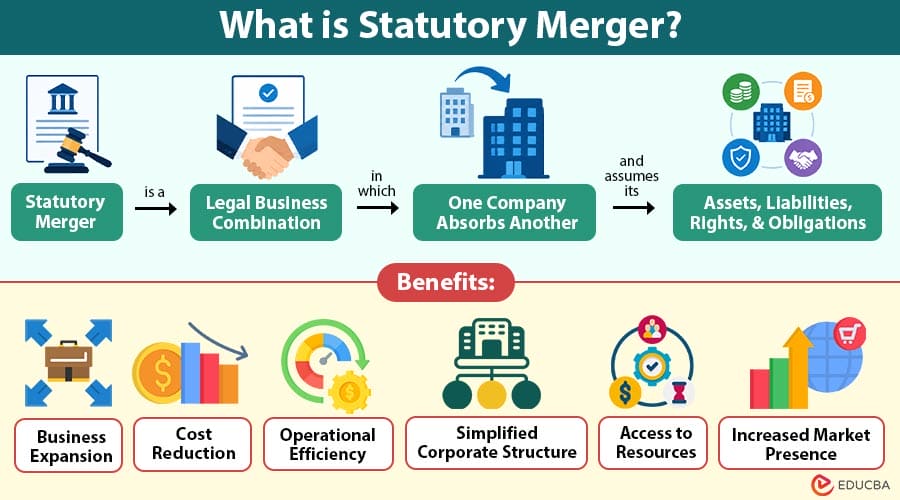
A statutory merger is a legal business combination in which one company absorbs another and assumes its assets, liabilities, rights, and obligations. The merged company ceases to exist as separate legal entity after the transaction.
Table of Contents:
- Meaning
- Working
- Types
- Example
- Benefits
- Challenges
- Difference
- Factors to Consider Before a Statutory Merger
- Who Uses Statutory Mergers?
Key Takeaways:
- A statutory merger combines two or more companies into a legally recognized business entity.
- The surviving company assumes the assets and liabilities of the merged company.
- The company that does not survive generally ceases to exist as a separate legal entity.
- Shareholder, regulatory, and legal approvals may be required.
- Statutory mergers can reduce duplication and simplify corporate structures.
How Does a Statutory Merger Work?
A statutory merger follows a structured legal and business process. The exact requirements vary by jurisdiction and companies involved.
1. Strategic Planning
The companies first determine why they want to combine. Common objectives include expanding into the new markets, reducing operating costs, combining complementary capabilities, or restructuring ownership. Management evaluates the potential financial, operational, and strategic effects of the proposed transaction.
2. Due Diligence
The companies conduct due diligence to examine important aspects of the businesses. This may include:
- Financial statements
- Assets and liabilities
- Contracts
- Intellectual property
- Tax obligations
- Employee arrangements
- Legal disputes
- Regulatory requirements
Due diligence helps identify potential risks before the merger becomes legally effective.
3. Valuation and Merger Terms
The companies determine how to structure the transaction. The agreement may specify the consideration offered to shareholders, treatment of existing shares, employee arrangements, governance provisions, and other transaction terms.
4. Approval of the Merger
The proposed merger is submitted for approval according to applicable corporate and securities laws. Depending on the jurisdiction and transaction structure, approval may involve boards of directors, shareholders, courts, regulators, creditors, or other authorities.
5. Legal Completion
After receiving the required approvals and satisfying closing conditions, the merger becomes legally effective on the specified effective date. In most cases, the surviving business takes on the pertinent rights, obligations, liabilities, and assets of the combined business.
6. Integration
Following completion, the surviving company integrates the businesses. Integration may involve combining employees, technology, financial systems, facilities, brands, customer operations, and management structures.
Types of Statutory Merger
Statutory mergers can take different types, depending on the companies involved and the transaction’s legal structure.
1. Horizontal Merger
A horizontal merger combines companies in the same industry or market, often to expand operations, reduce competition, or increase sales.
2. Vertical Merger
A vertical merger combines businesses operating at different stages of same supply chain to improve coordination, control costs, or efficiency.
3. Conglomerate Merger
A conglomerate merger combines companies from unrelated industries to diversify business activities, markets, and revenue sources across sectors and markets.
4. Related-Industry Merger
A related-industry merger involves businesses that operate in connected markets but may offer different products or services.
Example of a Statutory Merger
Consider Company A and Company B. Company A is financially stronger and has a larger operational structure. The companies agree to combine through a statutory merger.
After obtaining the required approvals, Company B ceases to exist as a separate legal entity. Company A becomes the surviving company and assumes Company B’s applicable assets, liabilities, contractual rights, and obligations.
Another example could involve two regional banks combining to operate under a single corporate structure. The merger may allow them to consolidate branches, technology platforms, management functions, and other resources.
Benefits of Statutory Merger
A statutory merger can provide several potential benefits when properly structured and implemented.
1. Business Expansion
A merger can provide access to new customers, geographic markets, distribution channels, or business capabilities.
2. Cost Reduction
Combining businesses can reduce duplicated expenses. Functions such as finance, administration, technology, human resources, and procurement may be consolidated.
3. Operational Efficiency
The surviving company can combine complementary resources and processes, potentially improving the efficiency of business operations.
4. Simplified Corporate Structure
When one company legally absorbs another, the resulting structure may be easier to manage than maintaining multiple separate entities.
5. Access to Resources
The surviving company may gain access to the merged company’s technology, intellectual property, employees, facilities, customer relationships, or other resources.
6. Increased Market Presence
Combining businesses can increase the scale of operations and expand the company’s presence in particular markets.
Challenges of Statutory Merger
Although statutory mergers can provide strategic benefits, they also involve significant challenges.
1. Regulatory Complexity
Mergers may require multiple approvals and compliance with corporate, securities, competition, tax, and industry-specific regulations.
2. Integration Difficulties
Combining two organizations can create challenges involving technology, processes, reporting systems, management structures, and business practices.
3. Cultural Differences
Employees from the two companies may have different workplace cultures, policies, and management expectations. These differences can affect integration.
4. Financial Risks
A merger may involve substantial transaction and integration costs. The surviving company may also assume liabilities that were previously associated with the merged company.
5. Employee Uncertainty
Mergers can create uncertainty about roles, reporting structures, compensation, locations, and employment arrangements.
6. Customer Disruption
Changes to products, systems, contracts, or service processes may affect customers during the integration period.
Difference Between Statutory Merger and Acquisition
The table below highlights the differences between the two:
| Basis | Statutory Merger | Acquisition |
| Meaning | Companies legally combine under a merger structure | One company obtains control over another |
| Legal existence | Merged company generally ceases to exist | Acquired company may continue as a separate entity |
| Surviving entity | Usually one company survives | Buyer and target may both remain separate |
| Structure | Governed by merger laws and approved transaction terms | Can involve purchase of shares, assets, or control |
| Integration | Usually involves combining businesses | Integration depends on the acquisition structure |
Factors to Consider Before a Statutory Merger
Companies generally evaluate several factors before proceeding with a statutory merger:
1. Strategic Objectives
Companies should assess whether the merger supports their long-term goals, market expansion plans, operational priorities, and overall business strategy.
2. Financial Condition
Companies should review revenue, profitability, debt, cash flow, assets, liabilities, and financial stability before proceeding with the merger.
3. Valuation
Accurate valuation of both companies helps determine a fair transaction structure, purchase consideration, ownership interests, and potential financial risks.
4. Regulatory Requirements
Companies must identify applicable laws, approvals, filings, and regulatory requirements to ensure the merger complies with relevant legal standards.
5. Tax Implications
Businesses should evaluate potential tax liabilities, benefits, restructuring consequences, and changes in tax obligations resulting from the merger transaction.
6. Legal Liabilities
Companies should examine existing contracts, lawsuits, obligations, compliance issues, and other legal liabilities that could affect the combined business.
7. Competition Considerations
Companies should assess whether the merger could affect market competition, customer choices, pricing, or compliance with applicable antitrust requirements.
Who Uses Statutory Mergers?
Statutory mergers can be used by various types of organizations, including:
1. Public Companies
Public companies may use statutory mergers to combine operations, expand market presence, strengthen resources, and achieve long-term corporate growth objectives.
2. Private Companies
Private companies may pursue statutory mergers to expand business operations, access new capabilities, combine resources, or enter new markets.
3. Financial Institutions
Financial institutions may use statutory mergers to consolidate operations, expand customer bases, strengthen financial resources, and improve service capabilities.
4. Technology Businesses
Technology businesses may pursue mergers to combine intellectual property, technology platforms, skilled teams, products, and market opportunities for business expansion.
5. Manufacturing Companies
Manufacturing companies may use statutory mergers to increase production capacity, combine facilities, improve supply chains, and strengthen operational efficiency.
6. Retail Businesses
Retail businesses may pursue statutory mergers to expand store networks, combine distribution systems, increase customer reach, and strengthen market operations.
7. Healthcare Organizations
Healthcare organizations may use statutory mergers to combine facilities, healthcare services, expertise, technologies, and administrative resources for broader service delivery.
Final Thoughts
A statutory merger is a legally structured business combination in which one company survives and another company ceases to exist as separate legal entity. The surviving company generally assumes the relevant assets, liabilities, rights, and obligations of merged company. Successful execution requires strategic planning, due diligence, valuation, regulatory compliance, approvals, and effective post-merger integration.
Frequently Asked Questions (FAQs)
Q1. Does a statutory merger require a merger agreement?
Answer: Yes, the transaction generally involves a formal merger agreement or similar legal document that establishes the terms and conditions of the combination.
Q2. What happens to contracts after a statutory merger?
Answer: Contracts may transfer to the surviving company according to applicable law and the terms of those agreements, although certain contracts may require additional consent.
Q3. How does a statutory merger affect employees?
Answer: Employees may experience changes in reporting relationships, responsibilities, workplace policies, compensation structures, or employment arrangements following the merger.
Q4. Can a statutory merger be cancelled after approval?
Answer: Cancellation may be possible before the merger becomes legally effective, depending on the transaction documents, applicable laws, approvals, and specific circumstances.
Recommended Articles
We hope that this EDUCBA information on “Statutory Merger” was beneficial to you. You can view EDUCBA’s recommended articles for more information.


