
What is Hyperbolic Discounting?
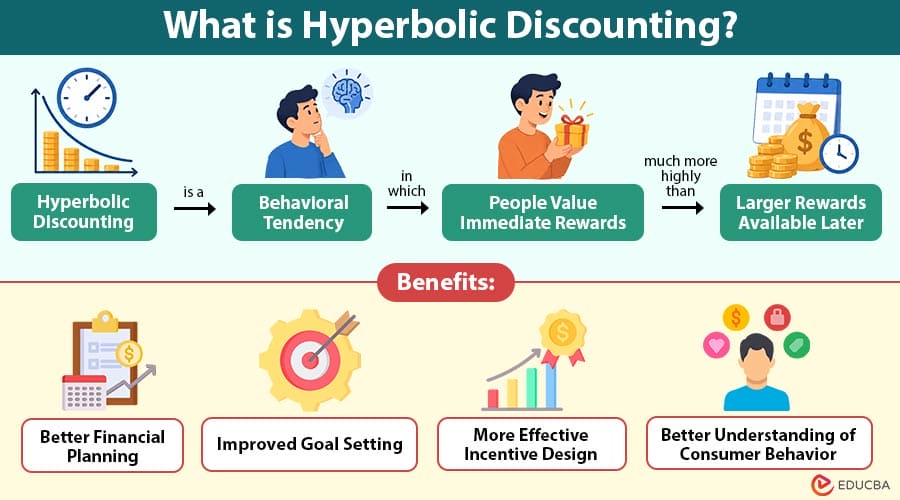
Hyperbolic discounting is a behavioral tendency in which people value immediate rewards much more highly than larger rewards available later. It explains why individuals may choose a smaller benefit today instead of waiting for a greater benefit later.
Unlike traditional economic models that often assume a consistent discount rate over time, hyperbolic discounting suggests that a reward’s perceived value decreases rapidly as the delay increases. However, as the delay becomes longer, the rate of decline becomes less pronounced.
For example, a person may prefer receiving ₹500 today rather than ₹600 next month but choose ₹600 in one year rather than ₹500 in eleven months. This change in preference occurs because the immediate reward is valued disproportionately more.
Hyperbolic discounting helps explain behaviors related to saving, spending, studying, health decisions, investing, and other situations involving present and future rewards.
Table of Contents:
- Meaning
- Working
- Types
- Examples
- Difference
- Why Does Hyperbolic Discounting Occur?
- Effects
- Benefits
- Limitations
- Applications
- How to Manage Hyperbolic Discounting?
Key Takeaways:
- Hyperbolic discounting shows how perceived reward value varies with timing and personal circumstances.
- Preference reversals can occur when individuals reassess choices as waiting periods become shorter.
- The concept helps explain inconsistent decisions across financial, educational, workplace, and personal situations.
- Recognizing time-based preferences can support strategies that encourage more deliberate and goal-oriented choices.
How Does Hyperbolic Discounting Work?
Hyperbolic discounting describes how people mentally reduce the value of future rewards. The closer a reward is to the present, the more strongly its timing can influence its perceived value.
A commonly used mathematical representation is:
Where:
- V = Present value of the delayed reward
- A = Actual value of the reward
- k = Discounting parameter
- D = Delay until receiving the reward
A higher value of k indicates stronger discounting of delayed rewards.
For instance, suppose someone can receive ₹1,000 immediately or ₹1,200 after one month. The person may select ₹1,000 because the immediate benefit feels more valuable. If both options are moved further into the future, the same person may prefer ₹1,200 because the difference in waiting time matters less.
This changing preference is central to hyperbolic discounting.
Types of Hyperbolic Discounting
Hyperbolic discounting can appear in different types depending on the decision and the timing of rewards.
1. Financial Hyperbolic Discounting
Financial hyperbolic discounting occurs when individuals favor immediate spending or consumption over larger financial benefits available after a longer period.
2. Health-Related Hyperbolic Discounting
Health-related hyperbolic discounting occurs when individuals choose immediate pleasure or comfort over healthier outcomes that require consistent effort and patience.
3. Academic Hyperbolic Discounting
Academic hyperbolic discounting occurs when students choose immediate enjoyable activities over studying or completing tasks that provide future educational benefits.
4. Workplace Hyperbolic Discounting
Workplace hyperbolic discounting occurs when employees or managers prioritize convenient immediate outcomes over actions that could produce greater long-term organizational benefits.
Examples of Hyperbolic Discounting
Below are common examples showing how people may prioritize immediate rewards over greater future benefits.
1. Saving Money
A person plans to save ₹5,000 every month but spends part of the amount on immediate purchases. The future financial benefit feels less valuable than current consumption.
2. Exercise
Someone may choose to relax after work instead of exercising because relaxation provides immediate comfort, while fitness benefits develop gradually.
3. Investment
An investor may avoid a long-term investment because the benefits are distant, even when the investment could create greater value over time.
4. Discount Offers
A customer may purchase an unnecessary product because of an immediate discount, even though keeping the money could provide greater value later.
Difference Between Hyperbolic Discounting and Exponential Discounting
The table below highlights the differences between the two:
| Basis | Hyperbolic Discounting | Exponential Discounting |
| Time preference | Changes with time | Remains relatively consistent |
| Immediate rewards | Strongly preferred | Discounted at a constant rate |
| Preference changes | Can occur as deadlines approach | Less likely under the model |
| Behavioral realism | Often captures observed behavior | Provides a simpler theoretical model |
| Common use | Behavioral economics | Traditional economic modeling |
Why Does Hyperbolic Discounting Occur?
Several factors can contribute to hyperbolic discounting.
1. Immediate Gratification
Immediate rewards offer instant satisfaction, making them more appealing than future benefits that require patience, waiting, or delayed gratification now.
2. Uncertainty About the Future
Future outcomes involve uncertainty, so individuals may prefer immediate benefits because their availability and value feel more predictable.
3. Limited Self-Control
Limited self-control makes it difficult for individuals to resist immediate temptations, even when they understand the advantages of choosing rewards.
4. Emotional Influence
Emotions such as stress or excitement can increase focus on immediate rewards and reduce attention toward longer-term consequences and benefits.
5. Salience of Present Outcomes
Present outcomes are visible and easier to imagine than distant rewards, making immediate benefits seem more important in decision-making.
Effects of Hyperbolic Discounting
Hyperbolic discounting can influence personal and organizational decisions in several ways.
1. Increased Impulsive Spending
Individuals may choose immediate purchases or entertainment over saving money for important future financial goals and planned expenses.
2. Lower Savings
A preference for immediate consumption can reduce the money available for future needs, investments, emergencies, or retirement planning.
3. Difficulty Maintaining Long-Term Goals
Individuals may establish meaningful long-term objectives but struggle to maintain consistent progress when attractive immediate alternatives become available.
4. Short-Term Business Decisions
Organizations may prioritize immediate cost savings or revenue opportunities instead of investments that could generate greater long-term operational benefits.
Benefits of Understanding Hyperbolic Discounting
Although hyperbolic discounting can create challenges, understanding the concept can help individuals and organizations make better decisions.
1. Better Financial Planning
Recognizing the preference for immediate rewards can encourage people to create automatic savings systems and spending limits.
2. Improved Goal Setting
Breaking long-term objectives into smaller milestones can make future rewards feel more immediate.
3. More Effective Incentive Design
Organizations can structure rewards so that desirable behaviors receive timely reinforcement.
4. Better Understanding of Consumer Behavior
Marketers and researchers can use the concept to understand why customers respond strongly to immediate discounts, rewards, and benefits.
Limitations of Hyperbolic Discounting
Below are the key limitations that can affect how accurately hyperbolic discounting explains real-world decision-making.
1. Individual Differences
People have different preferences for immediate and future rewards, so the model may not accurately represent everyone’s decision-making behavior.
2. Influence of External Factors
Income, risk, emotions, social circumstances, and past experiences can affect decisions beyond hyperbolic discounting.
3. Intentional Delayed Choices
People with clear goals, strong financial knowledge, or effective planning skills may deliberately choose larger future rewards.
4. Changing Preferences
An individual’s preference for immediate or delayed rewards may change depending on the situation, context, or the decision’s importance.
5. Measurement Challenges
Accurately measuring individual discounting behavior can be difficult because preferences may vary across different rewards, time periods, and circumstances.
Applications of Hyperbolic Discounting
Hyperbolic discounting is applied across several fields to understand and address decisions involving immediate and future outcomes.
1. Behavioral Economics
Economists use hyperbolic discounting to study how individuals evaluate present rewards against delayed benefits and make time-related decisions.
2. Personal Finance
Financial professionals consider present-focused preferences when developing saving, investment, budgeting, and retirement strategies that encourage stronger long-term financial planning.
3. Marketing
Marketers use the concept to understand how immediate rewards, limited-time offers, discounts, and incentives can influence customer purchasing decisions.
4. Healthcare
Healthcare programs can provide immediate incentives to encourage individuals to adopt behaviors that offer greater health benefits over longer periods.
5. Education
Educational institutions can use short-term milestones, feedback, and rewards to motivate students toward completing tasks with distant academic benefits.
6. Public Policy
Policymakers can design incentives and programs that make future benefits more noticeable while encouraging behaviors that support long-term social outcomes.
How to Manage Hyperbolic Discounting?
Individuals can use several practical approaches to reduce the influence of immediate rewards on long-term decisions.
1. Automate Savings
By automatically moving funds into savings or investing accounts, people can make fewer decisions and continue to make steady progress toward their long-term financial objectives.
2. Set Commitment Rules
Predefined rules and restrictions can reduce impulsive choices and make it easier to remain committed when immediate temptations arise.
3. Break Goals into Milestones
Dividing long-term objectives into smaller milestones makes progress easier to track and provides more immediate motivation to achieve larger goals.
4. Delay Nonessential Purchases
Waiting before making nonessential purchases gives individuals time to reconsider their choices and reduces decisions driven by immediate gratification.
5. Make Future Outcomes Visible
Clearly estimating future financial, academic, or personal benefits can make delayed rewards more tangible and encourage stronger long-term decision-making.
Final Thoughts
Hyperbolic discounting explains why people often favor immediate rewards over larger future benefits and may change their preferences as waiting periods shift. It provides useful insight into spending, saving, procrastination, health, education, and business decisions. Understanding this behavior can help individuals and organizations develop strategies that support more consistent long-term decision-making.
Frequently Asked Questions (FAQs)
Q1. Can hyperbolic discounting affect business decisions?
Answer: Yes. Managers may favor immediate cost reductions or short-term results instead of investments that could provide greater benefits over a longer period.
Q2. What is present bias in hyperbolic discounting?
Answer: Present bias is the tendency to give greater importance to immediate outcomes than to comparable outcomes that occur later.
Q3. Does hyperbolic discounting influence purchasing behavior?
Answer: Yes. Consumers may give greater importance to immediate discounts, free gifts, or instant rewards when deciding whether to purchase a product.
Q4. Is hyperbolic discounting always associated with poor decisions?
Answer: No. Choosing an immediate reward can be reasonable when the immediate benefit is valuable, the future outcome is uncertain, or waiting provides little additional value.
Recommended Articles
We hope that this EDUCBA information on “Hyperbolic Discounting” was beneficial to you. You can view EDUCBA’s recommended articles for more information.


