


What Is Sociocracy?
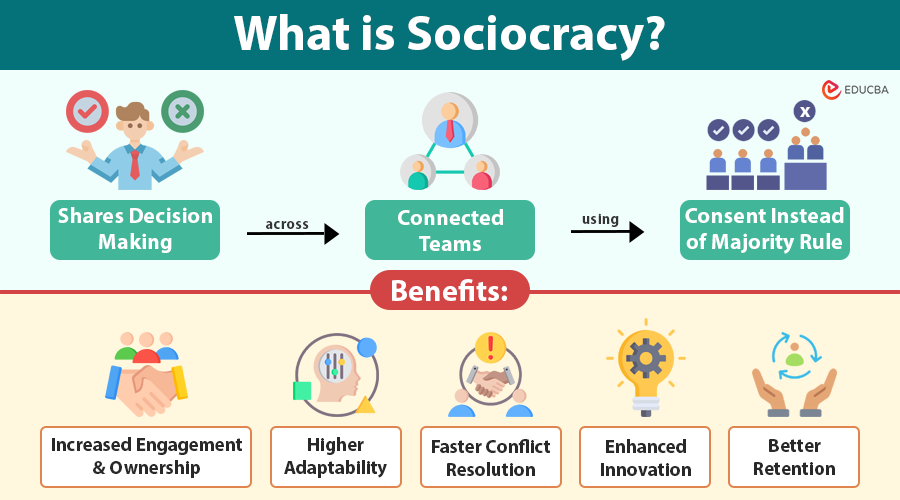
Sociocracy is a system of organizational governance in which decision-making power is distributed among semi-autonomous, interlinked teams (called circles) using consent-based decision-making rather than majority voting. It aims to ensure that everyone affected by a decision has a voice, striking a balance between effectiveness and equality.
For example, imagine a school where teachers, parents, and students form circles to decide on new school rules. They present a proposal for a new uniform policy. Instead of voting, the group uses a consent-based approach: they approve it if no one has a serious, reasoned objection. A student objects, pointing out that the uniform’s material is uncomfortable. The circle discusses and adjusts the proposal to include a softer fabric, and then everyone gives their consent.
Table of Contents
- Meaning
- Historical Background
- Core Principles
- Benefits
- Sociocracy vs. Traditional Hierarchy
- Challenges
- Real-World Examples
- Sociocracy vs. Holacracy
- How to Get Started?
- Future
Key Takeaways
- Sociocracy distributes decision-making through semi-autonomous circles, striking a balance between efficiency and inclusivity.
- Members empower decision-making by raising reasoned objections; otherwise, proposals proceed with the consent of the majority.
- Core principles, such as double-linking and elections by consent, build transparency, accountability, and trust.
- Organizations adopting sociocracy report higher employee engagement, faster conflict resolution, and better adaptability.
- Sociocracy is flexible enough to work across sectors — from cooperatives to schools to commercial enterprises — while preserving democratic participation.
Historical Background
The roots of sociocracy date back to the 19th century, when philosopher Auguste Comte proposed a society governed scientifically and collaboratively by its people. However, practical implementation did not begin until the mid-20th century.
In the 1970s, Dutch engineer Gerard Endenburg, inspired by cybernetics (the science of self-regulating systems), developed the Sociocratic Circle Organization Method (SCM). He applied these ideas in his family’s electrical engineering firm, Endenburg Elektrotechniek, to avoid the authoritarian methods he disliked while still maintaining effectiveness.
By using structured circles, consent-based decision-making, and double-linking between teams, Endenburg created a living example of a new kind of governance. His model rapidly gained recognition in the Netherlands and beyond, especially among cooperatives, schools, and non-governmental organizations.
Since then, sociocracy has continued to evolve further through movements like Sociocracy 3.0 and the international nonprofit Sociocracy for All, with plans to reach practitioners in over 40 countries by 2024.
Core Principles of Sociocracy
Sociocracy relies on four foundational principles at its core:
1. Consent Decision-Making
- Proposals move forward if there is no paramount and reasoned objection.
- This creates an environment where people feel safe to share their concerns openly and respectfully.
- Unlike consensus, it does not require everyone to love the proposal — only that they see no risk to the group’s objectives.
- A 2023 Sociocracy for All survey showed that 85% of sociocratic proposals pass in the first round, demonstrating high process efficiency.
2. Circle Organization
- Semi-autonomous circles handle different domains of work within the organization.
- Circles have the power to make decisions about their area of work, which builds a sense of ownership and responsibility among members.
- Circles can be nested (like subcommittees) or linked horizontally, creating a flexible network structure.
3. Double Linking
- Each circle stays connected to the next higher circle through two people: one who leads the circle and another who represents its members (the delegate).
- This ensures two-way communication, accountability, and mutual understanding across the hierarchy of circles.
- Research on organizational resilience (Hollnagel, 2022) suggests that double-linking is a best practice for robust information flow.
4. Elections by Consent
- Members openly nominate and give consent to fill roles such as circle facilitators or representatives.
- This prevents hidden biases and ensures that the group accepts the person in the role.
- People revisit elections regularly so they can adjust roles as individuals develop or circumstances change.
Benefits of Sociocracy
Organizations that have adopted sociocracy often cite a range of benefits that go beyond just “fairer” decision-making:
- Increased engagement and ownership: Employees feel their voice matters, which boosts morale and motivation. Studies by Sociocracy for All (2022) showed a 79% improvement in perceived job satisfaction after sociocratic implementation.
- Higher adaptability: Circles can respond faster to changing conditions because decision-making is local and flexible.
Research in agile organizations (McKinsey, 2023) suggests that team-based decision-making structures, such as sociocracy, can reduce change lag by up to 35%.
- Faster conflict resolution: Since everyone is heard through structured consent rounds, issues are less likely to fester.
- Enhanced innovation: Diverse perspectives are more easily integrated into proposals, leading to creative and resilient solutions.
- Better retention: Companies practicing sociocracy report 20–25% higher retention rates due to increased trust and psychological safety (SoFA, 2024).
Sociocracy vs. Traditional Hierarchy
Let us break this down even more thoroughly:
| Aspect | Traditional Hierarchy | Sociocracy |
| Decision-making | Centralized, top-down, often majority voting | Consent-based, inclusive, reasoned objections considered |
| Power structure | Authority held by a few leaders | Distributed among circles, with interlinked decision flows |
| Communication | Often one-way, command-and-control | Two-way, bidirectional via double-linking |
| Adaptability | Slow to change, rigid | Designed for rapid feedback and learning |
| Transparency | Limited; decisions made behind closed doors | High transparency with open proposals and objections |
| Employee involvement | Low, with occasional surveys | High, with participation in all key decisions |
This comparison highlights why sociocracy is becoming increasingly appealing, particularly to mission-driven organizations or companies operating in complex environments.
Challenges of Sociocracy
Like any system, sociocracy is not a magic bullet. Implementing it comes with obstacles:
- Learning curve: Transitioning to sociocracy involves training individuals in new habits of consent, facilitation, and role elections. This cultural transition can take anywhere from months to years.
- Time investment: Initially, sociocratic processes may seem time-consuming as individuals learn to present reasoned objections and integrate diverse perspectives.
- Scaling issues: Very large or highly regulated organizations may need to tailor sociocracy to fit their compliance needs or legal frameworks. In these cases, some organizations have developed hybrid models.
- Resistance to change: People accustomed to traditional hierarchy might fear losing status or worry about losing clear direction, making strong leadership support essential during the transition.
That said, with skilled facilitation and leadership buy-in, most organizations can overcome these hurdles.
Real-World Examples of Sociocracy
Here are more details on practical applications:
- Endenburg Elektrotechniek: Pioneered sociocracy’s modern form, showing it could work in a commercial engineering business while maintaining profitability.
- Aardewerk School (Netherlands): Applied sociocratic circles for educational collaboration between teachers, parents, and students, improving community satisfaction and student outcomes.
- Unicorn Grocery (UK): A cooperative supermarket with over 70 employees utilizes sociocratic circles for product range decisions, HR, finance, and strategy, achieving a 98% staff retention rate.
- The Sociocracy for All Network: A nonprofit providing sociocracy training to over 600 member organizations globally, including social enterprises, climate-action NGOs, and neighborhood cooperatives.
- Earthworker Cooperative (Australia): Uses sociocracy to run a renewable energy business, coordinating democratic ownership among worker members and local communities.
These examples show sociocracy’s flexibility across different industries and scales.
Sociocracy vs. Holacracy
It is worth highlighting that sociocracy and holacracy are not identical:
| Aspect | Sociocracy | Holacracy |
| Origin | Gerard Endenburg’s circle method | Brian Robertson’s holacracy framework |
| Core decision | Consent | Integrative decision-making |
| Structure | Circles with flexible roles and double linking | Predefined roles, with a constitutional approach |
| Flexibility | Adaptable to various cultures | More rule-bound, with a fixed constitution |
| Adoption | Often easier for grassroots groups | More suited to tech/startup environments |
Holacracy grew from sociocratic principles but applies more formal rules and tends to appeal to technology-driven organizations. In contrast, sociocracy is more organic and simpler for community-based or cooperative settings.
How to Get Started with Sociocracy?
If you would like to bring sociocracy into your organization, here is a deeper starter roadmap:
- Build Awareness: Host introductory workshops to explain the purpose, process, and values of sociocracy.
- Select a Pilot: Choose a circle or department to experiment with sociocracy before scaling organization-wide.
- Train Facilitators: Skilled facilitators are crucial for running meetings, managing consent rounds, and addressing objections constructively.
- Clarify Aims and Domains: Each circle should have a clear purpose and understand its authority.
- Use Feedback Loops: Evaluate decisions at set intervals, adjusting your processes as you learn.
- Seek Mentorship: Organizations like Sociocracy for All offer mentoring programs, online courses, and community practice circles.
Future of Sociocracy
As we move toward more networked, knowledge-based economies, sociocracy’s emphasis on distributed authority, rapid feedback, and inclusive governance is likely to grow.
A 2024 McKinsey report estimates that by 2030, over 70% of organizations will rely on some form of team-based or distributed decision-making, with sociocracy among the most adaptable models.
In the face of climate change, social injustice, and technological disruption, sociocracy may offer a governance framework that enables communities and businesses to remain resilient while upholding fairness and human dignity.
Final Thoughts
Sociocracy represents a powerful evolution in how we organize ourselves, replacing outdated, rigid hierarchies with collaborative, transparent, and adaptable governance. From cooperatives to schools and even corporations, sociocracy proves that decision-making can be both efficient and democratic.
By embracing consent, circles, double linking, and transparent elections, your organization can become more inclusive, responsive, and resilient in a world where these qualities matter more than ever.
Frequently Asked Questions (FAQs)
Q1. Is sociocracy recognized as a legally valid governance structure?
Answer: Sociocracy itself is not a legal status; it is a governance method that organizations can adopt within existing legal frameworks such as cooperatives, nonprofits, or corporations. Groups usually combine sociocratic practices with their required legal structures.
Q2. Does sociocracy work in multicultural or international teams?
Answer: Yes, sociocracy is adaptable for multicultural teams because it emphasizes respect, consent, and reasoned objections. However, teams should be culturally aware and may need to adjust their facilitation methods to accommodate language and local norms.
Q3. How does sociocracy address emergencies or crises that necessitate swift decisions?
Answer: In emergencies, circles can delegate authority to smaller subgroups or individuals to act quickly. Sociocracy’s structure is flexible enough to include “emergency mandates” while preserving accountability afterward.
Q4. Can sociocracy replace all forms of traditional leadership?
Answer: Not necessarily. Sociocracy redistributes leadership but does not eliminate it. Roles like circle leaders still exist; they operate with greater accountability and consent rather than unilateral authority.
Recommended Articles
We hope this comprehensive guide to sociocracy helps you better understand collaborative and consent-based governance. Explore these recommended articles for deeper insights into modern organizational models, participatory leadership, and workplace innovation.


