


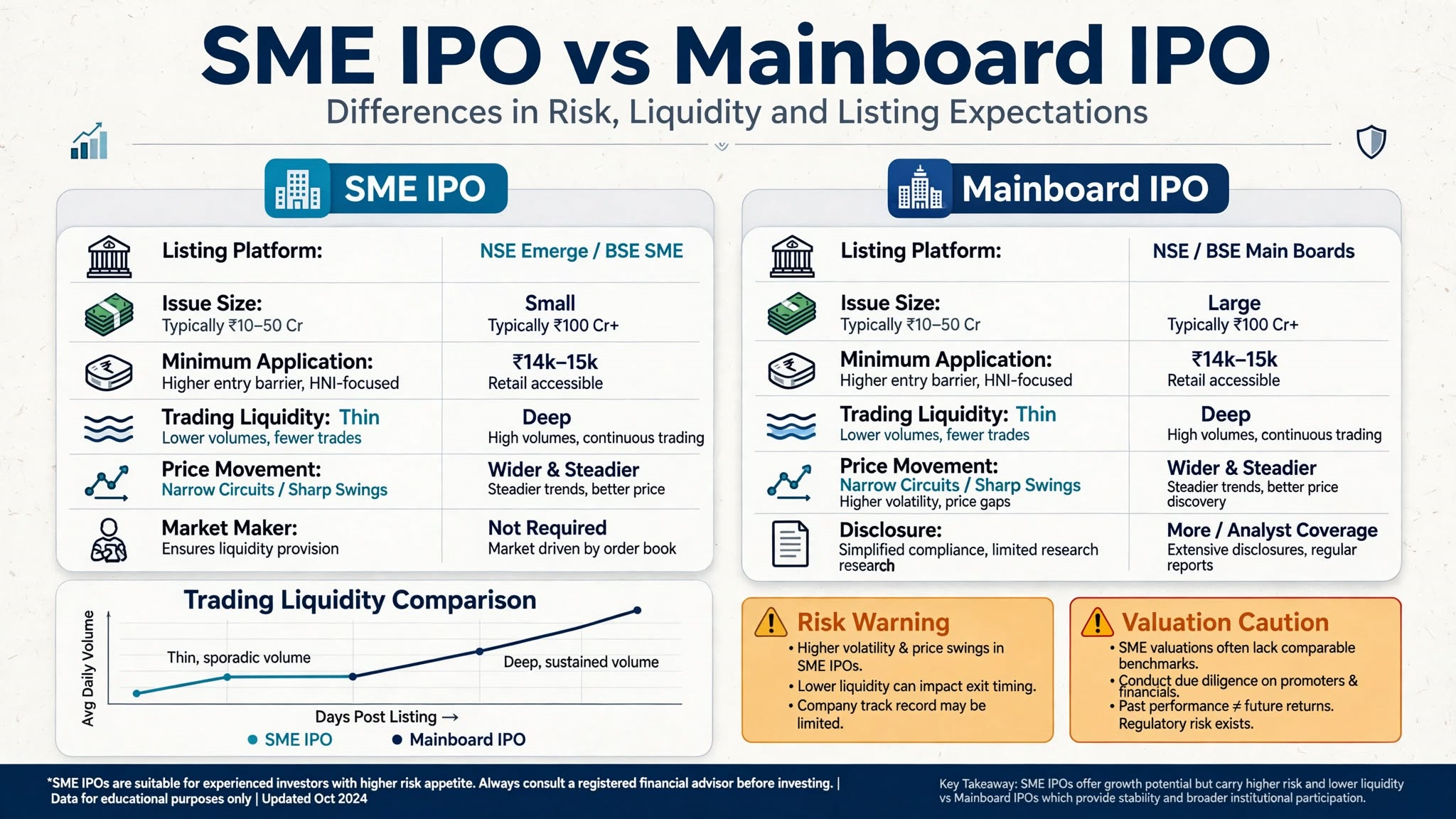
In the SME IPO vs Mainboard IPO comparison, SME IPOs are from “smaller firms”, list on “NSE Emerge” or ‘BSE SME”, need “bigger application amounts,” and have “fewer shares” traded after listing. Mainboard IPOs are issued by larger, more established companies and list on the main exchange boards with deeper liquidity. SME IPOs are generally riskier, mainly because exiting can be harder than entering.
A reader once asked me why his ₹1.3 lakh SME application felt so different from the ₹15,000 mainboard IPO he had applied for the month before. Both were “IPOs” to him. One he could forget about for a week. The other kept him checking the screen every ten minutes. His instinct was right, and the reasons are worth laying out.
SME IPO vs Mainboard IPO: What Are the Key Differences?
The main difference is the company’s size and maturity. SME IPOs are meant for smaller businesses that want to raise capital without meeting the full mainboard criteria. Mainboard IPOs are for larger companies that meet the NSE and BSE main board requirements for net worth, profitability, and track record.
Here is how they compare in practice:
| Feature | SME IPO | Mainboard IPO |
| Listing Platform | NSE Emerge, BSE SME | NSE and BSE main boards |
| Typical Issue Size | Small, often a few crore to a few hundred crore | Larger, often several hundred crore to thousands of crore |
| Minimum Application | Large lot size, commonly ₹1 lakh or more | Usually ₹14,000 to ₹15,000 for retail |
| Trading Liquidity | Thin, often low daily volumes | Deeper, with many participants |
| Price Movement | Narrow circuit bands, sharp swings | Wider bands, steadier on average |
| Market Maker | Mandatory for a fixed period after listing | Not required |
| Disclosure and Scrutiny | Lighter eligibility norms, less analyst coverage | More analyst and institutional coverage |
| Investor Participation | Mostly retail, HNIs and a few institutions | Strong institutional presence |
Are SME IPOs Riskier Than Mainboard IPOs?
On average, yes, and for specific reasons rather than a general sense of unease.
- Liquidity Risk: A mainboard stock may trade lakhs of shares a day. An SME stock may trade a few thousand shares a day. If you hold a large lot and want out, your own selling can push the price down. This is the risk that catches people most often.
- Concentration: Some small firms get most of their business from a few customers, one product, or one factory. Losing a major customer can cause real trouble.
- Governance and Scrutiny: SME companies receive less attention from analysts and institutions. That is why fewer people are checking the numbers. Related-party dealings and aggressive accounting are easier to miss.
- Volatility: With a small free float, a few trades can move the stock sharply, and circuit limits can trap you on the way down.
- Larger Bets: Because minimum lots are big, a wrong call costs more per application.
None of this makes every SME IPO a bad idea. It means the same mistake costs more, and the safety net is thinner.
SME IPO vs Mainboard IPO: How Does Valuation Differ?
The method is identical for both: take the upper band, calculate market capitalization on post-issue shares, compute price-to-earnings on the latest full-year profit, and compare it with listed peers. What changes is how much you trust the answer.
For SME issues, compare against both SME and mainboard peers, since SME peers alone can all be priced richly together. Check profits over a few years, as a sudden rise just before listing needs a closer look. A small company may have a different valuation from a large one, but there should be a good reason, like faster growth or better returns on capital.
How to Evaluate SME IPO Listing Expectations?
Treat the listing as the start of the risk, not the end of it. A few ground rules help.
- Separate the paper gain from the real gain: A stock that lists 40% higher on thin volume is not worth 40% more to you until you can sell. Ask how many shares trade on a typical day and compare that with your lot.
- Understand the market maker: SME issues have a market maker obliged to quote buy and sell prices for a set period, usually three years. That supports liquidity, but it does not guarantee a good price, and the obligation ends.
- Be careful with GMP: The grey market for SME issues is smaller than that for mainboard issues, making quotes more vulnerable to manipulation by a few operators. Understanding how the grey market premium works can help investors interpret these unofficial signals cautiously rather than relying on them when making IPO application decisions.
- Read subscription by category: Strong institutional bids at a fair valuation say more than a huge retail or HNI multiple on its own.
- Plan the exit before you apply: Decide whether you are taking a listing-day profit or holding, and how you will sell if the stock opens weak.
SME IPO vs Mainboard IPO: Which Should You Choose?
It depends on your goal and your tolerance.
- If you want lower friction and an easier exit, mainboard issues usually suit you better.
- If you are comfortable with higher risk and have done real research on the business, SME issues can offer opportunities, though with a firm cap on how much you commit.
- If you are new to IPOs, start with mainboard issues and learn how allotment, listing and exits work before moving to SME.
A sensible rule is to size an SME application so that losing the entire amount would be annoying but not damaging.
Track SME and Mainboard IPO Opportunities
Malik Times covers both segments. For open and upcoming issues in the smaller segment, see the latest upcoming SME IPO opportunities on the Upcoming SME IPO page. Our Malik Times IPO analysis and Malik Times IPO GMP pages put the numbers beside the reasoning, so you can compare issues before the subscription window opens. SME and mainboard IPOs look similar on an application form. They behave very differently once trading starts.
Final Thoughts
Understanding the differences between an SME IPO vs Mainboard IPO helps investors make informed decisions. SME IPOs may offer growth opportunities but often involve higher risks, lower liquidity, and larger application amounts. Mainboard IPOs generally provide better liquidity and broader investor participation.
Recommended Articles
We hope this comprehensive guide to SME IPO vs Mainboard IPO helps you understand the differences in risk, liquidity, and listing expectations. Check out these recommended articles for more insights into IPO investing and strategies to make informed financial decisions.

