


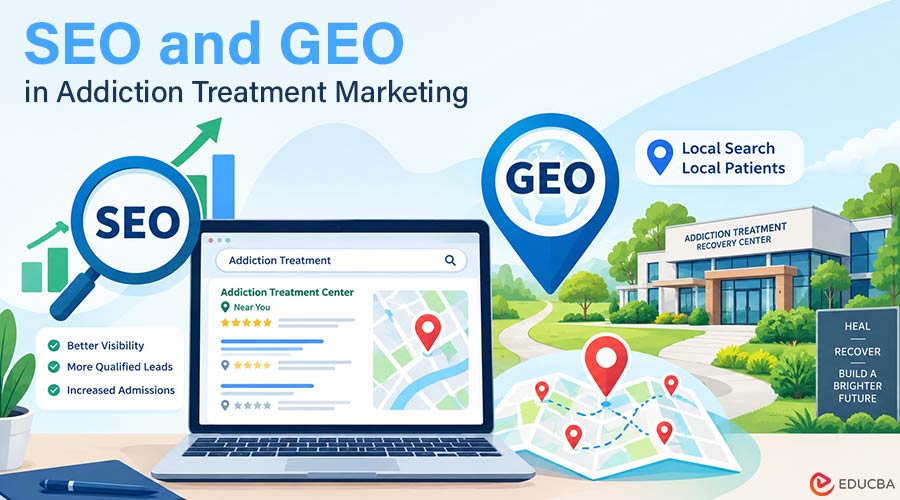
A behavioral health provider’s website needs to do more than appear in search results. It should explain available services, define unfamiliar terms, and make the next step clear. When people research addiction treatment through search engines and AI assistants, the marketing team is responsible for the accuracy of the information they encounter. Search engine optimization, or SEO, focuses on visibility in search results. Generative engine optimization, commonly called GEO, also examines how a provider is represented in AI-generated answers. Together, SEO and GEO in addiction treatment marketing can help marketing teams identify content gaps, improve consistency, and evaluate whether online visibility is reaching the intended audience.
SEO and GEO share a core principle: publish information people can find, understand, and verify. For addiction treatment providers, that means clearly describing services without making unsupported promises about suitability or outcomes.
What is SEO in Addiction Treatment Marketing?
SEO involves improving a website’s content and technical accessibility so search engines can discover its pages. For a treatment provider, this can include creating clear program pages, keeping location information accurate, and organizing educational resources around common questions. It also involves checking whether search engines can crawl and index important pages, whether navigation works, and whether the website is usable on a phone. The purpose of a service page should be clear.
For example, a page about an outpatient program should explain the program’s intended population, location, and schedule, along with the process for determining suitability. Relevant visibility matters more than broad exposure alone. Attracting visitors looking for a service the organization does not offer can frustrate both readers and admissions staff. A useful SEO strategy therefore connects search demand with the organization’s actual services.
What Does GEO Add to Addiction Treatment Marketing?
GEO expands the review beyond the search results page to the answers AI systems generate. A marketing team might check whether a provider is mentioned in response to a relevant question, whether its website is cited, and whether the answer accurately describes its services. These are separate findings. An assistant can cite an educational article without recommending the provider behind it. It can also name a treatment center while getting its location or available programs wrong.
GEO gives teams a reason to systematically inspect that representation. Its value comes from identifying problems and informing decisions, rather than collecting favorable screenshots. Providers should also recognize the limits of their control. Publishing a clear page does not guarantee that an AI system will cite it or accurately repeat its contents. Check generated answers against current, verified information.
The Shared Foundations of SEO and GEO in Addiction Treatment Marketing
SEO and GEO often draw attention to the same underlying work. Google Search Central states that established SEO practices remain relevant to AI Overviews and AI Mode. Its guidance does not require special AI markup or additional technical measures for inclusion in those features. Eligibility also does not guarantee an appearance.
For providers, the shared foundations include:
- Accessible pages containing important information in readable text.
- Clear navigation between related services and resources.
- Accurate descriptions of programs and locations.
- Current staff and organizational information.
- Consistency between visible content and any structured data.
- Educational material written for a defined audience.
These priorities matter whether a reader arrives through a traditional search result, an AI answer, or another channel.
Start With Questions From Admissions Conversations
Keyword research can help identify search topics, but admissions conversations provide context that a keyword alone may miss. Ask staff which questions recur before an assessment or inquiry progresses. Readers may want to know what information to prepare, how payment verification works, or whether a program’s schedule fits their responsibilities. Turn those questions into a content plan. For each proposed page, identify its intended reader, the question it should answer, and the person responsible for checking its accuracy.
Clinical topics should receive appropriate professional review. Keep different audiences in mind. Someone considering treatment personally may need a different explanation from a family member or a professional exploring referral options. The same questions can also inform a GEO audit. That connects visibility testing with actual information needs rather than prompts chosen only because they produce favorable answers.
Build Pages That Explain One Service Clearly
A program page should establish the essential facts near the beginning. Explain what the program is, who it serves, where it operates, and what participation involves. Define unfamiliar terms before using them throughout the page. Include practical details that the organization can maintain accurately. Depending on the service, these may include scheduling, family participation, and the steps involved in an initial assessment. Describe limitations where they matter. If a program serves adults only, say so clearly.
If services differ by location, identify those differences rather than presenting every location as interchangeable. Avoid relying on broad statements such as “comprehensive care” to carry the explanation. Readers need to understand what that phrase means in the specific program. A clear page provides a useful destination for search traffic and a factual reference against which AI-generated descriptions can be reviewed.
Maintain a Consistent Public Record
A provider’s website may be current while an older directory profile describes services that have changed. Create an inventory of important public listings and review the core facts across them. Check the organization’s name, address, program descriptions, and intended population. Prioritize discrepancies that could affect someone’s decision. An incorrect location or unavailable service deserves more attention than a minor difference in wording.
Assign responsibility for updates. Without an owner, corrections can become a one-time project that gradually falls out of date. Consistency does not guarantee an AI recommendation. It does give people a clearer account of the organization and reduces contradictions that marketing teams would otherwise need to investigate. Keep an approved internal fact sheet so reviewers have a current reference when checking website content and generated answers.
Measure Search Performance and AI Visibility Separately
SEO reporting may include search impressions, clicks, relevant queries, and landing-page activity. GEO reporting should identify the prompts tested and what appeared in the answers. For an initial AI visibility review, select a manageable set of questions. Separate branded prompts, which name the provider, from unbranded prompts asking about services or options. Save the full responses, displayed sources, dates, and testing conditions. Record unfavorable answers as well as positive ones.
Track mentions, citations, and material factual errors independently. Show counts alongside percentages so readers can understand the size of the sample. Repeated runs can reveal variation, but a selected prompt panel does not measure all prospective patients. Describe findings as observations within that panel. Google includes traffic from its AI search features within Search Console’s overall Web reporting. A change in that report alone does not isolate the contribution of those features.
Connect the Findings With Marketing Decisions
A report should lead to a concrete action. Repeated confusion about a program may justify revising its page. An outdated citation may prompt a review of an older resource. Inquiries about unavailable services may indicate a mismatch between campaign wording and what the organization offers. Review these findings with admissions staff. They can help determine whether online misunderstandings also appear in conversations.
Keep visibility measures separate from commercial and clinical outcomes. More mentions do not automatically establish more appropriate admissions, and marketing reports cannot establish treatment effectiveness. Assign an owner and review date to each improvement. Keep a short change log so you can interpret later observations alongside content updates, campaign changes, and operational developments.
Make Accuracy Part of the Ongoing Process
SEO and GEO work best as recurring responsibilities within a broader marketing program. Review high-priority pages when services change. Check public listings periodically. Repeat a documented set of AI questions and investigate material errors. Use admissions feedback to improve explanations that readers find confusing.
The relationship between SEO and GEO in addiction treatment marketing is practical: SEO helps you assess visibility in search results, while GEO examines how providers and their services appear in generated answers. Both benefit from clear content and a reliable public record.
For addiction treatment providers, the most useful outcome is a marketing system that helps people understand what the organization offers and how to explore their options. Visibility brings attention to that information. Accuracy and a dependable admissions experience give people a reason to trust it.
Recommended Articles
We hope this guide to SEO and GEO in addiction treatment marketing helps you improve online visibility and communicate your services more effectively. Check out these recommended articles for more insights and strategies to strengthen your digital marketing efforts.


