


Updated October 30, 2025
What is Sentiment Analysis?
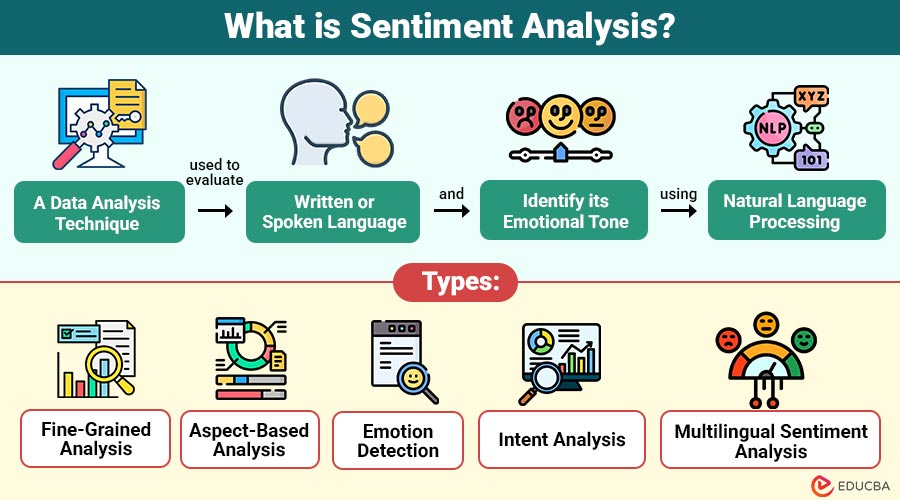
Sentiment Analysis is a data analysis technique used to evaluate written or spoken language and identify its emotional tone using natural language processing. It assigns a sentiment score (positive, negative, or neutral) to a given piece of text.
For instance, in customer feedback such as “The customer service was quick and helpful,” sentiment analysis detects the emotion as positive. On the other hand, “The delivery took too long,” would be classified as negative.
Table of Contents:
Key Takeaways:
- Sentiment analysis transforms unstructured text into measurable emotions, guiding strategic actions across industries.
- It empowers organizations to enhance customer experience, monitor reputation, and adapt rapidly to market sentiment.
- AI-driven models like BERT and LSTM improve accuracy by understanding linguistic nuances and contextual expressions.
- Despite challenges like sarcasm detection, sentiment analysis remains vital for data-driven decision-making and innovation.
Importance of Sentiment Analysis
Sentiment analysis plays an important role in helping organizations make sense of unstructured data. Here are some key reasons why it matters:
1. Improved Customer Experience
Businesses use sentiment analysis to track real-time opinions, quickly resolve issues, and enhance overall customer satisfaction and loyalty.
2. Brand Reputation Management
By monitoring public sentiment, organizations can proactively manage crises, shape communication strategies, and maintain a strong, positive brand image.
3. Market Research
It helps companies understand competitor perception, market preferences, and consumer trends, enabling smarter marketing and business strategy decisions.
4. Political and Social Insights
Governments and analysts assess public mood on policies, elections, and movements to predict behavior and guide effective communication strategies.
5. Product Development
By analyzing customer feedback, businesses identify product strengths and weaknesses, helping improve features, design, and innovation for greater satisfaction.
How Sentiment Analysis Works?
Sentiment analysis operates through a combination of Natural Language Processing, Text Analytics, and Machine Learning. The following steps can be used to summarize the workflow:
1. Data Collection
Text data is first gathered from a variety of sources, including emails, chat logs, product reviews, and social media posts.
2. Text Preprocessing
Before analysis, the text must be cleaned and standardized. This involves:
- Removing punctuation, special characters, and stopwords
- Tokenization (splitting sentences into words)
- Lemmatization or stemming (reducing words to their root form)
3. Feature Extraction
The next step is converting text into numerical form so that algorithms can process it. Common techniques include:
- Bag of Words (BoW)
- TF-IDF (Term Frequency-Inverse Document Frequency)
- Word Embeddings (Word2Vec, GloVe, or BERT)
4. Model Training and Classification
Using labeled datasets, machine learning models such as Naive Bayes, Support Vector Machines (SVM), or Deep Learning models (like LSTM or Transformers) are trained to recognize sentiment patterns.
5. Sentiment Scoring
The model outputs a sentiment score indicating the polarity of the text. For example:
- +1 → Positive
- 0 → Neutral
- –1 → Negative
6. Visualization and Reporting
The results are visualized using dashboards or analytical tools to identify trends, patterns, or spikes in sentiment over time.
Types of Sentiment Analysis
It can be carried out at various levels, depending on the required depth and granularity.
| Type | Description | Example Use Case |
| Fine-Grained Analysis | Classifies emotions on a detailed scale (e.g., very positive, positive, neutral, negative, very negative) | Product reviews |
| Aspect-Based Analysis | Identifies sentiment about specific product features or topics | “The camera quality is great, but the battery drains fast.” |
| Emotion Detection | Detects emotions like joy, anger, sadness, or fear | Social media monitoring |
| Intent Analysis | Understands the intent behind a message (complaint, query, or appreciation) | Customer support systems |
| Multilingual Sentiment Analysis | Processes text in multiple languages | Global brand monitoring |
Applications of Sentiment Analysis
Sentiment Analysis is widely used across industries. Below are key application areas:
1. Marketing and Brand Monitoring
Businesses use sentiment analysis to evaluate customer reactions to campaigns, ads, and competitors, thereby refining engagement and communication strategies.
2. Customer Service
Sentiment analysis in chatbots and support systems detects emotions, prioritizes customer complaints, and ensures faster, more empathetic responses.
3. Financial Market Predictions
Analysts study investor sentiment from news, social media, and reports to forecast stock performance, market fluctuations, and economic behavior trends.
4. Political Campaigns and Governance
Governments analyze public sentiment on policies, elections, and speeches to understand public opinion, improve engagement, and guide decision-making effectively.
5. Product Improvement
Businesses analyze reviews and feedback to uncover recurring issues, understand customer preferences, and design improved products or features.
6. Media and Entertainment
Studios and platforms use sentiment tracking to gauge audience emotions, optimize releases, and tailor future content to improve viewer engagement.
Benefits of Sentiment Analysis
Here are the benefits that highlight why sentiment analysis is essential for modern businesses:
1. Real-Time Insights
Sentiment analysis enables organizations to respond instantly to changes in public opinion, ensuring timely actions and improved customer engagement.
2. Scalability
It can efficiently process and analyze thousands of opinions across various digital channels, enabling large-scale feedback management.
3. Data-Driven Decisions
By offering evidence-based insights, sentiment analysis supports smarter marketing, public relations, and product development strategies.
4. Cost Efficiency
Automating sentiment detection reduces the need for manual data analysis, saving time, labor, and operational costs.
5. Competitive Edge
Organizations gain a market advantage by anticipating customer needs and adapting strategies faster than their competitors.
Challenges in Sentiment Analysis
Sentiment analysis faces several challenges that affect accuracy and interpretation.
1. Sarcasm and Irony Detection
It often misclassifies sarcastic remarks like “Great! Another crash!” because literal words contradict intended emotions.
2. Contextual Ambiguity
Words can express different meanings based on context—phrases like “The movie was sick!” may indicate either praise or criticism.
3. Multilingual and Cultural Variations
Regional slang, idioms, and cultural expressions make it difficult for sentiment models to interpret emotions across diverse languages accurately.
4. Domain-Specific Jargon
Industry-specific terminology, such as medical or technical terms, can confuse models trained on general datasets, reducing interpretability.
5. Mixed Sentiments
Single reviews often express conflicting emotions—both praise and complaints—making sentiment classification and polarity scoring more challenging for algorithms.
Real-World Examples
Here are some real-world examples illustrating how leading organizations apply sentiment analysis:
1. Coca-Cola
Coca-Cola uses sentiment analysis to analyze social media reactions, track opinions on new flavors, and refine its marketing strategies.
2. Twitter
Twitter applies sentiment analysis algorithms to identify offensive or harmful content, enhancing platform safety, moderation, and overall user experience.
3. United Airlines
United Airlines monitors tweet sentiments to detect negative feedback, manage public relations crises, and respond promptly to customer dissatisfaction.
Final Thoughts
Sentiment Analysis has evolved from a niche research area to a powerful business intelligence tool. By leveraging AI and NLP, organizations can understand how people feel, act on insights faster, and build stronger customer relationships. In a world where every tweet, post, and review matters, mastering sentiment analysis is not just an analytical advantage—it is a strategic necessity.
Frequently Asked Questions (FAQs)
Q1. What is sentiment analysis used for?
Answer: It is used to identify and analyze opinions, emotions, and attitudes in text data for decision-making and brand monitoring.
Q2. Which tools are popular for sentiment analysis?
Answer: Tools like IBM Watson NLP, MonkeyLearn, Lexalytics, and Google Cloud Natural Language API are widely used.
Q3. Is sentiment analysis limited to English text?
Answer: No. Modern NLP frameworks support multiple languages for global sentiment detection.
Q4. How accurate is sentiment analysis?
Answer: Accuracy depends on data quality, algorithms, and contextual complexity—typically ranging from 70% to 90%.
Recommended Articles
We hope that this EDUCBA information on “Sentiment Analysis” was beneficial to you. You can view EDUCBA’s recommended articles for more information.


