


Updated August 19, 2026
What is Semantic Caching?
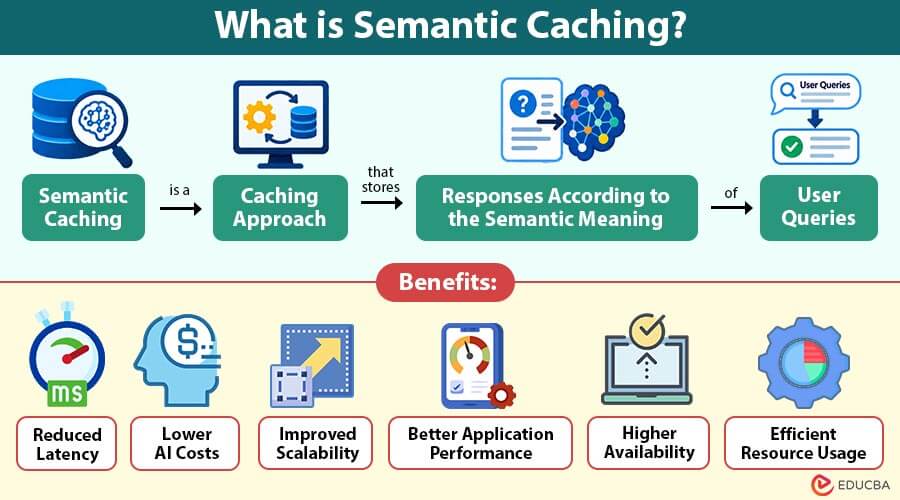
Semantic caching is a caching approach that stores responses according to the semantic meaning of user queries. Instead of comparing requests character by character, it uses techniques such as embeddings and vector similarity to determine whether a new query matches a previously processed one.
When a user sends a request, the system converts the query into a numerical representation called an embedding. This embedding captures the request’s meaning and context. The system then compares it with embeddings stored in the cache.
If it finds a sufficiently similar query, it can return the cached response without reprocessing the request. This can reduce response time, computational requirements, and costs associated with repeated AI model calls.
Table of Contents:
Key Takeaways:
- Semantic caching reuses responses for semantically similar queries, reducing repeated AI model processing and improving application efficiency.
- Embeddings and vector similarity help identify semantically related queries, enabling flexible cache matching beyond exact text comparisons.
- Semantic caching can reduce latency, LLM costs, and computational workload, and improve scalability across AI-powered applications.
- Effective semantic caching requires appropriate similarity thresholds, context handling, data freshness, privacy controls, and cache monitoring.
How Does Semantic Caching Work?
Semantic caching generally follows a series of steps:
1. User Sends a Query
The process begins when a user submits a question or request to an application. For example, a user may ask, “How can I reduce cloud costs?”
2. Query is Converted Into an Embedding
An embedding model converts query into a numerical vector. This vector represents the query’s semantic characteristics.
3. Cache Searches for Similar Queries
The system compares the generated embedding with embeddings stored in a vector database or semantic cache. Similarity measures, such as cosine similarity, help determine how closely the queries are related.
4. Similarity Threshold Is Checked
The system checks whether the similarity score meets a predefined threshold. If the score is high enough, the system considers the cached response relevant.
5. Cached Response Is Returned
When a suitable match exists, the application returns the stored response instead of sending the request to an LLM or another expensive backend service.
6. New Response Is Generated When Necessary
If no sufficiently similar result exists, the request is sent to the underlying model or application. The system can then store the newly generated response in the cache for future use.
Key Components of Semantic Caching
Several components work together to create a semantic caching system.
1. Embedding Model
An embedding model converts text into numerical vectors. These vectors help the system compare the meaning of different queries.
2. Vector Database
A vector database stores embeddings and enables similarity searches. Popular options include Pinecone, Weaviate, Milvus, and Chroma.
3. Cache Store
The cache stores the original query, embedding, generated response, metadata, and other information required to retrieve the result.
4. Similarity Search
Similarity search determines how closely a new query matches stored queries. The system uses a similarity score to identify potential cache hits.
5. Similarity Threshold
The threshold determines how similar two queries must be before a cached response can be reused. A high threshold generally provides stricter matching, while a lower threshold may increase cache hits but also increases the risk of irrelevant responses.
Types of Semantic Caching
Semantic caching can be implemented in different types depending on the application.
1. Query-Based Semantic Caching
This method compares the semantic meaning of new queries with previously cached queries. It is useful for applications where users frequently ask similar questions.
2. Response-Based Caching
Here, the system stores generated responses along with their semantic representations. The system can retrieve relevant responses based on the meaning of incoming requests.
3. Context-Aware Semantic Caching
Context-aware caching considers additional information such as conversation history, user intent, language, or application state. This approach is useful for conversational AI systems.
4. Hybrid Caching
Hybrid caching combines traditional exact-match caching with semantic caching. Exact matches can be handled quickly using conventional caching, while semantically similar requests are processed through vector-based matching.
Benefits of Semantic Caching
Semantic caching offers several benefits for AI-powered applications.
1. Reduced Latency
Cached responses can be delivered much faster than generating a new response through an LLM. This can improve the overall user experience.
2. Lower AI Costs
LLM calls can be computationally expensive. Reusing existing responses reduces model requests and can lower API or infrastructure expenses.
3. Improved Scalability
Applications handling large numbers of similar queries can serve more users without increasing model usage at the same rate.
4. Better Application Performance
By avoiding unnecessary processing, semantic caching can improve system efficiency and reduce the workload on backend services.
5. Higher Availability
Previously generated responses may remain available when model services experience temporary slowdowns or availability issues, depending on the system architecture.
6. Efficient Resource Usage
Semantic caching reduces repetitive computation and allows organizations to use AI infrastructure more efficiently.
Applications of Semantic Caching
Semantic caching can be used across many AI and software applications.
1. AI Chatbots
Customer service chatbots often receive similar questions from different users. Semantic caching can reuse responses to common questions and reduce unnecessary model calls.
2. Retrieval-Augmented Generation
RAG systems repeatedly process similar questions and retrieve information from knowledge sources. Semantic caching can store useful results and reduce repeated retrieval and generation work.
3. Customer Support
Businesses can cache responses to common support questions, such as billing procedures, account instructions, or product information.
4. Search Applications
Search platforms can use semantic caching to reuse results for queries with similar intent, improving response speed.
5. Virtual Assistants
AI assistants can benefit from semantic caching when users repeatedly ask about common tasks, services, or information.
6. Enterprise Knowledge Systems
Internal business applications can cache responses to frequently asked questions about policies, processes, products, and company information.
Challenges of Semantic Caching
Although semantic caching provides significant benefits, it also introduces several challenges.
1. Incorrect Cache Matches
A semantically similar query does not always require the same answer. Two questions may appear similar but have different contexts or requirements. Poor matching can therefore result in inaccurate responses.
2. Choosing the Right Threshold
Selecting an appropriate similarity threshold can be difficult. A threshold that is too low may return irrelevant results, while one that is too high may reduce cache hit rates.
3. Data Freshness
Cached responses can become outdated when underlying information changes. Applications dealing with prices, financial data, policies, or real-time information need suitable cache expiration and invalidation strategies.
4. Privacy and Security
Cached responses may contain sensitive information. Organizations must carefully manage what they store and ensure cached content isn’t incorrectly returned to another user.
5. Storage Requirements
Large-scale semantic caches can require considerable storage for embeddings, responses, metadata, and indexes.
Difference Between Semantic Caching and Traditional Caching
Below are the key differences between semantic caching and traditional caching.
| Aspect | Semantic Caching | Traditional Caching |
| Matching Method | Uses semantic similarity to match queries based on meaning. | Uses exact or rule-based matching. |
| Query Example | “What is artificial intelligence?” and “Explain AI” can be recognized as similar queries. | “What is artificial intelligence?” matches only if the same or predefined query is stored. |
| Cache Hit | Can produce a cache hit even when the wording is different. | Requires an exact or closely defined match. |
| Focus | Focuses on the meaning and intent of the request. | Focuses on the request’s text or structure. |
| Flexibility | More flexible for variations of the same question. | Less flexible for differently worded queries. |
| Main Advantage | Improves response reuse for semantically similar queries. | Simple and fast to implement. |
Final Thoughts
Semantic caching improves AI application performance by reusing responses for semantically similar queries. It reduces latency, LLM costs, and resource usage while improving scalability. Effective implementation requires similarity thresholds, context management, freshness controls, privacy protection, and monitoring for reliable performance across chatbots, RAG systems, assistants, and search platforms.
Frequently Asked Questions (FAQs)
Q1. Can semantic caching work without a vector database?
Answer: Yes. Smaller applications can use in-memory or other storage systems, although vector databases are useful for large-scale similarity searches.
Q2. Does semantic caching work with every AI model?
Answer: It can work with most applications that generate reusable responses, regardless of the specific AI model used behind the application.
Q3. Can semantic caching support multilingual queries?
Answer: Yes, as long as the selected embedding model can represent and compare the languages used by the application’s users effectively.
Q4. Is semantic caching suitable for real-time information?
Answer: It can be used selectively, but rapidly changing information requires strict freshness rules to prevent outdated results from being served.
Recommended Articles
We hope that this EDUCBA information on “Semantic Caching” was beneficial to you. You can view EDUCBA’s recommended articles for more information.


