


What is Seed Funding?
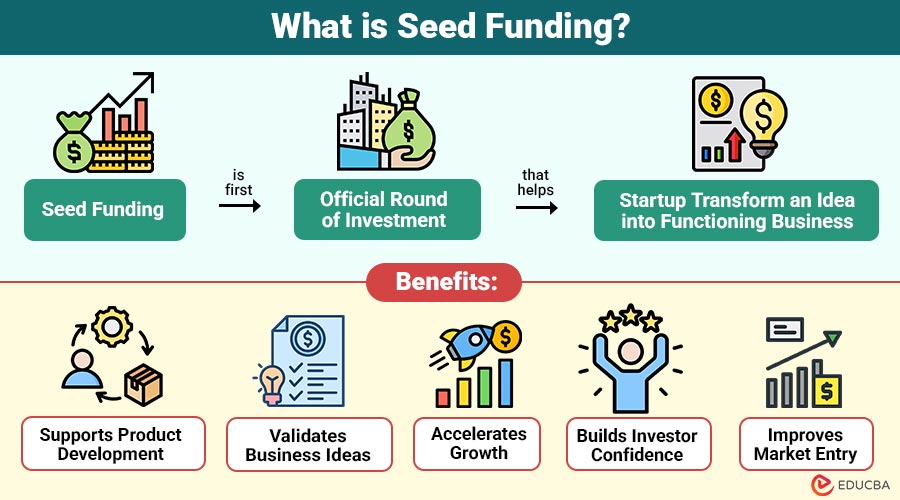
Seed funding is first official round of investment that helps a startup transform an idea into a functioning business. It provides entrepreneurs with the capital needed to develop products, conduct market research, hire a small team, and launch initial operations.
In simple words, seed funding is the money a startup receives during its earliest stage to “plant the seed” for future growth. This funding gives founders the resources to test their business idea before seeking larger investments.
Table of Contents:
Key Takeaways:
- Seed funding is the first external investment for startups.
- It helps businesses develop products and validate their ideas.
- Funding can come from angel investors, venture capital firms, crowdfunding, or incubators.
- Successful seed funding prepares startups for larger funding rounds, such as Series A.
Why is Seed Funding Important?
Seed funding plays an important role in helping startups build a strong foundation for growth. Below are the key reasons why seed funding is important:
1. Build a Minimum Viable Product
Seed funding helps startups develop a minimum viable product to validate ideas, gather feedback, and attract early customers.
2. Conduct Market Research
It enables businesses to research customer needs, analyze competitors, identify opportunities, and refine products before entering the market at scale.
3. Hire Key Employees
Seed funding allows startups to recruit skilled professionals who contribute expertise, accelerate development, and support sustainable business growth.
4. Develop Marketing Strategies
It provides resources for creating marketing campaigns, building brand awareness, acquiring customers, and establishing a strong market presence.
5. Cover Operational Expenses
It helps cover essential operational costs, including office expenses, technology, legal compliance, and day-to-day business activities.
How Does Seed Funding Work?
Seed funding involves investors providing capital to a startup in exchange for partial ownership (equity) or convertible securities.
The typical process works as follows:
- A founder develops a business idea.
- The startup prepares a business plan and pitch deck.
- Investors evaluate the business potential.
- Funding negotiations take place.
- Investors provide capital.
- The startup uses funds to grow its business.
- As the company expands, it may raise additional funding rounds such as Series A.
Unlike bank loans, seed funding generally does not require monthly repayments. Instead, investors earn returns if the company’s value grows.
Types of Seed Funding
The following are the most common types of seed funding that help startups secure early-stage capital to launch and grow their businesses.
1. Bootstrapping
Founders use personal savings, income, or assets to finance startup operations without relying on external investors.
2. Friends and Family Funding
Entrepreneurs receive financial support from trusted relatives and friends during the early stages of startup development.
3. Angel Investors
Wealthy individuals invest personal capital in promising startups, often providing mentorship alongside early-stage funding opportunities.
4. Venture Capital Seed Funds
Startups with scalable business ideas and significant growth potential receive seed funding from specialized venture capital firms.
5. Crowdfunding
Startups collect small financial contributions from numerous supporters through online platforms to validate innovative business ideas.
6. Startup Incubators and Accelerators
Organizations provide seed funding, mentorship, networking, workspace, and business guidance to accelerate startup growth and success.
Seed Funding Process
The seed funding journey generally includes several steps.
Step 1: Develop the Business Idea
Create a unique solution to a market problem and define the target customers.
Step 2: Build a Minimum Viable Product
Develop a basic version of the product to demonstrate its functionality.
Step 3: Prepare Business Documents
Create:
- Business plan
- Financial projections
- Pitch deck
- Revenue model
Step 4: Identify Investors
Research investors who specialize in your industry and startup stage.
Step 5: Pitch Your Startup
Present your business opportunity, market potential, competitive advantage, and financial projections.
Step 6: Negotiate Investment Terms
Discuss valuation, investment amount, equity percentage, and investor rights.
Step 7: Receive Funding
After agreements are signed, the startup receives the investment and begins executing its growth strategy.
Benefits of Seed Funding
It offers several benefits for startups.
1. Supports Product Development
It enables startups to build, improve, test, and refine products before launching them into the competitive market.
2. Validates Business Ideas
Investor support demonstrates confidence in the startup’s concept, confirming its potential for market demand and future growth.
3. Accelerates Growth
Funding helps startups hire skilled employees, upgrade technology, expand operations, and scale business activities more rapidly.
4. Builds Investor Confidence
Early achievements increase credibility, making it easier to attract larger investments during future funding rounds and expansion.
5. Improves Market Entry
It enables faster product launches, stronger marketing efforts, and better competition in target markets from inception.
Challenges of Seed Funding
Despite its advantages, seed funding also comes with challenges.
1. Equity Dilution
Founders surrender a portion of company ownership in exchange for capital, reducing their overall equity and decision-making control.
2. Difficult Fundraising
Securing seed funding is highly competitive because investors carefully evaluate business potential, market demand, and the founding team’s capabilities.
3. High Expectations
Investors expect consistent business growth, customer acquisition, revenue growth, and the achievement of key startup milestones over time.
4. Business Uncertainty
Early-stage startups often lack proven financial performance, making investment decisions riskier for potential investors and stakeholders.
5. Pressure to Scale
Startups face constant pressure to expand quickly, meet investor expectations, and achieve sustainable long-term business growth.
Difference Between Seed Funding and Venture Capital
The table below highlights the key differences between both:
| Feature | Seed Funding | Venture Capital |
| Business Stage | Early-stage startups | Growing businesses |
| Investment Size | Smaller | Larger |
| Risk Level | Higher | Lower compared to the seed stage |
| Primary Purpose | Product development and validation | Business expansion |
| Investors | Angel investors, incubators, seed funds | Venture capital firms |
| Revenue Requirement | Often minimal | Usually, some market traction |
Real-World Examples
Many successful startups began their journey with seed funding. Below are some well-known examples of companies that used early-stage investment to build and grow their businesses.
1. Airbnb
Airbnb raised seed funding to improve its platform and attract its first users. Early investment helped the company validate its business model before securing larger venture capital funding.
2. Uber
Uber received seed funding to develop its ride-hailing platform and expand into new markets. The early investment laid the foundation for its rapid global growth.
3. Dropbox
Dropbox used seed funding to develop its cloud storage technology, improve its product, and grow its initial customer base before raising additional investment rounds.
Final Thoughts
Seed funding provides startups with the capital needed to develop products, validate business ideas, and accelerate growth. Despite challenges such as equity dilution and competitive fundraising, it creates opportunities for future investment, business expansion, and long-term success through strong planning, execution, and investor support.
Frequently Asked Questions (FAQs)
Q1. How much seed funding do startups usually raise?
Answer: It varies by startup, but it typically covers 12–18 months of early business operations.
Q2. Do startups need revenue to receive seed funding?
Answer: No. Many startups secure seed funding based on their idea, team, and growth potential.
Q3. How long does it take to raise seed funding?
Answer: The process usually takes a few weeks to several months.
Q4. What do seed investors look for?
Answer: They assess the team, market opportunity, product, business model, and scalability.
Recommended Articles
We hope that this EDUCBA information on “Seed Funding” was beneficial to you. You can view EDUCBA’s recommended articles for more information.


