


Starting a Security Services Business in India
The security services business in India has seen tremendous growth in the last decade. This is primarily driven by growing concerns over personal and organizational safety, increasing demand for surveillance, and evolving regulations that acknowledge private security’s role in national security. With businesses in commercial, residential, industrial, and institutional sectors seeking strong security solutions, starting a security services business in India has become a viable and profitable option for entrepreneurs.
However, since the services offered in this industry are directly related to law and public safety, the security services sector is heavily regulated. A proper legal and operational framework is required to operate in this space.
The Private Security Agencies (Regulation) Act, 2005 (PSARA Act) is a key law that governs the security industry, and obtaining a PSARA license is essential.
Legal Framework: The PSARA Act
The Private Security Agencies (Regulation) Act, 2005 (PSARA Act) governs the functioning of private security agencies (PSAs) in India. According to the Act:
- No entity can provide or offer private security services without obtaining a valid PSARA license from the designated controlling authority in each state or union territory.
- The Act ensures that security agencies operate within a structured, lawful, and accountable framework, emphasizing the credentials of their promoters, personnel training, and mechanisms of supervision and redressal.
- State-specific rules and administrative protocols make the licensing and compliance process decentralized and multi-layered.
Process of Obtaining a PSARA License
The first essential step in starting a security services business in India is legally establishing the business entity there. The choice of entity—whether a sole proprietorship, partnership, LLP, or private limited company—should be based on scalability, compliance needs, investor relations, and operational risks.
#1. Types of Business Entities for PSARA
While sole proprietorships and partnerships are simpler, LLPs and private limited companies offer advantages like limited liability and enhanced investor acceptance. Businesses aiming to bid on government tenders or expand across multiple jurisdictions often prefer an LLP or private limited company due to their structured governance and increased credibility.
Once the Ministry of Corporate Affairs incorporates the business entity, ensure the Memorandum of Association (MoA) includes object clauses allowing the company to provide security services. Failure to do so may result in delays or objections during the licensing process, as regulatory authorities will scrutinize the MoA to confirm the company’s eligibility to operate as a Private Security Agency (PSA).
#2. PSARA Application Process
After establishing the business entity, the next step is to apply for the PSARA license. The process begins with signing a Memorandum of Understanding (MoU) with a training institute recognized by the state’s Home Department.
The PSARA Act requires private security personnel to undergo training aligned with the National Skill Qualification Framework (NSQF). These institutes, approved by state governments, provide structured training that includes physical fitness, disaster management, firefighting, legal duties, first aid, and equipment handling. All training must be documented and subject to audit by regulatory bodies.
#3. Documents Required for PSARA Application
The PSARA application process is documentation-heavy, requiring a comprehensive application package that includes the following:
- Incorporation Certificate of the business entity.
- PAN and TAN of the business.
- Proof of registered office and the lease/ownership deed of the premises.
- GST Registration and Professional Tax Registration (where applicable).
- Promoters’ personal credentials, including police verification reports, affidavits affirming legal compliance, and identity/address proofs. Some states may require security clearance from the Intelligence Bureau, especially for ex-servicemen or foreign nationals involved in management.
After submitting the application and documents, the next step is background verification, which involves checking criminal history, assessing financial stability, and ensuring compliance with legal requirements. A negative police report can lead to the rejection of the application. Once you verify and comply, the controlling authority issues the PSARA license, which remains valid for five years and requires renewal before expiration.
#4. PSARA Registration Requirements
The PSARA license is state-specific, requiring a separate license for each state where the agency operates. For businesses expanding across multiple states, this means navigating the compliance requirements and costs of obtaining and maintaining multiple licenses.
Beyond obtaining the PSARA license, businesses must complete several statutory registrations to become fully operational. These include:
- EPF (Employees Provident Fund) and ESI (Employees State Insurance) registration (for businesses with employees above the threshold limits).
- Shops and Establishments Registration under local laws.
- Labour Welfare Fund Registration and Professional Tax Act Enrollment (where applicable).
- Businesses must obtain a trade license if local regulations require it, and GST registration is mandatory for tax compliance.
Hiring and Deployment of Security Personnel
After obtaining the necessary licenses and statutory registrations, the next step is hiring and deploying security personnel. Eligibility criteria for guards include Indian citizenship, physical fitness, mental health, and a minimum of 8th—or 10th-grade education. While prior service in the armed forces or police is not mandatory, clients often highly value it.
Guards must undergo PSARA-compliant training, and agencies must maintain records of this training. Additional operational requirements include uniforms, photo IDs, deployment logs, and duty rosters, which must be available for regulatory authorities to inspect.
Risk Mitigation and Insurance
To mitigate risks, security agencies should invest in appropriate employee insurance coverage, such as public liability insurance, workers’ compensation insurance, and group medical insurance. To minimize legal exposure, client contracts should include clear service level agreements (SLAs), indemnification clauses, and incident reporting protocols.
- Financial Management and Billing Model: A security agency’s financial structure typically involves monthly billing based on the number of guards deployed and the hours worked. Margins can vary depending on the service segment (e.g., residential, commercial, industrial, or event-based) and geographic location. High-margin services, like armed security and surveillance systems, require specialized compliance and logistical capabilities. Many agencies engage virtual CFOs or outsourced accounting services to manage cash flow, timely payments to guards, statutory contributions, and tax compliance.
- Marketing and Brand Building: Building trust and visibility is crucial for success. To do so, agencies should create a professional brand, build a website, list on B2B platforms, apply for government tenders, and establish relationships with real estate developers, facility managers, hospitals, and corporate offices. Trademark registration is also advisable to protect the agency’s brand identity.
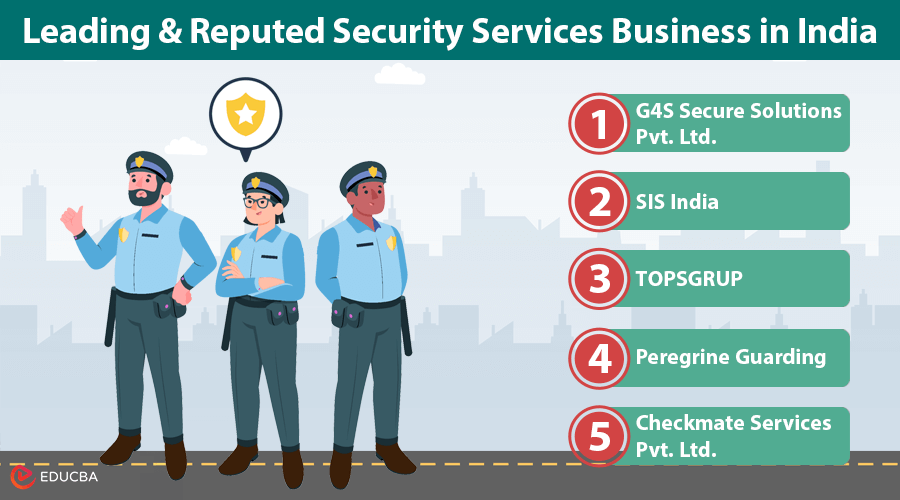
Leading and Reputed Security Services Business in India
Here are some of the leading security services agencies in India:
#1. G4S Secure Solutions (India) Pvt. Ltd.
G4S has been India’s globally recognized security services provider since the early 1990s. It offers many services, including manned guarding, risk consultancy, electronic surveillance, and cash handling solutions. G4S holds valid PSARA licenses in multiple Indian states and sets the benchmark for industry standards and compliance.
#2. SIS India (Security and Intelligence Services India Ltd.)
SIS India is one of India’s largest integrated security and facility management companies. With its headquarters in Patna and operational control from Gurgaon, the company serves diverse sectors, including BFSI, logistics, aviation, and infrastructure. The company is publicly listed and holds PSARA licenses across most Indian states, employing over 2 lakh personnel.
#3. TOPSGRUP
TOPSGRUP is an established Indian security company with over four decades of experience. It offers guarding, event security, emergency response, and consultancy services. With pan-India operations, it is PSARA-compliant and known for serving MNCs, government institutions, and Fortune 500 companies.
#4. Peregrine Guarding (A Tenon Group Company)
Peregrine Guarding is part of the Tenon Group and has become a major player in the Indian private security industry. Known for advanced training modules and risk-based security solutions, Peregrine holds PSARA licenses across states and emphasizes technology-integrated guarding solutions.
#5. Checkmate Services Pvt. Ltd.
Founded in 1985, Checkmate is a major provider of security services in India, particularly strong in Gujarat and Maharashtra. It provides a mix of manned guarding, fire safety, and industrial security services. The company is PSARA-licensed and well-regarded for its adherence to statutory compliance and training standards.
#6. Securitas India
Part of the global Securitas AB, headquartered in Sweden, Securitas India offers customized security and risk management solutions to various industries. It operates with full PSARA compliance and is known for its global best practices and modern surveillance support.
#7. CMS Security Services (India) Pvt. Ltd.
CMS is another well-known security company that offers guarding, cash management, and ATM services. Its strong backend systems and geographical presence make it a preferred choice for BFSI clients. CMS is PSARA-certified and ISO-compliant.
#8. Walsons Services Pvt. Ltd.
With operations across India and Southeast Asia, Walsons is known for providing high-end security and manpower solutions. It offers integrated facility and security services and maintains full PSARA compliance.
#9. Bhartiya Suraksha Sansthan
This is a rising indigenous player focused on industrial and infrastructure security. Known for operating in North and Central India, it is fully PSARA compliant and offers well-trained security staff for the factory, logistics, and warehousing sectors.
Final Thoughts
Establishing a security services business in India requires a good understanding of legal requirements, procedural diligence, and operational preparedness. While designed to ensure standardization and security, the PSARA law imposes significant compliance obligations that must be complied with precision. However, for those willing to undertake this structured approach, the private security sector offers immense opportunities for growth and diversification, especially in a country like India that is rapidly urbanizing and digitizing its security infrastructure. Suppose you have recently registered your private limited company or limited liability partnership. In that case, you can also go for Startup India Registration, which will help you avail yourself of government grants, subsidies, and tax exemptions. For any help, you can contact Compliance Calendar LLP, a leading legal firm that helps with PSARA licenses.
Recommended Articles
We hope this guide on starting a security services business in India helps you confidently navigate the industry. Check out these recommended articles for more insights and strategies to grow your business successfully.

