


What is Secure Access Service Edge (SASE)?
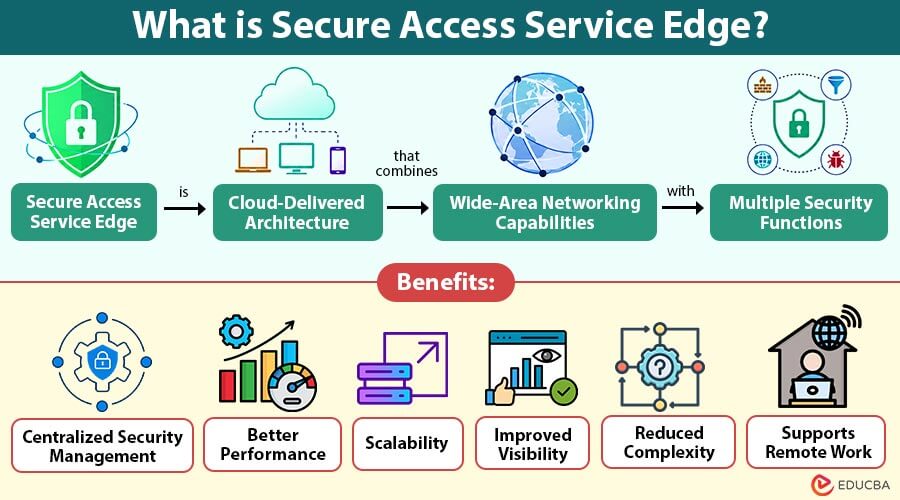
Secure Access Service Edge is cloud-delivered architecture that combines wide-area networking capabilities with multiple security functions. Instead of routing all traffic through traditional centralized data centers, SASE provides secure connectivity and security controls through globally distributed cloud services.
The architecture is designed around identity, context, and access policies rather than relying only on a user’s physical network location. This approach allows organizations to evaluate factors such as user identity, device security, application, location, and access requirements before granting access. SASE is particularly useful for organizations with remote employees, branch offices, cloud applications, and distributed IT environments.
Table of Contents:
- Meaning
- Importance
- Key Components
- Working
- Benefits
- Use Cases
- Challenges
- How to Implement a Secure Access Service Edge?
- Best Practices
Key Takeaways:
- Secure Access Service Edge combines cloud networking and security to protect users, applications, devices, and organizational data.
- It supports remote work by providing secure, consistent access to business applications from different locations.
- It improves security through identity-based policies, continuous monitoring, and integrated cloud-based security controls.
- It simplifies infrastructure by integrating networking and security services into a scalable cloud-delivered architecture.
Why is Secure Access Service Edge Important?
Below are the key reasons why Secure Access Service Edge is important for modern organizations:
1. Supports Remote Work
SASE enables employees to securely access business applications from different locations while maintaining consistent security policies across devices and networks.
2. Protects Cloud Applications
SASE provides security controls for SaaS, cloud, and internet applications, helping organizations protect resources beyond traditional data center environments.
3. Improves Network Performance
Cloud-based security services operate closer to users, reducing unnecessary traffic routing through centralized data centers and improving application performance.
4. Strengthens Security
SASE applies identity-based, context-aware security policies and supports Zero Trust principles to protect users, devices, applications, and organizational data.
Key Components of Secure Access Service Edge
Below are the key components that work together to provide secure, scalable, and cloud-based network access:
1. Software-Defined Wide Area Networking (SD-WAN)
SD-WAN intelligently connects users, offices, cloud environments, and data centers while selecting efficient network paths based on performance.
2. Zero Trust Network Access (ZTNA)
ZTNA verifies users and devices before granting application access, applies security policies, and reduces unnecessary network exposure and risk.
3. Secure Web Gateway (SWG)
SWG protects users from malicious websites and harmful online content, enforces internet usage policies, and provides traffic visibility.
4. Cloud Access Security Broker (CASB)
CASB monitors cloud application usage, identifies risky activities, enforces security policies, and protects sensitive information across SaaS environments.
5. Firewall as a Service (FWaaS)
FWaaS provides cloud-based firewall capabilities that filter traffic, enforce security rules, control access, and support distributed organizational environments.
6. Data Loss Prevention (DLP)
DLP identifies sensitive information, monitors data movement, prevents unauthorized sharing, supports compliance requirements, and protects confidential business information.
How Does Secure Access Service Edge Work?
SASE connects users and devices to cloud-based networking and security services.
Step 1: User Requests Access
A user requests access to an application, website, cloud service, or business resource through the organization’s network.
Step 2: Identity Verification
SASE verifies the user’s identity and authentication status before allowing access to organizational applications, services, or resources.
Step 3: Device Evaluation
The system evaluates the device’s security posture, checking factors such as device health, compliance, configuration, and security status.
Step 4: Policy Evaluation
SASE evaluates user identity, device condition, application, location, and organizational security policies to determine appropriate access permissions.
Step 5: Access Decision
Based on evaluated security conditions, SASE allows, restricts, or denies access according to predefined organizational security policies.
Step 6: Security Inspection
Network traffic passes through appropriate security services that inspect, filter, and protect communications before reaching requested applications or resources.
Step 7: Continuous Monitoring
SASE continuously monitors users, devices, traffic, and access activities to detect threats and enforce security policies throughout sessions.
Benefits of Secure Access Service Edge
SASE provides several benefits for modern organizations.
1. Centralized Security Management
SASE provides unified security management, allowing IT teams to apply consistent policies across users, devices, applications, and locations.
2. Better Performance
Cloud-based security services can operate closer to users, reducing unnecessary data center routing and improving application access.
3. Scalability
SASE supports growing users, devices, applications, and distributed environments without requiring organizations to continuously deploy additional physical security appliances.
4. Improved Visibility
SASE provides visibility across users, devices, applications, and network traffic, helping security teams identify and analyze suspicious activities.
5. Reduced Complexity
SASE integrates networking and security capabilities into one architecture, simplifying infrastructure management and reducing the need for multiple independent systems.
6. Supports Remote Work
SASE enables remote employees to securely access applications while maintaining consistent security policies across distributed workforces and locations.
Secure Access Service Edge Use Cases
Below are the key use cases where Secure Access Service Edge (SASE) helps organizations improve connectivity, security, and access control:
1. Remote Workforce
SASE provides secure remote access to corporate and cloud applications while reducing dependence on traditional network-based access methods.
2. Branch Offices
SASE securely connects branch locations using SD-WAN and cloud security, reducing the need for extensive hardware deployments.
3. Cloud Applications
SASE protects SaaS access, provides cloud usage visibility, and applies consistent security policies to cloud-based network traffic.
4. Third-Party Access
SASE provides controlled access for contractors and partners, limiting permissions to required applications while reducing internal network exposure.
5. Hybrid Cloud Environments
SASE connects users with private and public cloud applications while applying consistent security policies across distributed enterprise workloads.
Challenges of Secure Access Service Edge
Despite its benefits, implementing SASE can involve several challenges.
1. Implementation Complexity
Integrating multiple networking and security services requires careful planning, configuration, testing, and potential modifications to existing organizational infrastructure and systems.
2. Legacy Infrastructure
Older applications and systems may not integrate easily with cloud architectures, requiring organizations to adopt gradual migration strategies for compatibility.
3. Vendor Selection
Organizations must carefully compare SASE providers based on security capabilities, performance, integrations, scalability, management features, and overall requirements.
4. Policy Management
Poorly designed access policies can create security gaps, making clearly defined identity, authentication, authorization, and access rules essential.
5. Skills and Expertise
SASE requires expertise in networking, cloud technologies, cybersecurity, and identity management, which may require additional employee training or specialized professionals.
How to Implement a Secure Access Service Edge?
Organizations can follow a structured approach when adopting SASE.
1. Assess Existing Infrastructure
- Review current networking technologies.
- Identify existing security tools.
- Analyze users, devices, applications, and workloads.
2. Identify Security Requirements
- Determine which applications require protection.
- Identify sensitive data.
- Define user access requirements.
- Establish security and compliance requirements.
3. Prioritize SASE Capabilities
- Determine whether SD-WAN is required.
- Evaluate ZTNA requirements.
- Consider SWG, CASB, FWaaS, and DLP capabilities.
- Prioritize technologies based on business needs.
4. Select a SASE Solution
- Compare vendors and architectures.
- Evaluate integration capabilities.
- Review performance and scalability.
- Assess security features and management tools.
5. Start With a Pilot
- Implement SASE for a limited group of users or locations.
- Test security policies and network performance.
- Identify integration problems.
6. Expand Gradually
- Extend SASE to additional users and applications.
- Continuously monitor performance.
- Update policies based on security requirements.
Best Practices for Secure Access Service Edge
Organizations can improve SASE deployments by following several best practices.
1. Adopt Zero Trust Principles
Verify users and devices before access, and provide only the permissions required for specific applications and resources.
2. Strengthen Identity Security
To stop unwanted access, implement role-based access controls, use strong authentication, and regularly review user permissions.
3. Monitor Continuously
Track network activity and security events continuously, and quickly investigate unusual user behavior or suspicious activity.
4. Protect Sensitive Data
Use DLP and encryption where appropriate, and apply data access policies based on information sensitivity levels.
5. Update Security Policies
Regularly review security policies, remove outdated permissions, and adapt controls as applications, devices, users, and threats change.
Final Thoughts
Secure Access Service Edge (SASE) combines cloud networking and security services to protect modern organizations. It integrates SD-WAN, ZTNA, SWG, CASB, and FWaaS while supporting remote users, cloud applications, and branches. Effective implementation requires planning, strong identity management, clear policies, continuous monitoring, and scalable security controls.
Frequently Asked Questions (FAQs)
Q1. Can SASE support organizations with multiple office locations?
Answer: Yes. SASE can provide consistent connectivity and security policies across geographically distributed offices, branches, and remote locations.
Q2. Is SASE suitable for small businesses?
Answer: Yes. Small businesses can use cloud-based SASE services to access enterprise-grade networking and security capabilities without maintaining extensive physical infrastructure.
Q3. What role does identity play in SASE?
Answer: Identity helps determine whether a user should access a particular resource. SASE can use identity information, along with other contextual factors, to make access decisions.
Q4. How does SASE handle unmanaged devices?
Answer: Organizations can establish policies that restrict or limit access from devices that do not meet defined security or compliance requirements.
Recommended Articles
We hope that this EDUCBA information on “Secure Access Service Edge” was beneficial to you. You can view EDUCBA’s recommended articles for more information.


