
Introduction to Sales Pipeline Management Tools
Sales pipeline management tools are software solutions that help businesses track, organize, and optimize sales opportunities across every stage of the sales process. These tools provide visibility into deal progress, automate repetitive tasks, improve forecasting accuracy, and enable sales teams to prioritize high-value prospects, ultimately driving higher conversions and predictable revenue growth. Below are some of the top sales pipeline management tools, along with their key features and ideal use cases, to help you choose the right solution for your business needs.
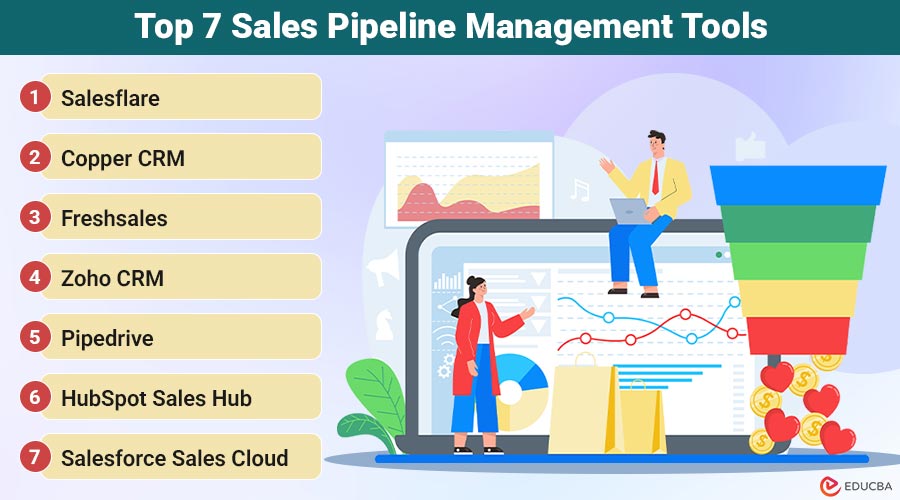
Top 7 Sales Pipeline Management Tools
The following 7 tools help businesses effectively track, manage, and optimize sales opportunities across every stage of the sales pipeline.
#1. Salesforce Sales Cloud
Salesforce Sales Cloud is an enterprise-grade CRM that manages complex sales pipelines using AI insights, automation, and advanced analytics to improve forecasting, productivity, and deal closure rates.
Key Features:
- Customizable pipeline stages
- AI-powered forecasting
- Advanced reporting dashboards
- Automation with workflow rules
#2. HubSpot Sales Hub
HubSpot Sales Hub is a user-friendly sales pipeline tool that helps teams track deals, automate follow-ups, and align sales activities with marketing and customer service efforts.
Key Features:
- Drag-and-drop pipeline view
- Automated email tracking and follow-ups
- Built-in forecasting tools
- Strong integration ecosystem
#3. Pipedrive
Pipedrive is a sales-focused CRM designed around visual pipelines, allowing teams to track deals, prioritize tasks effectively, stay organized, and consistently move sales opportunities toward successful closure.
Key Features:
- Visual, activity-based pipelines
- Custom deal stages
- Sales automation and reminders
- Simple reporting
#4. Zoho CRM
Zoho CRM is tool that helps businesses manage their sales process. It allows customization, offers automation and AI support, and lets you handle multiple sales pipelines easily, all at a economical price.
Key Features:
- Multiple pipeline configurations
- Workflow automation
- AI assistant (Zia)
- Integration with the Zoho ecosystem
#5. Freshsales
Freshsales is an AI-powered sales CRM that streamlines pipeline management through deal scoring, built-in communication tools, automation, and predictive insights for faster conversions.
Key Features:
- AI-based deal scoring
- Built-in phone and email
- Visual pipelines and automation
- Predictive forecasting
#6. Copper CRM
Copper CRM is a Google Workspace–native sales pipeline tool that automatically tracks activities, manages deals, and simplifies forecasting for teams working directly within Gmail and Calendar.
Key Features:
- Native Google Workspace integration
- Automatic activity logging from email
- Simple pipeline stages and deal tracking
- Reporting and forecasting dashboards
#7. Salesflare
Salesflare is a sales pipeline tool for small and mid-sized B2B teams, using automation and AI to fill in data automatically and help teams manage deals easily every day
Key Features:
- Smart contact and lead enrichment
- Pipeline views and sales forecasting
- Automated activity capture (emails, calls)
- Native integrations (Zapier, calendars, email)
Final Thoughts
Choosing the right sales pipeline management tools is essential for improving sales visibility, efficiency, and revenue predictability. From enterprise-grade solutions like Salesforce to user-friendly platforms such as HubSpot and Pipedrive, each tool serves different business needs. Evaluating features, scalability, and team workflows helps ensure better deal tracking, more accurate forecasting, and consistent sales growth.
Frequently Asked Questions (FAQs)
Q1. Why are sales pipeline management tools important?
Answer: They improve sales visibility, forecasting accuracy, team productivity and help close deals faster.
Q2. Which sales pipeline management tool is best for small businesses?
Answer: HubSpot Sales Hub, Pipedrive, and Salesflare are ideal for small businesses due to simplicity and affordability.
Q3. Can sales pipeline management tools improve revenue forecasting?
Answer: Yes, they use historical data, deal stages, and AI insights to generate accurate revenue predictions.
Q4. How do sales pipeline management tools integrate with other business systems?
Answer: Most tools offer integrations with CRMs, marketing automation, email platforms, calendars, and analytics systems to streamline workflows and unify data.
Recommended Articles
We hope that this EDUCBA information on “Sales Pipeline Management Tools” was beneficial to you. You can view EDUCBA’s recommended articles for more information.


