


Introduction to Safe-Haven Currencies
When geopolitical conflicts, sudden economic downturns, or unexpected policy changes rattle global markets, investors actively seek assets that hold their value. Safe-haven currencies are a critical part of this defensive strategy. These are currencies that maintain or even increase their value during periods of uncertainty, offering traders a hedge against volatile market conditions.
Among the top safe-haven currencies, the Japanese yen (JPY) stands out. For decades, it has earned a reputation for stability, often strengthening when other currencies are under pressure. Alongside the Swiss franc (CHF) and U.S. dollar (USD), the yen is considered one of the most reliable currencies in times of global turbulence.
Why Do Investors See the Japanese Yen as a Safe Haven?
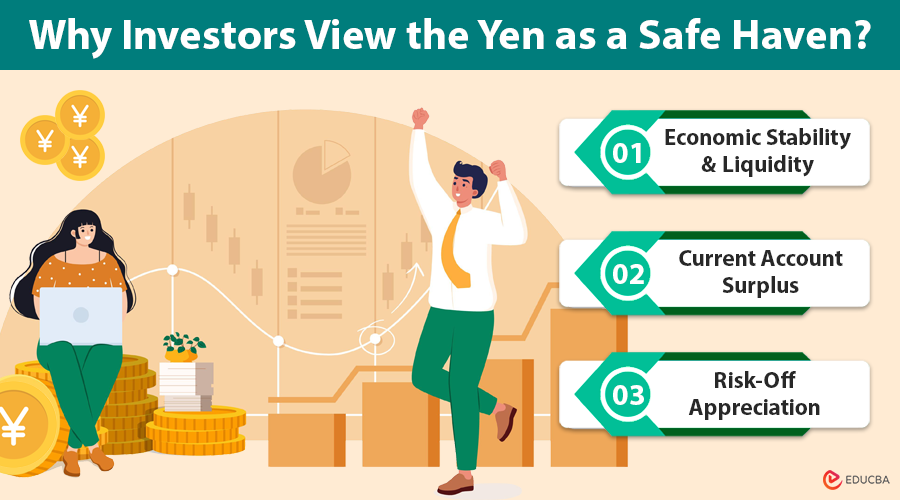
1. Economic Stability and Liquidity
Japan is the world’s third-largest economy, with a diverse industrial base, robust export sector, and advanced technological infrastructure. These factors give investors confidence in the yen’s long-term value.
The depth of Japan’s financial markets also plays a key role. The yen is one of the most traded currencies globally, ensuring high liquidity even during market stress. This liquidity means that large institutional investors can shift into yen quickly without causing extreme price distortions, making it a practical choice for managing risk.
2. Current Account Surplus
Japan’s consistent current account surplus is a major reason for its safe-haven appeal. This surplus comes from strong exports, steady returns on overseas investments, and relatively low reliance on imported energy compared to other nations.
During risk-off periods, Japanese investors often repatriate funds from overseas, boosting demand for the yen. This repatriation effect can cause the currency to appreciate sharply, especially against the U.S. dollar, as reflected in moves in the USD/JPY exchange rate.
3. Risk-Off Appreciation
The yen’s behavior during global market downturns has been remarkably consistent. For example:
- During the 2008 global financial crisis, the yen surged against most major currencies.
- In the early months of the COVID-19 pandemic, it again appreciated as investors sought stability.
When uncertainty rises, demand for the yen spikes, often pushing USD/JPY lower, which means the yen is gaining value while the dollar is losing ground. This pattern makes it a useful hedge for traders exposed to riskier assets.
Yen in Real-Time Context
- Japan’s bank of Japan policy pivot: The Bank of Japan is nearing a potential policy shift amid inflation pressures. The slowest-in-30-years spike at 3.3% in June is prompting discussions of tightening.
- Yen outpaces peers: A single comment from U.S. Treasury Secretary Scott Bessent triggered a ~0.7% yen appreciation to around ¥146.38, a move born of speculation that the Fed and BoJ might align monetary policies more closely.
- Sharp JPY decline leads to bond buying: In July, the yen weakened about 4.5% against the dollar, its steepest drop since late 2024. In response, Japanese investors shifted ¥536 billion out of foreign equities and poured ¥3.82 trillion into long-term bonds, a clear hedging pattern.
- USD/JPY technical perspective: The pair recently dropped 2.7% as it tested multi-week uptrend support. With volatility mounting, charts spotlight pivotal levels like 145.84 (support) and 148.07 (resistance), hinting at possible fuel for both rebound or correction.
- Risk-on rally reverses safe-haven pull: As global markets rallied, USD/JPY climbed to ¥148, dampening the yen’s safe-haven edge amid revived risk appetite
How Does the Yen Compare With Other Safe-Haven Currencies?
Swiss Franc (CHF)
Switzerland’s political neutrality, strong banking system, and fiscal discipline have built the Swiss franc’s reputation as a haven. European investors particularly favor it during regional instability. However, its smaller economy means it does not offer the same level of liquidity as the yen, making large-scale moves into CHF potentially more volatile.
U.S. Dollar (USD)
The U.S. dollar benefits from its role as the world’s primary reserve currency. International traders use it heavily, and the size of the U.S. economy supports it. However, domestic political disputes, debt ceiling standoffs, and unexpected Federal Reserve policy shifts sometimes challenge its safe-haven status. In certain crises, investors have preferred the yen over the dollar, especially when U.S. risks are part of the problem.
By contrast, the yen’s appeal tends to be more consistent, as it is less exposed to the same kind of global policy influence that affects the dollar.
The Dual Nature of the Yen
One unique aspect of the yen is that it is both a safe-haven currency and a popular funding currency in the carry trade.
- Safe haven in crises: In periods of high uncertainty, the yen tends to strengthen rapidly, making it valuable for risk management. Investors sell riskier assets and buy yen, driving appreciation.
- Funding currency in calm times: Japan’s low interest rates make borrowing yen cheap. Traders often borrow yen to invest in higher-yielding assets abroad, which can cause the yen to weaken when market sentiment is stable.
This dual nature means that the yen can swing between periods of appreciation and depreciation depending on global risk sentiment. For example, in a calm market, USD/JPY might trend higher as traders borrow yen, but during turmoil, the trend can reverse sharply as investors unwind carry trades.
Final Thoughts
The Japanese yen’s safe-haven status rests on several pillars: the strength and stability of Japan’s economy, its consistent current account surplus, and its historical tendency to appreciate during market stress. While the Swiss franc and U.S. dollar share this status, the yen’s combination of deep liquidity, economic resilience, and predictable “risk-off” behavior makes it uniquely valuable to investors.
Traders can make more informed decisions when volatility strikes by understanding how the yen reacts in different market conditions and seeing this reflected in pairs like USD/JPY.
Recommended Articles
We hope this guide on safe-haven currencies was insightfFul. Explore related articles on forex risk management, global currency market trends, and strategies for trading during market volatility to strengthen your trading decisions.

