


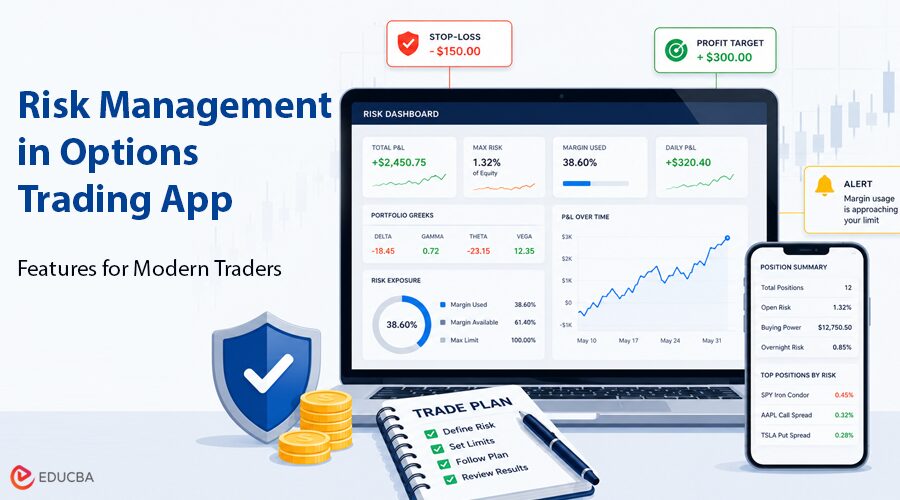
Options trading offers significant profit opportunities but also substantial risks. While many traders focus on finding profitable strategies, experienced investors understand that long-term success depends on effective risk management in options trading. As markets become more volatile and retail participation in derivatives grows, a well-designed option trading app must go beyond charts and order placement; it must embed robust risk management features at its core.
Essential Features for Risk Management in Options Trading App
Here are the essential risk management features every modern option-trading app should offer.
1. Position Sizing and Capital Allocation Tools
Position sizing is a key component of effective risk management. A good trading app should offer:
- Capital-based position calculators: Traders should be able to enter their total capital and the percentage of risk they are willing to take per trade (for example, 1%–2%). The app should then suggest an appropriate position size.
- Maximum exposure limits: Users should be able to set limits on total open risk, margin utilization, and the number of active strategies running simultaneously.
- Scenario-based trade simulations: The app should show how an options position may perform under different price and volatility scenarios.
Without these features, traders are more likely to overleverage their accounts, turning manageable losses into significant setbacks.
2. Built-in Stop-Loss and Profit Target Mechanisms
Manual discipline is helpful, but automated protection is far more effective. Every options trading platform should provide:
- Stop-loss orders for options: Support for both market and limit stop-loss orders specifically for options contracts.
- Trailing stop-loss: This feature automatically moves the stop-loss as the trade becomes profitable, helping to secure gains and protect profits.
- Profit targets: Predefined exit points help traders reduce emotional decision-making during volatile market conditions.
These features strengthen risk management in options trading by reducing emotional decision-making and ensuring traders stick to their plans.
3. Risk Analytics and Dashboard
Traders need access to a clear and comprehensive view of their overall risk exposure. A robust app should include:
- Real-time profit and loss (P&L) tracking: Monitor intraday, overnight, and overall portfolio performance from a single dashboard.
- Options Greeks analysis: View Delta, Gamma, Theta, and Vega at both the position and portfolio levels to better understand risk exposure.
- Margin utilization monitoring: Track available and used margin to avoid overleveraging.
- Margin call and exposure alerts: Receive notifications when margin requirements or portfolio risk levels approach predefined thresholds.
When risk is measured and presented clearly, traders can make faster and more informed decisions.
4. Advanced Order Types for Risk Control
Options trading requires more sophisticated order management than simple buy-and-sell orders. Important order types include:
- Bracket orders: A single order that includes entry, target, and stop-loss levels.
- Protective and hedging orders: Features that allow traders to add hedging positions when needed automatically.
- One-Cancels-the-Other (OCO) orders: When either the target or stop-loss order is executed, the other order is automatically canceled.
These order types help reduce the risk of incomplete or mismatched executions during periods of high market volatility.
5. Risk Limits and Alerts
Even experienced traders can get carried away during volatile market conditions. An option trading app should allow users to:
- Daily loss limits: Automatically restrict additional trades after a predefined loss threshold is reached.
- Volatility alerts: Notify traders when the underlying asset or implied volatility moves beyond set levels.
- Price gap notifications: Alert users to significant price movements that may impact open positions.
- Custom portfolio alerts: Send notifications when total Delta exposure, margin utilization, or overnight risk exceeds specified limits.
These features act as circuit breakers, helping traders avoid impulsive decisions.
6. Post-Trade Risk Review and Reporting
Risk management does not end once a trade is closed. A comprehensive app should provide:
- Trade journals: Records of entry and exit points, trade rationale, outcomes, win rates, average risk-reward multiples, and maximum drawdowns.
- Risk reports: Summaries showing capital utilization, breaches of risk limits, and strategies that contributed to losses.
- Data export capabilities: The ability to export data for deeper analysis using third-party tools.
Regularly reviewing trading performance is essential for improving risk management over time.
Final Thoughts
Long-term success in options trading is rarely determined by predicting every market move correctly. Instead, it depends on maintaining consistent discipline and implementing effective risk management in options trading. A modern option-trading app should do more than just facilitate trading. It should help traders think about risk, position sizing, and overall portfolio exposure. By embedding these features into the user experience, trading platforms can help investors build greater discipline, improve consistency, and enhance their long-term sustainability in the derivatives market.
Recommended Articles
We hope this guide to risk management in options trading helps you better protect your capital and improve your trading discipline. Check out these recommended articles for more insights and strategies to enhance your options trading performance.

