


Why One Risk Adjustment Vendor Management Often Backfires?
The promise sounds perfect: consolidate all risk adjustment services with a single vendor to simplify management, reduce costs, and improve coordination. Your executive team loves streamlined contracting. Procurement celebrates volume discounts. IT appreciates the single integration point. But twelve months later, you discover why top risk adjustment vendors rarely excel at everything. Your all-eggs-in-one-basket strategy is costing millions more than maintaining specialized partnerships. Effective risk adjustment vendor management requires more than convenience—it requires strategic choice.
The Reality in Risk Adjustment Vendor Management
Risk adjustment involves multiple complex functions, each requiring distinct expertise, technology, and operational approaches.
- Chart Retrieval: Requires strong provider relationships, logistical coordination, and follow-up processes.
- Coding: Demands clinical knowledge, regulatory expertise, and precise documentation practices.
- Analytics: Relies on data science, predictive modeling, and actionable reporting.
Despite marketing claims, no single vendor truly excels across all these areas. Large vendors may grow through acquisitions, bundling different services under one brand, but integration rarely goes beyond invoicing. Coding teams often operate separately from retrieval teams, and analytics departments may exist in silos, disconnected from operations.
The result is consolidated contracts but fragmented capabilities, leading to mediocre performance at a premium cost. Specialized vendors, in contrast, focus on their core competency, continually investing in innovation and process improvement. Organizations using best-of-breed partners see higher quality in each area, while those relying on a single vendor often experience stagnant performance across all services.
The Hidden Switching Costs
Once you have consolidated with a single vendor, extraction becomes nearly impossible. They control your data, understand your processes, and have embedded themselves across multiple functions. The switching costs are not just financial—they are operational, technical, and political. Data hostage situations emerge subtly. Your historical coding lives in their proprietary system. Your provider relationships route through their networks. Your workflows depend on their technology. When performance deteriorates or prices increase, you can not simply switch vendors without massive disruption. They know this, and their service quality often reflects this power imbalance.
The contract complexity multiplies switching barriers. Master service agreements spanning multiple services create interdependencies that make partial transitions impossible. Terminating coding services might trigger penalties in retrieval contracts. Reducing volumes in one area affects pricing across all services. The vendor has engineered lock-in through contract architecture. Internal resistance compounds external barriers. Teams that spent months integrating with the consolidated vendor resist another transition. Executives who championed consolidation resist admitting strategy failure. The organizational inertia favors the status quo even when performance clearly suffers. Bad vendor relationships persist because change seems harder than tolerance.
The Performance Degradation Pattern
Consolidated vendors follow a predictable performance pattern. Initial results often meet expectations as they deploy their best resources to secure the relationship. But once embedded, service quality gradually deteriorates while prices steadily increase. The accountability vacuum emerges when one vendor controls multiple services. Poor retrieval rates get blamed on provider cooperation. Coding errors get attributed to documentation quality. Analytics failures get explained by data limitations. Without competitive benchmarks, you can not distinguish vendor failures from market realities.
Resource allocation within consolidated vendors favors their most profitable services, not your most critical needs. If coding generates better margins than retrieval, which team gets the experienced staff and technology investments? Your comprehensive partnership means accepting their internal prioritization, which rarely aligns with your requirements. Innovation stagnates without competitive pressure. Specialized vendors must continuously improve to win and retain clients. Consolidated vendors rely on switching costs rather than superior performance. They innovate enough to prevent termination, but not sufficiently to drive real value. You get stability at the expense of advancement.
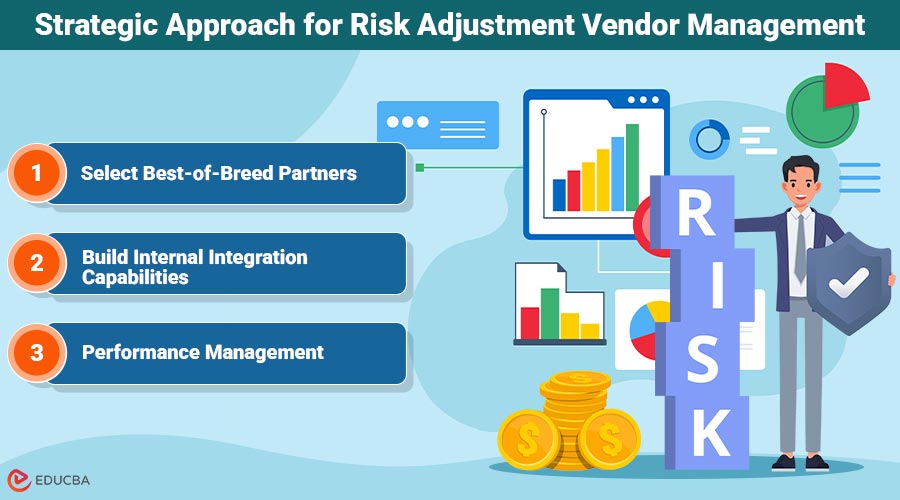
Strategic Approach for Risk Adjustment Vendor Management
Leading health plans are moving away from consolidation toward a strategic multi-vendor ecosystem. This approach focuses on performance and specialization rather than convenience.
1. Select Best-of-Breed Partners
- Identify which vendor retrieves charts most efficiently in your region.
- Choose coding partners with superior accuracy for your population’s complexity.
- Partner with analytics vendors capable of delivering actionable insights rather than just dashboards.
This ensures excellence in each capability while fostering competition and continuous improvement.
2. Build Internal Integration Capabilities
Instead of relying on vendors for connections, health plans develop internal orchestration capabilities:
- Data flows through internal systems rather than vendor platforms.
- Workflows are coordinated internally across multiple vendors.
- Your organization maintains control while leveraging specialized expertise.
3. Performance Management
Active oversight ensures continuous improvement:
- Benchmark vendor performance regularly.
- Maintain the flexibility to transition underperforming vendors without disruption.
- Use competitive tension to negotiate better pricing and service levels.
Transitioning from Consolidation to Multi-Vendor Management
Shifting from a single-vendor model to a multi-vendor strategy requires careful planning:
- Partial Transitions: Begin by identifying the weakest service from your consolidated vendor and contract a specialized vendor for that function first.
- Build Internal Infrastructure: Develop vendor management processes, data integration expertise, and performance monitoring systems.
- Negotiate Strategically: Partial transitions can prompt consolidated vendors to improve service or reduce costs.
- Document Lessons Learned: Capture integration challenges, coordination successes, and performance improvements to inform future decisions.
Gradual evolution minimizes operational risks while driving superior results.
The Excellence Imperative
Risk adjustment success requires excellence across multiple dimensions. Consolidation promises simplicity but delivers mediocrity. Strategic multi-vendor management seems complex, but it produces superior results. The choice depends on whether you are optimizing for procurement ease or program performance.
The best vendors acknowledge their limitations, focusing on core competencies rather than service sprawl. They welcome ecosystem participation rather than demanding exclusivity. They compete on performance rather than lock-in. These partners become true strategic assets rather than necessary evils.
Your next vendor decision should not start with “Who can do everything?” but rather “Who does each thing best?” The answer leads to an ecosystem of excellence rather than a monopoly of mediocrity.
Final Thoughts
Risk adjustment programs thrive when organizations prioritize performance over convenience. Consolidating all services with one vendor may appear cost-effective initially, but it often results in operational inefficiencies, lock-in, and stagnation. A strategic multi-vendor approach, supported by robust internal processes and performance oversight, ensures superior outcomes, innovation, and long-term success in risk adjustment vendor management.
Recommended Articles
We hope this guide to risk adjustment vendor management helps optimize your vendor strategies. Check out these recommended articles for more insights and best practices.

