


What is Bailment?
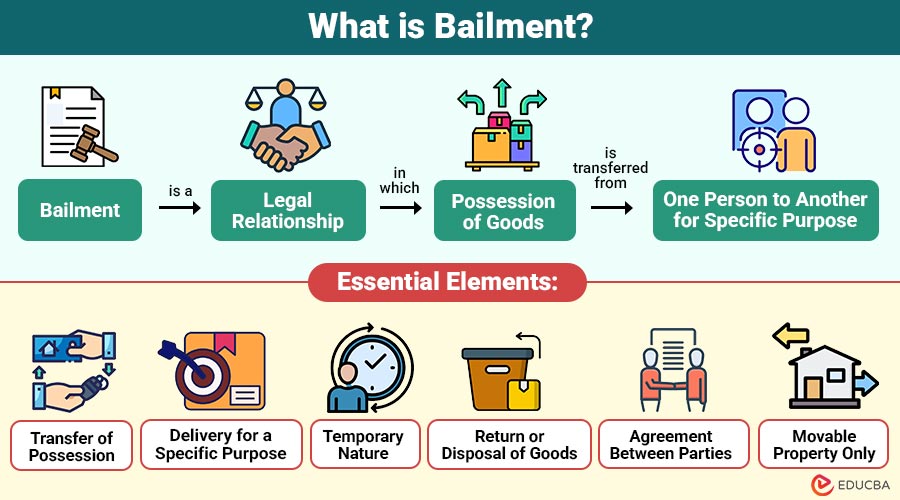
Bailment is a legal relationship in which possession of goods is transferred from one person to another for a specific purpose. Once the goal has been achieved, the commodities must be returned or disposed of in line with the conditions of the agreement.
It is important to note the following:
- Only possession is transferred, not ownership
- The goods must be movable property
- The relationship is based on trust and responsibility
Table of Contents:
- Meaning
- Legal Importance
- Essential Elements
- Types
- Rights Associated with Bailment
- Duties
- Termination
- Practical Applications
Key Takeaways:
- Bailment involves the temporary transfer of possession of goods without legally transferring ownership rights.
- It is based on trust and responsibility between the bailor and bailee parties, which is always essential.
- It applies only to movable goods delivered for specific lawful purposes and to agreements valid only.
- It ends upon completion, expiry of time, destruction, breach, or mutual agreement to terminate the contract.
Legal Importance of Bailment
The following points highlight the legal importance of bailment in business and everyday transactions:
1. Protects Goods during Temporary Transfer
legally protects goods during a temporary transfer, ensuring safety, accountability, and proper handling throughout the term of the arrangement.
2. Ensures Responsible Handling of Property
It ensures responsible handling of property by imposing a legal duty to care for goods with reasonable caution.
3. Builds Trust in Commercial Transactions
Builds trust in commercial transactions by creating a reliable legal framework for safe exchange and custody of goods.
4. Supports Logistics, Warehousing, and Service Industries
It supports the logistics, warehousing, and service industries by enabling the smooth movement, storage, and handling of goods.
5. Reduces Disputes through Clear Legal Obligations
Reduces disputes by clearly defining the legal obligations, responsibilities, and expectations among the parties involved in the transaction.
Essential Elements of Bailment
The following are the essential elements required to create a valid bailment under law:
1. Transfer of Possession
Transfer of possession occurs when goods are handed over, while ownership remains unchanged with the original owner.
2. Delivery for a Specific Purpose
Goods are delivered for a specific lawful purpose, such as repair, storage, transport, or safe custody.
3. Temporary Nature
It is temporary in nature, lasting only until the agreed purpose is fulfilled.
4. Return or Disposal of Goods
Upon completion, the bailee must return the goods to the owner or dispose of them strictly according to the previously agreed instructions.
5. Agreement Between Parties
Originates from a written, verbal, or behaviorally implied agreement between the parties.
6. Movable Property Only
The bailment arrangement can include only movable property, such as goods, vehicles, electronics, or documents.
Types of Bailment
The following are the major types commonly recognized in legal and commercial transactions:
1. Free Bailment
This type involves no monetary consideration. Goods are handed over without payment, usually for safekeeping or personal favor.
2. Paid Bailment
In this arrangement, the service provided in handling or storing goods involves payment, such as warehouse storage or courier services.
3. Mutual Benefit Bailment
Both parties benefit in this arrangement. One party receives service, and the other receives compensation or an advantage.
4. Bailment for Safe Custody
Goods are handed over purely for protection or safekeeping, such as storing valuables in a bank locker.
5. Bailment for Repair or Service
Goods are delivered for improvement, repair, or maintenance, such as vehicle servicing or electronic repair.
6. Bailment for Transportation
Goods are transferred for movement from one place to another, as in logistics and courier services.
Rights Associated with Bailment
Bailment relationships come with certain legal rights to ensure fairness and protection:
1. Right to Receive Goods Back
This right ensures that the bailee returns the goods in their original condition, without unnecessary delay, after completing the purpose for which they were obtained.
2. Right to Compensation
If goods are damaged due to negligence or improper handling, compensation can be legally claimed from the responsible party.
3. Right to Terminate Agreement
When either party violates the terms, the affected party can immediately terminate the bailment agreement as permitted by law.
4. Right Over Accrued Benefits
The bailee must return any natural increase, profit, or benefit arising from the goods along with the original goods.
Duties in Bailment
The following are the important duties that parties must fulfill in a bailment arrangement:
1. Duty of Reasonable Care
Goods must be handled with reasonable care, as a prudent person would protect their own property.
2. Duty to Follow Instructions
The bailee must use the goods strictly according to the instructions given and only for the agreed specific lawful purpose.
3. Duty Not to Misuse Goods
The bailee must not misuse the goods or use them beyond the agreed purpose, ensuring proper legal compliance and responsibility at all times.
4. Duty to Return Goods on Time
The bailee must return the goods promptly after completing the purpose without unnecessary delay or retention under any condition.
5. Duty Not to Mix Goods
Goods must remain separate and not mixed with others unless explicitly permitted to avoid confusion or loss.
Termination of Bailment
The following are the common situations in which a bailment arrangement comes to an end:
1. Completion of Purpose
The bailment ends automatically once the parties fully complete the intended purpose and no longer require the goods.
2. Expiry of Time Period
The bailment automatically ends after the parties complete the agreed fixed time period.
3. Destruction of Goods
The destruction of the goods or their becoming unusable for any reason immediately terminates the bailment.
4. Mutual Agreement
Both parties can terminate the bailment before completing the purpose if they mutually agree to end the arrangement.
5. Breach of Conditions
If either party violates the agreed conditions, the breach of contract terms and obligations immediately terminates the bailment.
Practical Applications of Bailment
The following are some common practical applications of bailment in daily life and commercial activities:
1. Courier and Delivery Services
Courier services apply bailment principles when they temporarily handle, transport, and safely deliver goods to recipients.
2. Vehicle Parking Facilities
Vehicle parking involves a bailment in which parking operators temporarily store vehicles in designated spaces under their safety and supervision.
3. Repair and Maintenance Services
Repair services use bailment when customers hand over goods for repair, maintenance, or technical servicing.
4. Storage of Goods in Warehouses
Warehouses store goods temporarily under bailment, ensuring proper care, security, and systematic handling of inventory items.
5. Renting Equipment or Tools
Equipment rental involves bailment, where rental companies temporarily provide tools for use, and users must return them properly.
6. Banking Lockers for Valuables
Banks operate lockers on a bailment basis by securely storing valuables for temporary safekeeping under controlled conditions.
Final Thoughts
Bailment is a key contract law concept involving the temporary transfer of goods for specific purposes. It ensures responsible handling, proper use, and safe return of property while defining legal duties and protections that support trust, accountability, and efficient transactions across personal services and commercial operations in modern legal systems.
Frequently Asked Questions (FAQs)
Q1. Can bailment exist without a written agreement?
Answer: Yes, bailment can be created through written, oral, or implied agreements based on the parties’ conduct.
Q2. Is consideration necessary for bailment?
Answer: Not always. Bailment can be free (without payment) or paid, depending on the parties’ agreement.
Q3. Can bailment be terminated early?
Answer: Yes, it can be terminated early if both parties agree or if there is breach of conditions.
Q4. What happens if the bailee damages the goods?
Answer: The bailee may be legally responsible to compensate the bailor if damage occurs due to negligence or misuse.
Recommended Articles
We hope that this EDUCBA information on “Bailment” was beneficial to you. You can view EDUCBA’s recommended articles for more information.


