
What is Project Baseline?
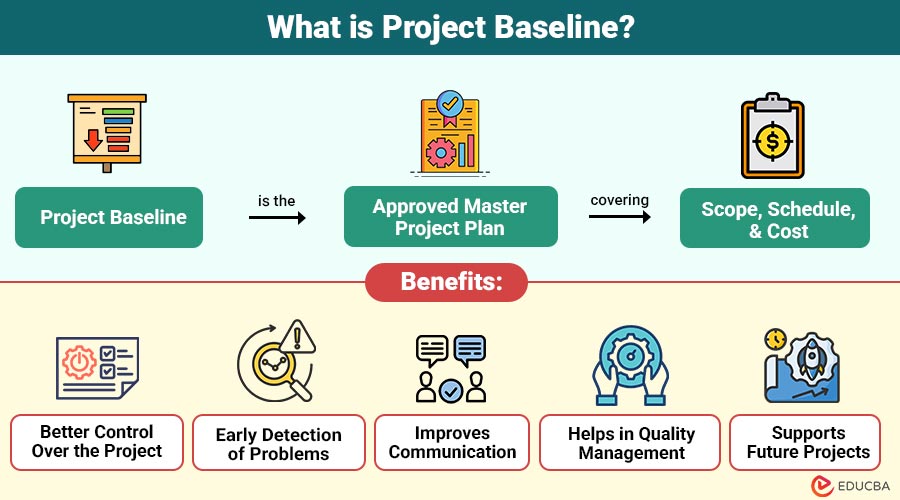
A Project Baseline is the approved master project plan covering scope, schedule, and cost. It defines what work will be done, when it will be done, and how much it will cost, serving as the reference for all progress and change controls.
Table of Contents:
- Meaning
- Why Project Baseline Matter?
- Types
- How to Create a Project Baseline?
- Benefits
- Real-World Example
- Challenges
- Use Cases
Key Takeaways:
- A project baseline provides a clear, approved reference for planned scope, schedule, and overall cost.
- Baselines enable accurate progress tracking by comparing actual results with planned project performance metrics.
- Effective baselines improve decision-making by highlighting delays, risks, cost overruns, and required corrective actions.
- Properly maintained baselines strengthen communication, alignment, forecasting accuracy, and control throughout the project lifecycle.
Why Project Baseline Matter?
Setting a baseline is one of the most important steps in project management. Here is why:
1. Clarity and Alignment
A baseline ensures everyone—including clients, managers, and team members—understands the project goals and expectations.
2. Performance Tracking
Project performance is measured by comparing actual results with baseline values. This reveals delays, overruns, or risks early.
3. Change Control
If a stakeholder requests a change, the baseline shows how the change will affect cost, timeline, or scope. This avoids unwanted surprises.
4. Better Decision-Making
With a clear baseline, managers can make smarter decisions based on facts, not assumptions.
5. Accurate Forecasting
Predicting completion time, budget usage, and future risks becomes easier.
Types of Project Baselines
It usually refers to these three core components:
1. Scope Baseline
This defines what work the project will deliver. It includes:
- Project Scope Statement
- Work Breakdown Structure (WBS)
- WBS Dictionary
The scope baseline defines the project’s boundaries—what is included and what is excluded.
2. Schedule Baseline
This defines when each activity must be completed. It includes:
- Project timeline
- Gantt charts
- Milestones
- Deadlines
The schedule baseline is essential for tracking delays or early completions.
3. Cost Baseline
This defines the amount of money the project will require. It includes:
- Estimated costs
- Cost breakdown
- Budget allocation
The cost baseline helps monitor spending and prevent overruns.
How to Create a Project Baseline (Step-by-Step Process)
Below is simple step-by-step guide.
Step 1: Collect Requirements
Understand what stakeholders expect from the project. Document their needs clearly.
Step 2: Define the Scope
Use tools such as WBS and scope statements to define what the project will deliver clearly.
Step 3: Build the Project Schedule
Break tasks into smaller activities, assign durations, and sequence them logically. Use project management tools like MS Project, Asana, or Jira.
Step 4: Estimate Costs
Estimate the cost for every task, resource, and activity. Add contingency amounts for unexpected risks.
Step 5: Get Approval
Present the scope, timeline, and cost plan to key stakeholders. Once approved, this becomes the official baseline.
Step 6: Lock the Baseline
Store the version in your project documentation. Do not change it unless a formal request comes.
Step 7: Monitor and Compare
Throughout the project, compare actual progress with the baseline. Identify deviations early.
Benefits of Project Baseline
Here are the key benefits that a project baseline provides for effective project management:
1. Better Control Over the Project
Managers gain clear visibility into planned work and actual progress, enabling improved control.
2. Early Detection of Problems
Delays, cost overruns, and scope deviations are quickly identified, allowing timely corrective actions to prevent failure.
3. Improves Communication
A shared reference point ensures that every team member and stakeholder understands expectations and stays effectively aligned.
4. Helps in Quality Management
Comparing planned outcomes with actual performance helps identify quality issues early and maintain project standards.
5. Supports Future Projects
Historical baseline data improves estimation accuracy and planning efficiency for future similar projects across teams.
Real-World Example
Here is an example demonstrating how a project baseline works in a real scenario:
A Website Development Project
Scope Baseline Includes:
- Homepage, About page, Contact page
- Admin dashboard
- Mobile-responsive design
- SEO optimization
Schedule Baseline Includes:
- Week 1–2: Wireframes & design
- Week 3–5: Development
- Week 6: Testing
- Week 7: Launch
Cost Baseline Includes:
- Designer: $2,000
- Developer: $4,000
- Tester: $1,500
- Tools/software: $500
If the developer takes 7 weeks instead of 5, the variance clearly shows a delay. Managers can take action to resolve it early.
Common Challenges in Setting a Baseline
Here are some of common challenges teams commonly face while creating an accurate and reliable project baseline:
1. Unclear Requirements
When stakeholder expectations are not clearly understood, the baseline becomes inaccurate and difficult to manage effectively.
2. Poor Estimation
Incorrect time, cost, or resource estimates create unrealistic baselines, negatively impacting project planning and execution.
3. Frequent Changes
Continuous scope changes disrupt baseline stability, making progress tracking difficult and significantly reducing overall project predictability.
4. Lack of Communication
Without a clear explanation, team members misinterpret baseline details, leading to confusion and misalignment throughout the project lifecycle.
Use Cases of Project Baseline
Here are the use cases where it plays a important role in ensuring smooth execution and control:
1. Construction Projects
Used to monitor materials, labor costs, and scheduling progress, and ensure work aligns with planned timelines.
2. IT Projects
Helps manage development sprints, project budgets, technical deliverables, and overall progress against the approved baseline.
3. Event Planning
Enables managing venue bookings, activity schedules, required resources, and event expenses according to planned baselines.
4. Marketing Campaigns
Used to track campaign tasks, deadlines, allocated budgets, and performance progress against predefined baseline plans.
Frequently Asked Questions (FAQs)
Q1. Who approves the project baseline?
Answer: Usually, the project sponsor or senior project manager.
Q2. Can a baseline be changed?
Answer: Yes, but only through an approved change-control process.
Q3. Why is a baseline important?
Answer: It helps track progress, detect issues early, and keep the project aligned.
Recommended Articles
We hope that this EDUCBA information on “Project Baseline” was beneficial to you. You can view EDUCBA’s recommended articles for more information.

