


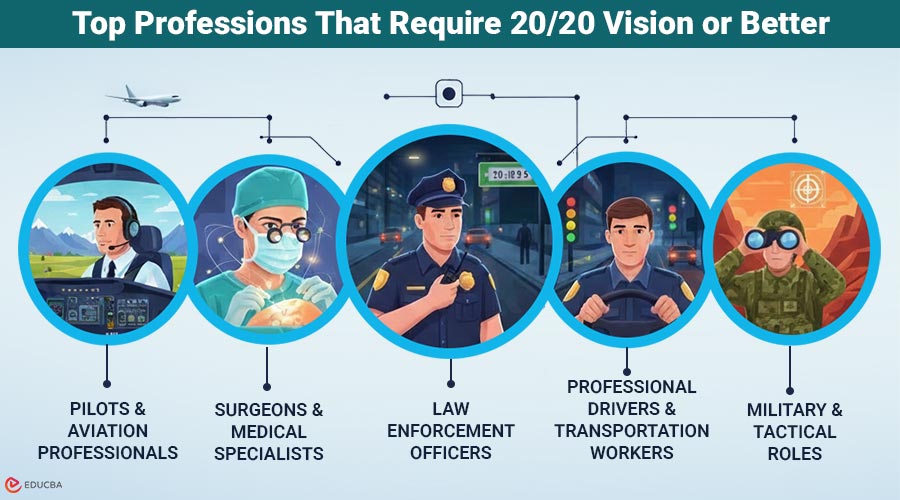
Professions That Require 20/20 Vision: Overview
Clear vision is an important factor in many types of jobs, especially those that require accuracy and quick decision-making. Some roles require a high level of vision to perform competently. Even slight vision issues can affect performance or make the candidate ineligible to get their foot in the door let alone climb the ladder of success in the industry. While glasses and contact lenses correct vision, some opt for LASIK eye surgery to enhance their vision without the need for corrective devices that can be cumbersome in some environments. In this article, we explore five professions that require 20/20 vision and explain why perfect eyesight is essential to success in these careers.
Top Professions That Require 20/20 Vision or Better
Here are some of the top professions that require 20/20 vision or better, along with the key reasons why clear eyesight is essential for each role.
1. Pilots and Aviation Professionals
Few industries are as demanding of vision acuity as aviation. Air pilots, military pilots, and private pilots require top-level vision to do their jobs dependably. Pilots use their distance vision to see airplanes, topography, and runway markers, and their near and intermediate vision to see cockpit instruments and computer screens. Depth perception and peripheral vision are needed when operating in heavy air traffic or during difficult landings.
Although some aviation organizations permit pilots with corrective lenses, there are standards they must meet for both uncorrected and corrected vision. LASIK surgery has become popular among pilots because most organizations now allow pilots who have undergone authorized vision corrective surgeries.
2. Surgeons and Medical Specialists
In medical settings, especially in surgical operations, precision is non-negotiable. Surgeons must be able to recognize fine details, often for prolonged periods under stressful conditions. Even subtle distortion of the visual field may contribute to eye strain or inaccuracy in complex surgery situations.
Although corrective lenses are common practice, some surgeons choose not to wear them during long procedures due to discomfort or fogging. High visual acuity is also essential for dentists, ophthalmologists, and other specialists, who work mostly within a small visual field. Having perfect eyesight enables specialists to work accurately and safely.
3. Law Enforcement Officers
Police and other law enforcement officers need excellent vision to respond effectively to situations. Spotting suspects, reading number plates, observing the surroundings, and handling weapons safely depend on clear vision. It can literally be a matter of life and death.
Most police forces have minimum vision standards for recruits, which include specifications for both corrected and uncorrected vision. Recruiters conduct field awareness, night vision, and depth perception tests during the recruitment process.
4. Professional Drivers and Transportation Workers
Professional drivers who require significant visual acuity to safely transport the general public include truck drivers, bus drivers, and train engineers. All of these individuals are constantly monitoring road activity and distances. The transport sector typically sets minimum visual standards, including requirements for distance and field of vision.
Other positions may require accurate color vision, particularly for interpreting traffic signals. For individuals who drive for most of the day, visual fatigue can become a problem. Good vision reduces eye strain from driving and improves reaction times, both of which are essential for accident avoidance.
5. Military and Tactical Roles
Service members in the military, particularly those in combat, aviation, and special operations, may be subject to some of the toughest vision criteria of any occupation. Military and tactical roles require excellent vision for target identification, direction, surveillance, and coordination. In tactical operations, using glasses or contact lenses could pose some operational difficulties.
Contact lenses could fog, shatter, or malfunction in adverse environments. Currently, the military widely accepts LASIK and other corrective surgeries. For personnel, having correctable vision creates new employment opportunities that eyesight restrictions previously limited.
Final Thoughts
Roles that involve guiding aircraft, performing surgery, ensuring public safety, or operating in tactical environments are among the key professions that require 20/20 vision. Advances in vision correction options enable more people to pursue careers that might not have been available to them previously. Whether through conventional glasses, contact lenses, or the LASIK procedure, you need perfect eyesight to fulfill the responsibilities of some career paths. The good news is that vision correction surgery means the door would not automatically be shut to certain careers just because you require eyewear to achieve the level of visual acuity required.
Recommended Articles
We hope this guide on professions that require 20/20 vision helps you explore career options. Check out these recommended articles for more insights on pursuing careers that demand perfect eyesight.

