


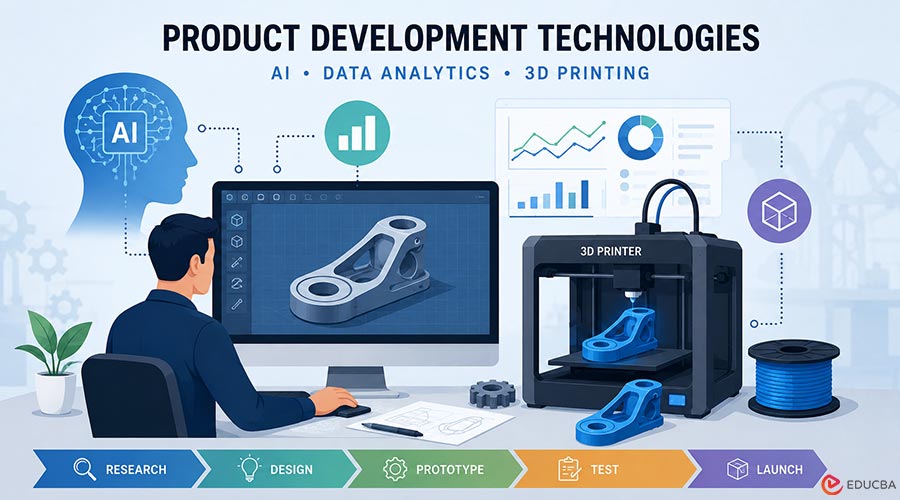
Product development technologies have undergone a remarkable transformation over the last decade. Companies are increasingly moving away from depending only on intuition, manual testing, and long development cycles when launching new products. Instead, they are leveraging advanced product development technologies such as AI, data analytics, and 3D printing to accelerate innovation and improve decision-making.
The integration of these technologies has enabled a more efficient, data-driven approach to product design and manufacturing. Organizations can now analyze customer needs, simulate product performance, identify potential issues, and test physical prototypes faster than ever before. As organizations advance their digital transformation efforts, it has become increasingly important for students, engineers, analysts, and professionals across various industries to understand how these technologies integrate and function together.
What is Modern Product Development?
Product development is the process of designing, testing, and refining a product before it is launched in the market. Traditionally, this process involved multiple stages of design, prototyping, testing, and manufacturing. The challenge with traditional approaches was that mistakes discovered late in the process could be expensive to fix. Design flaws, manufacturing issues, and customer feedback often emerged only after significant investments had already been made.
Modern product development aims to reduce these risks through digital technologies and data-driven decision-making. Organizations today use simulations, analytics, and automated design tools to identify problems early and improve product quality before large-scale production begins.
Understanding the Role of AI in Product Development Technologies
AI has emerged as an important tool in product development, with AI systems capable of processing large datasets and uncovering patterns that human designers might not easily detect. This capability allows organizations to make better design decisions while reducing development time. One growing application is generative design. In generative design, engineers specify requirements such as dimensions, materials, performance goals, and manufacturing constraints. AI algorithms then generate multiple design alternatives that meet those requirements.
This approach enables teams to explore a wider range of possibilities while discovering solutions that might not have been considered through traditional methods. AI is also being used for predictive analysis. By studying historical product data, machine learning models can estimate performance outcomes, identify potential failure points, and support more accurate decision-making throughout the development process.
How Does Data Analytics Support Better Decisions?
Data analytics plays a vital role in converting raw data into valuable, actionable insights. Organizations gather information from various sources such as customer feedback, product trials, manufacturing processes, and connected devices. This information helps teams understand how products perform under real-world conditions. For example, analytics can help companies identify recurring defects, monitor quality metrics, and understand customer preferences. These insights enable organizations to improve products while reducing operational risks continuously.
Predictive analytics is especially useful as it enables teams to forecast future outcomes using historical data. Rather than responding to issues after they arise, organizations can detect potential problems in advance and take proactive steps. This proactive approach leads to higher-quality products and more efficient development processes.
What is 3D Printing?
A manufacturing process called 3D printing uses digital plans to create physical things layer by layer. Unlike traditional manufacturing methods that often require molds, tooling, or extensive setup, 3D printing allows designers to produce parts directly from computer-generated models. This flexibility offers several advantages:
- Faster prototype creation
- Reduced material waste
- Lower development costs
- Greater design freedom
- Faster iteration cycles
Because of these benefits, 3D printing has become an important technology in modern engineering and product development.
Combining AI, Analytics, and 3D Printing
The true value of these technologies becomes apparent when they are used together. AI can generate optimized designs based on specific performance requirements. Data analytics can evaluate the effectiveness of those designs using simulations and testing data. 3D printing can then transform those digital concepts into physical prototypes within a short period. This integrated workflow significantly accelerates innovation.
To accelerate testing and design validation, many organizations use 3D printing services to produce prototypes quickly and gather real-world performance data before moving into full-scale production. The information collected from prototype testing can then be analyzed and fed back into future design iterations, creating a continuous improvement cycle. As a result, organizations can develop better products while reducing development costs and shortening time-to-market.
Industry Applications of Product Development Technologies
Here are the key industry applications of product development technologies explained through the following points.
1. Automotive Industry
Automotive manufacturers use AI-driven design tools and rapid prototyping to improve vehicle components, reduce weight, and enhance performance. Data analytics helps engineers evaluate safety, reliability, and manufacturing efficiency before products enter production.
2. Aerospace Industry
The aerospace sector relies heavily on simulation, analytics, and additive manufacturing to create lightweight components and improve fuel efficiency. Rapid prototyping allows engineers to validate designs before investing in expensive manufacturing processes.
3. Healthcare Industry
Medical device manufacturers use these technologies to develop customized solutions, improve testing accuracy, and accelerate product approval processes. 3D printing has further enabled the creation of patient-specific models that assist in planning medical procedures.
4. Consumer Electronics
Technology companies frequently use rapid prototyping to test new products and gather user feedback before launching devices to market. This approach reduces uncertainty and improves product quality.
Career Opportunities in the Digital Manufacturing Era
As AI, analytics, and advanced manufacturing become more common, demand for professionals with interdisciplinary skills continues to grow.
Career opportunities include:
- Data Analyst
- Data Scientist
- AI Engineer
- Product Development Engineer
- Manufacturing Engineer
- Industrial Designer
- Digital Transformation Specialist
Professionals who understand both data-driven technologies and engineering processes are increasingly valuable across industries.
Final Thoughts
Modern product development technologies are making the product creation process smarter, faster, and more efficient. Artificial intelligence helps organizations optimize designs, data analytics provides actionable insights, and 3D printing enables rapid physical validation of ideas. Together, these technologies are transforming how products are designed, tested, and improved. For students and professionals looking to build future-ready skills, understanding the relationship between AI, analytics, and additive manufacturing is becoming increasingly important. As technology continues to advance, organizations that effectively integrate these capabilities will be more equipped to innovate, minimize risks, and deliver improved products to market more quickly than before.
Recommended Articles
We hope this guide on product development technologies helps you gain deeper insights. Check out these recommended articles for more strategies and knowledge to stay ahead in innovation and product development.


