


Leveraging AI for Predictive IT Support and Maintenance
What if your IT systems stop working in the middle of a busy day? Employees scramble, customers get frustrated, and your business loses valuable time and money. This common scenario leaves many business owners questioning how they could have prevented it. Here is the good news — predictive IT maintenance is changing the way IT support works. Artificial Intelligence (AI) helps businesses predict issues before they happen. By studying data patterns, AI tools keep IT systems stable and lower the chances of sudden downtime. This blog explains how AI-driven predictive IT maintenance makes IT support more efficient, reliable, and cost-friendly.
Key Technologies for Predictive IT Support
AI excels in tools that identify issues before they grow. These technologies collaborate to maintain system efficiency and prevent expensive disruptions.
1. Machine Learning for Anomaly Detection
Machine learning identifies unusual patterns in IT systems before they lead to problems. Algorithms analyze data from servers, networks, and devices to detect anomalies. These tools identify early signs of equipment failure or irregular activity that humans might overlook. For example, it can detect sudden spikes in network traffic due to a potential cyberattack. Quick alerts allow businesses to respond swiftly, avoiding costly downtime. Teams like Netsurit’s cybersecurity team specialize in leveraging these AI-driven methods to keep IT environments resilient and secure.
Predictive analytics powered by machine learning enhances system health monitoring. Constant observation identifies issues like memory leaks or declining hardware performance. This analysis helps IT teams address problems faster and more effectively than traditional methods. Smart detection ensures smoother operations across connected environments while saving time and resources for future actions.
2. IoT Sensors and Real-Time Monitoring
IoT sensors gather data from IT equipment continuously. They track temperature, power usage, and system performance to identify issues early. This real-time information helps prevent equipment failure by signaling unusual patterns or conditions. For instance, a server operating at a higher temperature than usual can send warnings, enabling quick action before it overheats.
Sensors also enhance operational efficiency by minimizing the need for manual checks. Automated alerts direct IT teams to critical areas without delays. These tools boost system reliability and significantly reduce downtime risks.
Operating around the clock, they reassure businesses while cutting long-term maintenance expenses. Many companies enhance these benefits further by partnering with Netwize, ensuring their IT support and monitoring strategies align with modern predictive technologies. Without IoT monitoring, you are estimating when issues occur rather than knowing immediately.
3. Big Data Analytics and Predictive Models
Connected data from IoT sensors often feeds directly into big data systems. These systems can handle and analyze large volumes of information in a short time. By analyzing patterns in this vast array of numbers, predictive models can identify potential failures before they occur.
Machine learning algorithms excel in this area, transforming raw data into actionable insights. For example, a sudden spike in server temperature might indicate hardware burnout. Predictive analytics does not just stop at detection—it provides IT teams with the time and resources to prevent downtime or costly repairs.
How AI Powers Predictive IT Maintenance?
Artificial intelligence identifies issues before they grow more serious. It ensures systems operate efficiently without ongoing human involvement.
1. Proactive Identification of System Failures
AI identifies issues before they develop further. By examining data patterns from IoT sensors, it detects abnormalities that indicate possible equipment problems. Minor indicators, such as unexpected temperature increases or delayed system responses, are promptly noticed. It is better to address a crack than replace the entire wall. With predictive analytics and machine learning, businesses plan maintenance only when necessary. This method saves time and minimizes operational interruptions without relying on continuous manual oversight.
2. Automation in Issue Resolution
AI systems now resolve common IT issues without human involvement. Automated tools address recurring errors, reset incorrect settings, or apply patches promptly. These systems save teams hours by removing the need for manual inspections. For example, machine learning algorithms predict equipment failure and trigger corrective measures before problems escalate. Chatbots built into support platforms respond instantly to user inquiries. They assist employees step-by-step in resolving basic issues or forward complex ones to technicians. This minimizes wait times and improves system reliability in workplaces of all sizes.
3. Real-Time Alerts and Notifications
Automation in resolving issues prepares the way for instant updates. Real-time alerts identify potential problems early, reducing downtime and ensuring smooth operations. IoT sensors and predictive analytics collaborate to monitor systems continuously. Alerts inform teams about unusual patterns or potential equipment failures, enabling swift decision-making. Notifications eliminate uncertainty, enabling IT services to respond promptly and prevent disruptions.
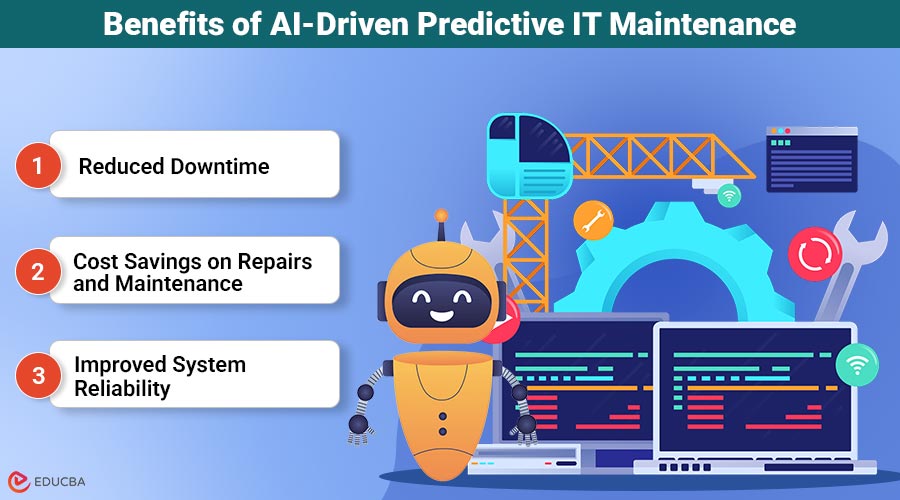
Benefits of AI-Driven Predictive IT Maintenance
AI simplifies maintenance, trims costs, and keeps systems humming smoothly—dive deeper to see how it works wonders for your IT.
1. Reduced Downtime
AI detects potential issues before systems fail. It forecasts equipment problems using data analysis and condition monitoring, reducing unexpected breakdowns. This forward-thinking maintenance ensures that critical operations continue uninterrupted. Automation speeds up issue resolution. Instant alerts from IoT sensors enable swift action, reducing delays in repairs. With reduced downtime, businesses save time and sustain operational efficiency with ease.
2. Cost Savings on Repairs and Maintenance
AI lowers repair costs by identifying issues early. Predictive analytics detects potential failures before they worsen, reducing expenses on major fixes. Businesses prevent costly downtime and urgent repairs with dependable fault detection methods in place. Routine equipment inspections become more effective through condition monitoring tools powered by machine learning. These systems examine real-time data, enabling IT teams to determine maintenance requirements accurately. By addressing problems at the appropriate time, companies significantly reduce unnecessary servicing costs.
3. Improved System Reliability
Reducing the frequency of repairs directly strengthens system reliability. AI-based fault detection predicts issues before they worsen, ensuring consistent performance. Automated monitoring reduces human error and identifies changes faster than manual checks. Live sensor data enables IT systems to operate efficiently. Machine learning models consistently learn from this data to enhance accuracy in identifying potential problems. Avoiding failures safeguards uptime, maintaining steady and reliable operations.
Challenges in Implementing AI for IT Maintenance
Training AI models for predictive IT maintenance requires accurate and complete data inputs. Inadequate datasets pose challenges, making patterns more difficult to identify in predictive analytics. Many businesses also encounter difficulties integrating AI solutions with current systems and infrastructure. Compatibility is critical, but older hardware or software often fails to support sophisticated algorithms or sensor monitoring.
Costs can present significant challenges during implementation. Employing data scientists and obtaining machine learning tools demands substantial resources at the outset. Additionally, maintaining system reliability entails continuous updates to minimize false alarms or undetected equipment failure predictions. Without effective monitoring frameworks established, errors increase instead of improving operational efficiencies over time.
Final Thoughts
AI in predictive IT maintenance keeps systems running efficiently. It identifies issues early and prevents costly failures. Businesses save time, money, and hassles by addressing problems beforehand. Intelligent tools like machine learning and data analysis make this achievable. The future of IT support looks more promising than ever with these technologies.
Recommended Articles
We hope this comprehensive guide to predictive IT maintenance helps you keep your systems reliable and efficient. Check out these articles for more strategies to strengthen your IT support.

