


What is PESTLE Analysis?
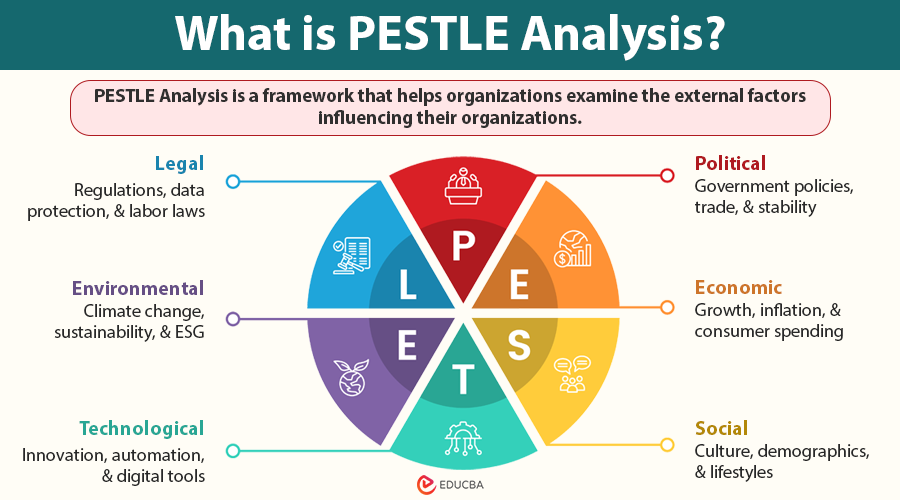
PESTLE Analysis is a framework that helps organizations examine the external factors influencing their organizations. It helps leaders identify external risks, anticipate change, and align strategies with market realities.
PESTLE analysis stands for:
- P – Political
- E – Economic
- S – Social
- T – Technological
- L – Legal
- E – Environmental
While businesses can control their internal operations, these six external factors are largely beyond their control. However, proactive scanning through PESTLE allows companies to minimize risks and capitalize on opportunities.
Table of Contents
- What is PESTLE Analysis?
- The Six Dimensions of PESTLE Analysis
- How to Conduct a PESTLE Analysis?
- Example of PESTLE Analysis
- Benefits of PESTLE Analysis
- Limitations of PESTLE Analysis
The Six Dimensions of PESTLE Analysis
PESTLE analysis examines six external factors:
1. Political Factors
Political factors represent the degree of government influence on the economy, industries, and businesses. They include laws, policies, and the overall political stability of a country.
Key considerations include:
- Government stability and ideology
- Trade and tariff policies
- Tax policies (corporate, income, VAT)
- Foreign direct investment (FDI) rules
- Labor and employment laws
- Corruption levels and bureaucracy
- Defense, security, and foreign policy.
Examples:
- The U.S. Inflation Reduction Act (IRA) incentivizes renewable energy, shaping investments in EVs and solar energy.
- Brexit altered trade agreements, customs regulations, and labor mobility in Europe.
- Political instability in countries like Venezuela discouraged multinational investments.
Strategic Implication: Political decisions can open doors (e.g., subsidies for clean energy) or close markets (e.g., sanctions on certain industries).
2. Economic Factors
Economic forces determine market attractiveness, cost structures, and consumer purchasing power. Managers must monitor both domestic and international economic indicators.
Key considerations include:
- GDP growth rate and overall economic health
- Inflation and interest rates
- Exchange rate volatility
- Employment and wage trends
- Disposable income levels
- Global trade dynamics
- Fiscal and monetary policy stance.
Examples:
- During the 2008 financial crisis, luxury retailers suffered, but discount retailers gained.
- The COVID-19 pandemic caused supply chain shocks, unemployment, and government stimulus spending.
- A weakening currency can make exports more competitive but increase import costs.
Strategic Implication: Economic factors directly influence pricing strategies, profitability, and investment decisions.
3. Social Factors
Social (or socio-cultural) factors reflect consumer behavior, lifestyle patterns, cultural values, and demographics. These shape demand and brand perception.
Key considerations include:
- Population growth rates and age distribution
- Education levels and skill availability
- Cultural norms, traditions, and religious influences
- Consumer attitudes toward health, safety, and sustainability
- Urbanization and lifestyle changes
- Social mobility and income inequality.
Examples:
- Growing awareness of health has fueled the organic food and fitness industries.
- Japan’s aging population is driving demand for healthcare and elderly care services.
- Millennials and Gen Z prefer sustainable brands, pressuring companies to adopt ESG practices.
Strategic Implication: Firms must align products, services, and marketing with evolving consumer values and demographic trends.
4. Technological Factors
Technology is one of the most disruptive forces in the business world. It affects operations, distribution, product development, and customer engagement.
Key considerations include:
- R&D activity and innovation levels
- Digital transformation and automation
- Emerging technologies (AI, IoT, blockchain, 5G, robotics)
- Cybersecurity threats
- Technology adoption rates among consumers
- Infrastructure (broadband, energy grids).
Examples:
- Amazon’s use of AI and big data revolutionized retail and supply chain efficiency.
- Ride-hailing apps like Uber and Ola disrupted traditional taxi industries.
- 5G rollout is enabling faster adoption of IoT and smart devices.
Strategic Implication: Companies that adopt new technologies can stay ahead, while those that do not may fall behind.
5. Legal Factors
Legal forces include all regulatory and compliance requirements imposed by governments and international bodies.
Key considerations include:
- Employment and labor laws
- Consumer protection laws
- Health and safety regulations
- Intellectual property rights (IPR)
- Antitrust and competition laws
- Data privacy laws (GDPR, CCPA)
- Product quality and safety standards.
Examples:
- Stricter GDPR rules in the EU forced companies to overhaul data practices.
- Apple faced lawsuits over antitrust concerns regarding its App Store policies.
- Food and drug companies must comply with the FDA or similar regulatory approvals.
Strategic Implication: Non-compliance can result in substantial fines, lawsuits, and reputational damage.
6. Environmental Factors
Environmental factors are increasingly critical as sustainability becomes a global priority. They include ecological and climate-related issues that affect operations and reputation.
Key considerations include:
- Climate change and carbon emission targets
- Renewable energy adoption
- Waste management and recycling laws
- Water usage and pollution control
- Environmental, Social, and Governance (ESG) expectations
- Consumer demand for eco-friendly products.
Examples:
- Demand for green energy and government EV incentives fuel Tesla’s growth.
- Fashion companies are facing scrutiny for the environmental impact of their fast fashion practices.
- Companies like Unilever promote sustainability in supply chains to build trust.
Strategic Implication: Sustainability is no longer optional; it is a strategic necessity.
How to Conduct a PESTLE Analysis?
- Define the scope: Decide whether the analysis is for a company, industry, or new market entry.
- Research & data collection: Use reports from the World Bank, IMF, government agencies, industry associations, and consulting firms.
- Identify key factors: List relevant Political, Economic, Social, Technological, Legal, and Environmental factors.
- Assess impact: Rank each factor as high, medium, or low impact on business.
- Prioritize: Focus on the most critical external factors.
- Integrate with strategy: Use insights to guide business planning, risk management, and innovation.
Example of PESTLE Analysis
1. Food & Retail (Starbucks)
- Political: Global trade policies, ethical sourcing requirements.
- Economic: Currency fluctuations, changes in consumer income levels.
- Social: Evolving coffee tastes, remote-work lifestyle influencing demand.
- Technological: Mobile payments, supply-chain innovations.
- Legal: Labor laws, food labeling regulations.
- Environmental: Sustainable coffee farming and concerns about plastic waste.
Strategic Implications:
Starbucks can respond by expanding mobile ordering systems, adopting eco-friendly packaging, and adjusting pricing strategies to manage currency risks.
2. Retail (Walmart)
- Political: Trade law changes, local store operating restrictions.
- Economic: Inflation, supply-chain cost pressures.
- Social: Growth of e-commerce, rising demand for same-day delivery.
- Technological: Warehouse automation, mobile shopping platforms.
- Legal: Labor-law reforms, compliance requirements.
- Environmental: Waste reduction, renewable energy adoption.
Strategic Implications:
Walmart can invest in online delivery networks, warehouse automation, and sustainability programs to remain competitive while mitigating regulatory and cost challenges.
3. Technology (Apple)
- Political:S.–China trade tensions, antitrust investigations.
- Economic: Semiconductor shortages, global economic slowdowns.
- Social/Technological: Rising demand for mobile and cloud-based solutions.
- Legal: Stricter privacy laws, digital copyright regulations.
- Environmental: Device recycling pressures, carbon footprint reduction.
Strategic Implications:
Apple can strengthen supply chain resilience, innovate product strategies, and proactively engage in regulatory and environmental policies.
Benefits of PESTLE Analysis
- Holistic view: Provides a comprehensive understanding of the external forces that influence the business.
- Risk management: Identifies risks early and develops strategies to mitigate them.
- Strategic guidance: Supports decision-making for market entry, expansion, or product launches.
- Competitive edge: Improves long-term adaptability and resilience in a changing market.
- Proactive thinking: Encourages businesses to anticipate changes instead of reacting late.
Limitations of PESTLE Analysis
- Broad in scope: May overlook industry-specific details.
- Rapidly changing environment: Analysis can become outdated quickly.
- Subjectivity: Analyst bias affects accuracy.
- No direct solutions: Highlights issues but does not prescribe actions.
Final Thoughts
PESTLE Analysis is an indispensable tool in strategic management, equipping businesses with insights into external forces that shape industries. By looking closely at political, economic, social, technological, legal, and environmental factors, companies can prepare for risks, find opportunities, and build strong strategies.
Organizations should not use PESTLE in isolation. When combined with SWOT analysis, Porter’s Five Forces, and scenario planning, it forms a powerful foundation for sustainable competitive advantage.
Frequently Asked Questions (FAQs)
Q1. What is the difference between PEST and PESTLE Analysis?
Answer: PEST includes Political, Economic, Social, and Technological factors. PESTLE adds Legal and Environmental factors for a more comprehensive analysis.
Q2. How often should businesses conduct a PESTLE Analysis?
Answer: Companies should update it annually, but in fast-changing industries (like tech or energy), they should review it quarterly.
Q3. Is PESTLE better than SWOT?
Answer: They complement each other: PESTLE identifies external factors, while SWOT connects these with internal strengths and weaknesses.
Recommended Articles
We hope this detailed guide on PESTLE Analysis was valuable. Explore our related articles on SWOT analysis, Porter’s Five Forces, and business strategy frameworks to strengthen your decision-making.


