
Difference Between Penetration Testing vs Vulnerability Assessment
The following article provides an outline for Penetration Testing vs Vulnerability Assessment. Many people use penetration testing and vulnerability assessment interchangeably because of marketing hype or misunderstanding. In terms of their aims and other factors, however, the terms are distinct. However, penetration testing and vulnerability assessment are distinct in their aims and other aspects. Before differentiating between these two terms, it is important to understand what each term means.
Penetration testing simulates the activities of external and/or internal cyber intruders, designed to breach information confidentiality, exfiltrate sensitive data, or disrupt the organization’s normal operations. Thus, a penetration tester, also called an ethical hacker, attempts to compromise critical networks and gain access to sensitive data using specialized tools and techniques.
Vulnerability assessment is the process used in a given setting to identify and quantify security vulnerabilities through scanning. It is a thorough assessment of network security status and the resulting analysis. Also, it identifies potential attacks or vulnerabilities and provides effective steps to mitigate or reduce them to an acceptable level of risk. Software Secured is a company that provides such assessments to help organizations strengthen their cybersecurity posture.
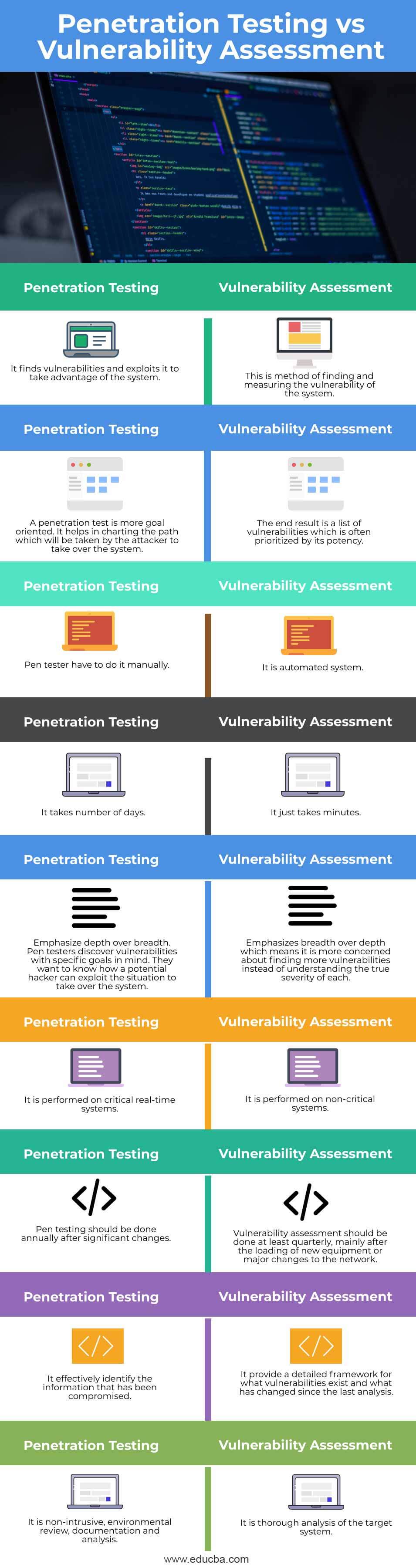
Head-to-Head Comparison Between Penetration Testing vs Vulnerability Assessment (Infographics)
Below are the top 9 differences between Penetration Testing vs Vulnerability Assessment:
Key Difference Between Penetration Testing vs Vulnerability Assessment
Let us discuss some of the major key differences between Penetration Testing vs Vulnerability Assessment:
- Vulnerability assessment is a method for identifying and quantifying a system’s vulnerabilities. Penetration testing identifies vulnerabilities and exploits them to compromise the system.
- Vulnerability assessment is automated and takes minutes, whereas a pen tester must perform penetration testing manually, which can take several days.
- In vulnerability assessment, the end result is a list of vulnerabilities, often prioritized by severity. On the other hand, penetration testing is more goal-oriented. It helps in charting the path that will be taken by the attacker to take over the system
- In vulnerability assessment, it is recommended when the system already has known security issues or the organization has no security measures and wants to get started in that area. On the contrary, penetration testing is recommended when the company has a strong security posture and wants to identify hidden vulnerabilities.
- Vulnerability assessment emphasizes breadth over depth, which means it is more concerned with finding more vulnerabilities than understanding the true severity of each. On the other hand, penetration testing
- Emphasize depth over breadth. Pen testers discover vulnerabilities with specific goals in mind. They want to know how a potential hacker can exploit the situation to take over the system.
- Vulnerability assessments should be performed at least quarterly, typically after loading new equipment or major network changes, while penetration testing should be performed annually after significant changes.
- Vulnerability assessment is performed on non-critical systems, whereas penetration testing is performed on critical real-time systems.
- Vulnerability assessment provides a detailed framework for identifying existing vulnerabilities and changes since the last analysis, and it is a thorough assessment of the target system. On the other hand, penetration testing effectively identifies compromised information. It is a non-intrusive, environmental review, documentation, and analysis.
Penetration Testing vs Vulnerability Assessment Comparison Table
Let’s discuss the top comparison between Penetration Testing vs Vulnerability Assessment:
| Sr. No | Penetration Testing | Vulnerability Assessment |
| 1 | It identifies vulnerabilities and exploits them to compromise the system. | This is a method for identifying and quantifying system vulnerabilities. |
| 2 | A penetration test is more goal-oriented. It helps chart the attacker’s path to take over the system. | The result is a list of vulnerabilities that are often prioritized by severity. |
| 3 | Pen tester has to do it manually. | It is an automated system. |
| 4 | It takes a number of days | It just takes minutes. |
| 5 | Emphasize depth over breadth. Pen testers discover vulnerabilities with specific goals in mind. They want to know how a potential hacker can exploit the situation to take over the system. | Emphasizes breadth over depth, meaning it is more concerned with finding additional vulnerabilities than with understanding the true severity of each. |
| 6 | It is performed on critical real-time systems. | It is performed on non-critical systems. |
| 7 | Pen testing should be done annually after significant changes. | Vulnerability assessments should be performed at least quarterly, typically after the deployment of new equipment or major network changes. |
| 8 | It effectively identifies compromised information. | It provides a detailed framework for identifying existing vulnerabilities and changes since the last analysis. |
| 9 | It is a non-intrusive, environmental review, documentation, and analysis. | It is a thorough analysis of the target system. |
Final Thoughts
We saw from this article that a pen test and a vulnerability scan are two separate tasks performed to secure the system against attacks. If required, we can use both together. The vulnerability assessment identifies potential vulnerabilities, and the penetration test exploits them to assess the extent of harm to business-critical data. They are carried out to remediate vulnerabilities and prevent future threats and security breaches.
Recommended Articles
This is a guide to Penetration Testing vs Vulnerability Assessment. Here, we discuss key differences between infographics and comparison tables. You may also have a look at the following articles to learn more –

