


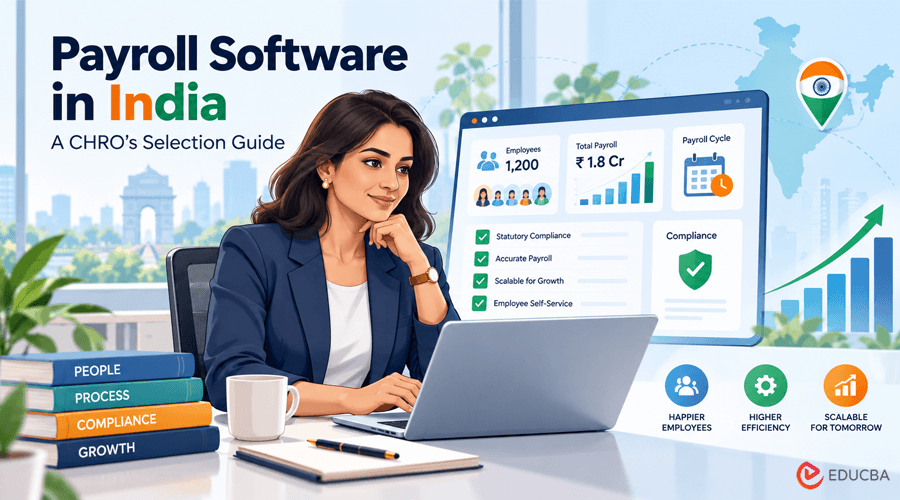
Payroll decisions rarely stay confined to HR. A CHRO signing off on new payroll software is effectively signing off on how accurately thousands of employees get paid, how exposed the organization is during a statutory audit, and how much manual firefighting the finance team ends up doing every month. Given how much rides on that one decision, it deserves a more structured approach than comparing feature lists side by side.
The starting point is not which platform looks the most polished during a demo. It is understanding what the organization actually needs from its human resource software, and then testing candidates against those needs rather than against a generic checklist. Choosing the right payroll software in India requires CHROs to consider compliance requirements, existing HR systems, workforce size, and future business plans.
Start With Where the Complexity Actually Lives
Every organization’s payroll complexity sits in a different place. For some, it is statutory compliance across multiple Indian states, each with slightly different professional tax rules and labor regulations. For others, it is a workforce spread across countries, where salaries have to be calculated and disbursed in different currencies under entirely different tax regimes. A CHRO evaluating payroll software in India needs to be honest about which of these problems the organization is actually solving because the platforms built for each are quite different.
- PeopleStrong was built specifically around the first kind of complexity. Its payroll engine applies PF, ESI, TDS, and state-specific compliance rules automatically, and because it operates as part of a broader human resource software suite, attendance and leave data flow directly into salary calculations without a separate reconciliation step. For CHROs managing large, hierarchy-heavy Indian organizations, this integration tends to matter more day-to-day than any single standout feature.
- Saral Pro, built on the long-standing Saral PayPack product line, takes a narrower but deeper approach to the same problem. It focuses almost entirely on getting Indian statutory calculations right, covering salary computation, benefits administration, and tax filing without trying to be a full HR suite. CHROs at organizations that already have a separate HRMS in place, and simply need dependable payroll processing underneath it, often find this focus useful rather than limiting.
Consider What the Organization Is Already Running
Payroll software rarely operates in isolation, and a CHRO who ignores the existing technology stack usually ends up paying for integration work later that could have been avoided at the selection stage.
- Zoho Payroll makes the most sense for organizations already using Zoho Books or Zoho People, since salary processing, accounting, and HR records stay connected without duplicate data entry. Outside that ecosystem, it still handles statutory filing and payslip generation competently, but its real advantage disappears if the rest of the organization is not on Zoho.
- greytHR takes the opposite approach, favoring simplicity and speed of implementation over deep ecosystem integration. Payroll runs, statutory filings, and attendance synchronization all happen with minimal setup. This makes it a sensible choice for CHROs who want dependable payroll software in India without spending months configuring a larger platform.
- Qandle sits somewhere in between, combining payroll with recruitment, performance, and attendance modules under one dashboard. Its configurability lets HR teams adjust salary structures as policies change without constant technical support, which suits CHROs who expect compensation structures to evolve as the organization grows.
Decide Whether Global Payroll Is Actually the Problem
A growing number of Indian enterprises now employ people outside the country, and this is where the evaluation criteria change considerably. Domestic payroll software, however capable, was not built to handle employment law in dozens of jurisdictions at once.
- Deel approaches this by owning its payroll infrastructure across more than 150 countries rather than relying on third-party processors in each market, which gives faster error resolution when something goes wrong with a specific country’s payroll run. It also offers Employer of Record services for hiring in markets where the organization has no legal entity, which matters for CHROs building distributed teams without setting up new subsidiaries for every hire.
- Playroll offers a similar proposition, covering hiring and payroll across more than 180 countries with a stated focus on faster onboarding and dedicated human support for both the employer and the employee. Its global payroll analytics module also lets CHROs consolidate reporting across multiple in-country providers into one dashboard, giving finance teams a single view of workforce costs across many currencies.
For CHROs whose payroll challenge is genuinely domestic, neither of these platforms is the right fit. However, organizations actively expanding their workforce outside India should consider global payroll solutions. Relying entirely on domestic payroll software in India may eventually create additional manual compliance work as international operations grow.
The Essential Payroll Software in India Evaluation Checklist
Once the organization’s core problem is clear, a shorter set of practical questions can help CHROs separate genuinely suitable platforms from those that only look suitable on paper.
Before selecting payroll software in India, CHROs should evaluate the following factors:
- Statutory compliance: Does the platform update statutory rules automatically as regulations change, without requiring manual reconfiguration for every payroll cycle?
- System integration: How well does it integrate with the attendance, leave, and HR systems already in use? Can it eliminate the need for separate monthly reconciliation?
- Salary structure flexibility: Can it handle the specific compensation structures the organization actually pays, including variable pay, reimbursements, and multi-state or multi-country compliance, without extensive customization?
- Scalability: Can the software support the organization’s expected growth over the next two to three years, rather than just its current headcount?
- Reporting and analytics: Does it provide accurate payroll reports that help HR and finance teams monitor salary expenses and make informed workforce decisions?
- Data security: Does the platform offer appropriate access controls and safeguards to protect sensitive employee and payroll information?
- Implementation and support: How long will implementation take, and what level of technical support does the vendor provide during and after deployment?
Evaluating these factors helps CHROs identify payroll software that meets their organization’s operational requirements while supporting long-term growth.
How to Make the Final Payroll Software Selection?
There is no single best payroll software that fits every organization, and CHROs who go looking for one usually end up with a platform that solves a problem they do not actually have.
The stronger approach is to match the platform to the complexity that genuinely exists, whether that is Indian statutory compliance, ecosystem integration, implementation speed, or global reach. CHROs should also run a short pilot before committing organization-wide.
Processing one department’s payroll on a shortlisted platform for a month reveals far more about its suitability than any vendor pitch ever will. It is a small investment compared with the risk of discovering the wrong choice only after the software is already live across the entire workforce.
Ultimately, choosing the right payroll software in India is about more than automating salary calculations. It is about improving payroll accuracy, simplifying compliance, reducing administrative work, and building a system that can support the organization as it grows. A structured evaluation process helps CHROs make this decision with greater confidence.
Recommended Articles
We hope this guide helps you understand how to choose the right payroll software in India based on your organization’s needs, compliance requirements, and growth plans. Explore our recommended articles for more insights on HR software, payroll automation, workforce management, and HR technology.


