
Updated August 3, 2026
What is Parameter-Efficient Fine-Tuning?
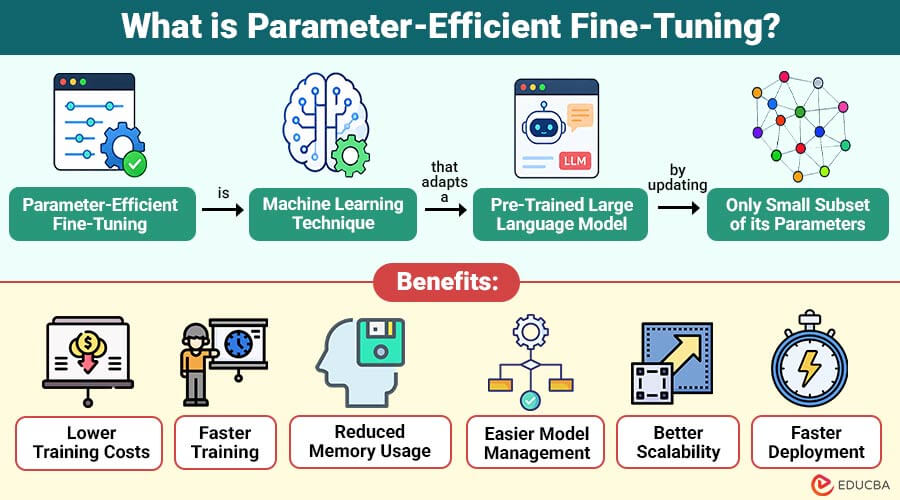
Parameter-Efficient Fine-Tuning (PEFT) is a machine learning technique that adapts a pre-trained large language model (LLM) by updating only a small subset of its parameters. This approach significantly reduces computational costs, memory usage, and training time while maintaining performance close to full fine-tuning.
Conventional fine-tuning techniques necessitate costly hardware and substantial processing power as huge language models continue to expand in size. Parameter-Efficient Fine-Tuning updates only small parts of the AI model instead of changing the entire model. This makes it practical for organizations to customize AI models for domain-specific tasks without investing in massive infrastructure.
PEFT is now used to build chatbots, virtual assistants, summary tools, code writing tools, healthcare AI systems, legal document tools, finance applications, and business knowledge assistants.
Table of Contents:
- Meaning
- Why Parameter-Efficient-Tuning Matters?
- Working
- Key Components
- Techniques
- Benefits
- Challenges
- Common Use Cases
- Popular Frameworks
Key Takeaways:
- Parameter-efficient fine-tuning customizes pre-trained AI models by training only small subset of parameters, reducing computational requirements.
- It reduces training costs, uses less memory, and makes deployment easier while maintaining good performance.
- It helps build AI for healthcare, finance, legal work, customer support, and software development.
- Uses a single shared AI model with separate adapters for different tasks, saving storage and enabling easy scaling.
Why Does Parameter-Efficient Fine-Tuning Matter?
Modern AI models are very large and expensive to train. Parameter-Efficient Fine-Tuning trains only a small part of the model, making it faster, cheaper, and easier to customize.
PEFT is especially valuable because it:
The basic steps of Parameter-Efficient Fine-Tuning are given below:
1. Select a Pre-trained Model
Choose an existing AI model, such as Llama, Mistral, Falcon, or GPT, that already has learned knowledge.
Key Components of Parameter-Efficient Fine-Tuning
Several important components contribute to successful PEFT implementation.
1. Pre-trained Foundation Model
2. Frozen Parameters
Most AI model settings stay unchanged, keeping existing knowledge while reducing training time and computing resources.
3. Trainable Adapters
Adds small modules to help the AI learn new tasks while keeping the original model unchanged.
4. Domain Dataset
Special training data helps AI learn industry-specific tasks, terms, and knowledge more accurately.
5. Inference Engine
Combines the base AI model and adapters to give accurate answers for specific tasks during real-world use.
Popular Parameter-Efficient Fine-Tuning Techniques
Several techniques are widely used for parameter-efficient fine-tuning.
1. Low-Rank Adaptation (LoRA)
Adds small trainable layers instead of updating all model parameters, reducing memory usage and training costs efficiently
2. Adapters
Adds small layers to the AI model, allowing it to learn new tasks without changing the original model.
3. Prefix Tuning
Adds trainable prefix vectors before model layers, helping the model learn new tasks without changing weights.
4. Prompt Tuning
Trains virtual prompt embeddings instead of model parameters, making fine-tuning faster, simpler, and more efficient.
5. Infused Adapter by Inhibiting and Amplifying Inner Activations (IA³)
Trains small scaling values to improve model performance while keeping most original parameters completely unchanged.
Benefits of Parameter-Efficient Fine-Tuning
Parameter-Efficient Fine-Tuning offers numerous benefits over traditional fine-tuning methods.
1. Lower Training Costs
Trains only a small part of the model, reducing GPU usage and overall training costs.
2. Faster Training
Updates fewer parameters, helping AI models learn new tasks faster and reducing training time.
3. Reduced Memory Usage
Uses less GPU memory, allowing fine-tuning on affordable hardware.
4. Easier Model Management
Uses small task-specific adapters instead of copying the full AI model, making different tasks easier to manage.
5. Better Scalability
Allows one AI model to support multiple applications by using separate lightweight adapters for different tasks.
6. Faster Deployment
Small adapter files make model updates, sharing, and deployment easier across different systems.
Challenges of Parameter-Efficient Fine-Tuning
Despite its advantages, PEFT has certain challenges.
1. Task-Specific Performance
Some complex tasks may need full fine-tuning to achieve the best accuracy and overall performance.
2. Adapter Management
Managing many task-specific adapters can make storage, updates, and maintenance harder as more AI tasks are added.
3. Hyperparameter Selection
Choosing the best learning rate, adapter size, and settings needs careful testing for better AI performance.
4. Data Quality
Poor-quality training data negatively impacts model accuracy regardless of the selected PEFT technique or approach.
5. Compatibility
Some pre-trained models support certain PEFT techniques better, affecting implementation flexibility and overall performance outcomes.
Common Use Cases of Parameter-Efficient Fine-Tuning
PEFT is widely used across various industries.
1. Customer Support Chatbots
Companies train AI assistants using company documents, FAQs, and customer conversations to give accurate answers.
2. Healthcare
Hospitals train AI models to help with medical records, diagnosis support, and finding health information while protecting privacy.
3. Legal Services
Law firms adapt models for contract analysis, legal research, compliance monitoring, and document summarization.
4. Financial Services
Banks use PEFT for fraud detection support, financial reporting, investment research, and customer service automation.
5. Software Development
Development teams train coding assistants using company coding standards and internal documents to improve code suggestions.
6. Knowledge Management
Businesses create enterprise search assistants trained on internal documents, policies, and technical manuals.
Popular Parameter-Efficient Fine-Tuning Frameworks
Several open-source frameworks simplify parameter-efficient fine-tuning.
1. Hugging Face PEFT
Provides efficient implementations of LoRA, Prefix Tuning, Prompt Tuning, IA³, and additional PEFT techniques.
2. Transformers
3. PyTorch
Enables flexible custom PEFT implementations using powerful deep learning libraries and extensive development tools efficiently.
4. DeepSpeed
Improves large AI model training by using less memory, working faster, and supporting efficient training across multiple computers.
5. Accelerate
Makes AI model training faster using multiple GPUs and supports easy deployment.
Final Thoughts
Parameter-Efficient Fine-Tuning enables organizations to customize large language models by training only small subset of parameters. It reduces training costs, memory usage, and deployment complexity while maintaining strong performance. As AI adoption grows, PEFT remains a scalable, efficient, and practical solution for building production-ready AI applications.
Frequently Asked Questions (FAQs)
Q1. Can parameter-efficient fine-tuning be used with open-source large language models?
Answer: Yes. PEFT is commonly used with open-source models such as Llama, Mistral, Falcon, Gemma, and Qwen. Many popular frameworks provide built-in support for applying PEFT techniques to these models.
Q2. Does parameter-efficient fine-tuning affect the original model?
Answer: No. In most PEFT methods, the original model remains unchanged. Only lightweight trainable components are added, allowing the same base model to be reused for multiple tasks.
Q3. Is PEFT only useful for text-based AI applications?
Answer: No. Although it is widely used with language models, PEFT techniques can also be applied to vision models, speech models, multimodal AI systems, and other deep learning architectures.
Recommended Articles
We hope that this EDUCBA information on “Parameter-Efficient Fine-Tuning” was beneficial to you. You can view EDUCBA’s recommended articles for more information.


