
What is Optical Networking?
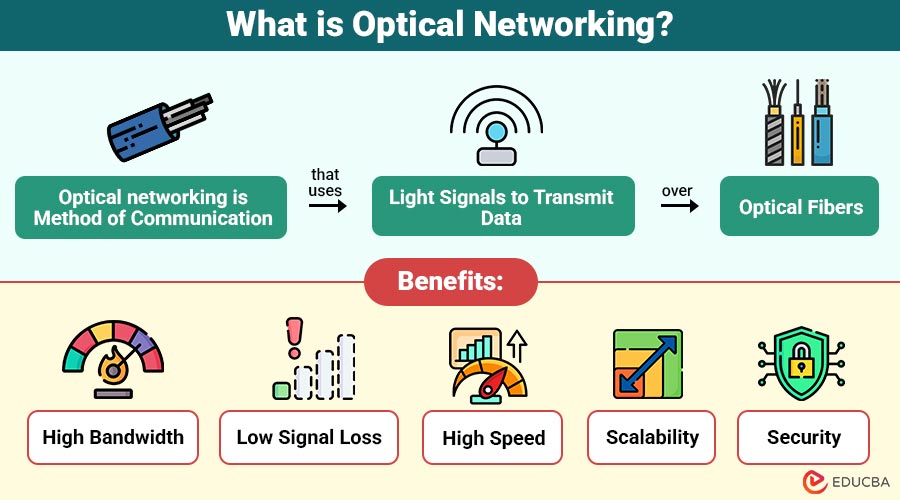
Optical Networking is the method of communication that uses light signals to transmit data over optical fibers. Unlike electrical signals in copper wires, optical fibers use light waves—often from lasers or LEDs—resulting in higher capacity, longer distances, and minimal signal loss.
At its core, an optical network relies on three key components:
- Transmitter – Converts electrical signals into light signals.
- Optical Fiber – The medium that carries the light signals.
- Receiver – The receiver converts light signals back into electrical impulses.
Optical networking powers long-haul telecommunication lines, metro networks, data centers, and submarine cables that connect continents.
Table of Contents:
Key Takeaways:
- Optical networking enables ultra-fast, secure, and scalable communication using light signals through fiber optic cables.
- Technologies such as WDM and optical amplifiers maximize capacity and maintain signal strength across long distances.
- Optical networks power telecom, cloud, 5G, and undersea communication, forming the backbone of digital infrastructure.
- Future innovations, such as quantum communication, AI-driven networks, and 6G, will redefine global connectivity and security.
How Optical Networking Works?
Here are key steps that explain how data travels efficiently through an optical network.
1. Data Conversion
Laser diodes or LEDs are used to convert electrical data impulses into light pulses, enabling effective transmission across optical fiber networks.
2. Transmission
Light pulses move through thin optical fibers almost at the speed of light, with very little weakening, allowing fast, high-quality communication over long distances.
3. Multiplexing
Wavelength Division Multiplexing (WDM) enables the simultaneous transmission of multiple data channels, each with a unique wavelength, thereby maximizing fiber capacity and efficiency.
4. Amplification
Optical amplifiers boost weak light signals directly, keeping them strong and clear over long distances without turning them into electrical signals.
5. Reception
At the receiving end, photodetectors turn light signals into electrical signals so devices can read and process the data correctly.
Components of Optical Networking
Optical networking relies on several critical components that work together to enable fast, reliable, and large-scale data transmission.
1. Optical Fiber Cables
Fiber optic cables transmit data as light. The core carries signals, while cladding ensures reflection, and is available in both single-mode and multi-mode types.
2. Transmitters
Transmitters convert electrical data into optical signals using lasers or LEDs, enabling fast, reliable light-based communication across fiber optic networks effectively.
3. Receivers
Receivers use photodiodes to catch light signals and change them back into electrical data so digital devices can process it.
4. Optical Amplifiers
Optical amplifiers, such as EDFA, boost weakened light signals directly within fibers, maintaining their strength over long distances without requiring electrical signal conversion.
5. Multiplexers/Demultiplexers
Multiplexers combine multiple light wavelengths for transmission, while demultiplexers separate them at the destination, enabling WDM technology to effectively maximize fiber capacity.
6. Optical Switches and Routers
Optical switches and routers intelligently direct light signals in networks, managing data traffic without requiring optical-to-electrical conversion, ensuring faster routing.
7. Undersea and Terrestrial Fiber Cables
Undersea and land-based fiber cables create the main backbone of global communication, connecting continents and cities to power the internet, phone networks, and business connectivity worldwide.
Benefits of Optical Networking
Optical networking offers several benefits that make it the preferred choice for modern, large-scale, and future-ready communication systems.
1. High Bandwidth
Optical fibers deliver terabits of data per second, offering massive bandwidth capacity that far surpasses traditional copper-based communication systems.
2. Low Signal Loss
Light signals weaken very little in fiber, allowing data to travel hundreds of kilometers without needing frequent boosting or regeneration.
3. High Speed
Data transmission through optical fibers occurs nearly at the speed of light, enabling ultra-fast, real-time communication across global and enterprise-scale networks.
4. Scalability
Wavelength Division Multiplexing enables multiple channels to be carried on a single fiber, significantly scaling network capacity without requiring additional infrastructure.
5. Security
Optical fibers are highly secure; tapping signals is difficult without detection, making them ideal for safe, encrypted, and confidential communications.
Challenges of Optical Networking
While optical networking delivers unmatched speed and scalability, it also presents challenges that impact adoption and deployment.
1. High Initial Cost
Building fiber optic infrastructure requires significant investment, including equipment, cables, amplifiers, and installation, making deployment initially expensive for organizations.
2. Complex Installation
Fiber optic cables are delicate and need skilled experts for joining, fixing, and upkeep, which makes installation and maintenance more complex.
3. Limited Availability in Remote Areas
Remote and rural regions often lack fiber infrastructure, relying instead on copper lines or wireless solutions due to cost constraints.
4. Signal Loss in Connectors/Splices
Bad splicing, sharp bends, or poor connectors can weaken light signals, reducing quality and slowing down the network.
Use Cases of Optical Networking
Optical networking is the backbone of modern communication systems, supporting a diverse range of industries and technologies worldwide.
1. Telecommunications
Optical networking powers the backbones of telecom and ISP networks, ensuring high-speed, reliable internet connectivity and communication services across regional, national, and global networks.
2. 5G and Beyond
Fiber optics offers super-fast speed with almost no delay and huge data capacity, making it crucial for 5G, self-driving systems, and future wireless technologies.
3. Cloud Data Centers
Optical networks interconnect servers, storage, and applications in cloud data centers, enabling massive bandwidth, fast processing, and seamless global operations.
4. Enterprise Networks
Businesses, universities, and financial institutions rely on optical networks for secure, high-performance connectivity across campuses and mission-critical enterprise applications.
5. Undersea Communication
Submarine fiber optic cables link continents, enabling reliable international communication, supporting global internet traffic, financial exchanges, and intercontinental enterprise connectivity.
6. Broadcasting and Media
Optical networking supports real-time video streaming, broadcasting, and content distribution, ensuring smooth, high-quality delivery across global digital media platforms.
7. IoT and Smart Cities
Fiber networks handle massive amounts of IoT sensor data, powering smart city applications such as traffic management, surveillance, healthcare, and infrastructure automation.
Real World Applications
Optical networking is not just theoretical—it powers the infrastructure of leading industries, global communication, and scientific innovation.
1. Google, Facebook, and Amazon
Tech giants like Google, Facebook, and Amazon depend on optical networking to interconnect massive cloud data centers, ensuring scalable, high-speed, and reliable global operations.
2. 5G Mobile Operators
5G companies use optical networks to link everything together. This lets them support billions of devices with super-fast internet, almost no lag, and smooth wireless service worldwide.
3. International Submarine Cables
Submarine fiber optic systems like SEA-ME-WE 6 are undersea cables that connect Asia, the Middle East, and Europe. They carry internet and phone data between countries, helping businesses and people communicate around the world.
4. Healthcare and Research Institutes
Hospitals and research centers use optical networks to send and process medical images fast, run tests on computers, handle lots of data, and use AI to help with diagnoses, which improves medicine and science.
Future of Optical Networking
The future of optical networking is shaped by innovations such as:
1. Optical Packet Switching
OPS enables switching data entirely in optical form, eliminating conversions and increasing efficiency, thereby reducing latency and enhancing overall network performance.
2. Space Division Multiplexing
SDM increases network capacity by using multiple cores or modes within a single fiber, enabling greater scalability and efficiency.
3. Quantum Communication
Quantum communication uses optical networks to exchange secret keys securely, providing hack-proof encryption and stronger cybersecurity for the future.
4. AI-driven Optical Networks
Artificial intelligence improves optical networks by predicting data traffic, spotting problems, fixing issues automatically, and making communication systems faster, smarter, and more reliable.
5. Integration with 6G Networks
Optical networks will make 6G possible by giving super-fast internet with almost no delay, so things like holograms, advanced AR/VR, and billions of smart devices can work smoothly.
Final Thoughts
Optical networking underpins today’s digital era, transmitting data via light in fibers with unmatched speed, capacity, and efficiency over copper. It runs 5G, cloud services, undersea cables, and smart cities, handling the rising need for data. With new tech like quantum communication, AI, and 6G coming soon, building optical networks guarantees safe, scalable, and ready-for-the-future connections.
Frequently Asked Questions (FAQs)
Q1. Is optical networking better than copper networking?
Answer: Yes, optical networking offers significantly higher bandwidth, lower signal loss, and enhanced security compared to copper-based systems.
Q2. Where is optical networking used most?
Answer: It is widely used in internet backbones, telecom, data centers, cloud computing, and submarine cables.
Q3. Is optical networking future-proof?
Answer: Yes. Optical fibers have an enormous capacity and can be upgraded with new multiplexing and amplification technologies without requiring the replacement of existing cables.
Recommended Articles
We hope that this EDUCBA information on “Optical Networking” was beneficial to you. You can view EDUCBA’s recommended articles for more information.


