


The Future of Open-Source AI Models: Overview
Artificial intelligence is growing at an unprecedented rate. New AI tools that can write text, generate images, or even analyze data like a human are emerging almost every few months.
However, with all the technological advances, one trend is silently reshaping the future of open-source AI models.
What is Open-Source AI?
Open-source artificial intelligence refers to code, data, or models that are made publicly available for use and modification. It means anyone can download, study, and even modify the code.
For example, companies like Meta and Mistral have released models such as LLaMA and Mistral 7B, which anyone can use to develop their applications.
This openness enables individuals to create AI chatbots, translation tools, and research apps without having to build from scratch or pay exorbitant license fees.
It is like accessing a library of powerful AI tools anyone can borrow, learn from, and build upon.
Why Open-Source AI Matters?
Open-source AI is not simply free software. It represents a movement toward transparency, collaboration, and fairness in the technology sector.
Here are a few reasons it matters:
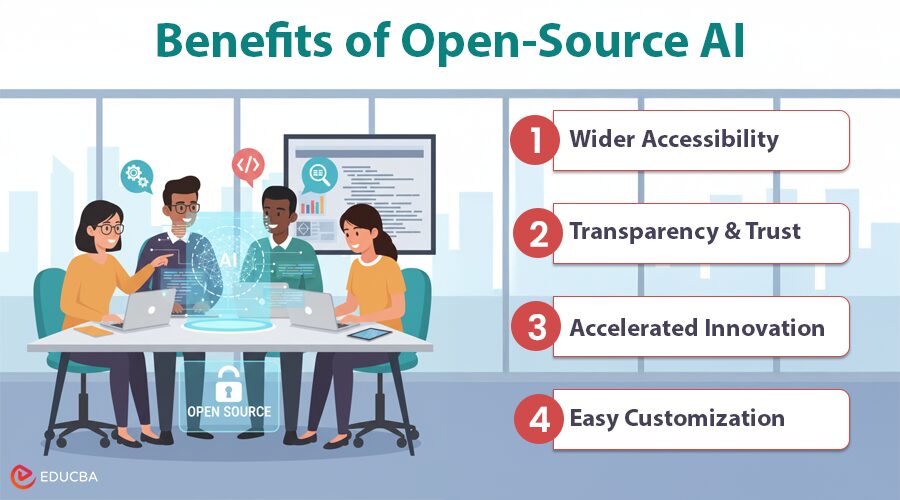
- Accessibility for everyone: Open models enable AI to be accessible to startups, researchers, and educators who lack the capital to afford expensive applications.
- Transparency builds trust: Open models can provide people with visibility into how they work, the data they use, and whether they are biased, which builds trust, unlike commercial “black box” models.
- Faster innovation: Countless developers worldwide can contribute to a single model, enabling the group to achieve breakthroughs more rapidly than a closed research team.
- Customization: Organizations can easily customize an open model for their industry, such as healthcare, legal, or e-commerce, without having to build one from scratch.
The Future of Open-Source AI
1. Local and Niche Applications
Not all AI models have to serve millions of users. Open-source models are well-suited for better adaptation based on local languages, regional data, or specific industries.
For example, a hospital could utilize an open model to facilitate doctors’ submission of medical documentation, and a local business could employ an open model to enhance customer service or even operate membership platforms for exclusive content or programs.
2. Education and Learning
It is easier than ever for students, researchers, and developers in open-source AI to play with real AI models, evaluate and assess them, and learn how they work.
This experiential learning helps develop skills and creativity.
3. Collaboration Across Borders
Open models promote collaboration, allowing people to unite and leverage ideas from diverse countries and backgrounds.
This promotes more diverse thinking and lessens the monopoly of a few firms.
4. Cost Savings for Businesses
Businesses utilizing open-source AI can achieve cost savings by avoiding recurring and expensive API subscriptions.
They can run models on their own servers, self-host them, and be more accountable about handling data and costs. Similarly, many companies today utilize tools like direct mail marketing automation to streamline outreach, conserve resources, and personalize campaigns, demonstrating how automation and open technologies can collectively make business operations smarter and more efficient.
Serious Challenges Open-source AI Faces
1. High Costs of Training
Even though models are open, training or fine-tuning them can still be expensive.
It requires powerful computers, electricity, and large amounts of data. Many small teams cannot afford that level of computing power.
2. Quality and Maintenance
Some developers maintain open models well and keep them reliable, but others do not update them regularly. Without updates or testing, older models can become outdated or insecure.
3. Misuse and Security Risks
People can use open-source AI for both beneficial and harmful purposes. Because it is freely available, bad actors can use it to create fake news, deepfakes, or spam content. Striking the right balance between openness and control is one of the most complex parts of this movement.
4. Lack of Regulation
There is no global rulebook for how open-source AI should be shared or managed. Questions like “What data can be used for training?” or “Who is responsible if an AI model causes harm?” are still being debated.
Open vs. Closed: Can They Coexist?
Many individuals believe that open-source AI will replace closed-source or commercial AI models. However, both types of AI are likely to co-exist.
Closed models of AI, such as ChatGPT or Gemini, will continue to outperform their open-source counterparts due to their access to extensive resources and training data. Open source models will provide greater customization, privacy, and access.
For example, a government agency may opt for an open model for privacy, while a global company might pursue a closed API for speed and scalability. Each model has its respective set of advantages; the future will likely include both models.
What is the Future of Open Source AI?
We will likely see a future in open-source AI where innovation, responsibility, and collaboration meet. We will likely see more efficient, smaller models that you can run on a laptop or smartphone.
We will see the development of community-based projects, open data sets, and shared research repositories where anyone can collaborate to utilize AI in solving the world’s problems.
Open models will play a crucial role in education, enabling millions of students to learn coding, data science, and machine learning in an affordable manner. In business, open models will also level the playing field by allowing small companies to utilize powerful AI tools.
How to Support Open-Source AI for the Future?
- Funding for investigations: The government and tech organizations can fund open projects that will benefit society.
- Ethical guidelines: Organizations must establish clear rules governing data usage, model safety, and accountability.
- Community contributions: AI Engineers, educators, and companies should give back to the community by sharing better strategies, model improvements, bug fixes, or documentation.
- Transparency: Developers of open models must clearly state how they build the model, what data they train it on, and how users can use it safely.
Final Thoughts
Open-source AI is not simply a tech trend. It represents a cultural shift. It seeks to make AI fairer, more transparent, and more inclusive.
Yes, there are challenges: financial implications, risks, and governance. However, the possible advantages outweigh these problems. When we share knowledge, it accelerates societal growth, especially with platforms like ZenBusiness Velo that foster collaboration and innovation among businesses.
The next several years will test how effectively we, as a society, can navigate the continuum between openness and responsibility. If we play this right, open-source AI can create a future where innovation belongs to everyone, not just a select few tech companies.
Recommended Articles
We hope this article on open-source AI helps you understand how publicly available models promote innovation, collaboration, and accessibility in technology. Explore our related articles to learn more about AI development, ethical guidelines, and emerging trends in artificial intelligence.


