
What is Ontology?
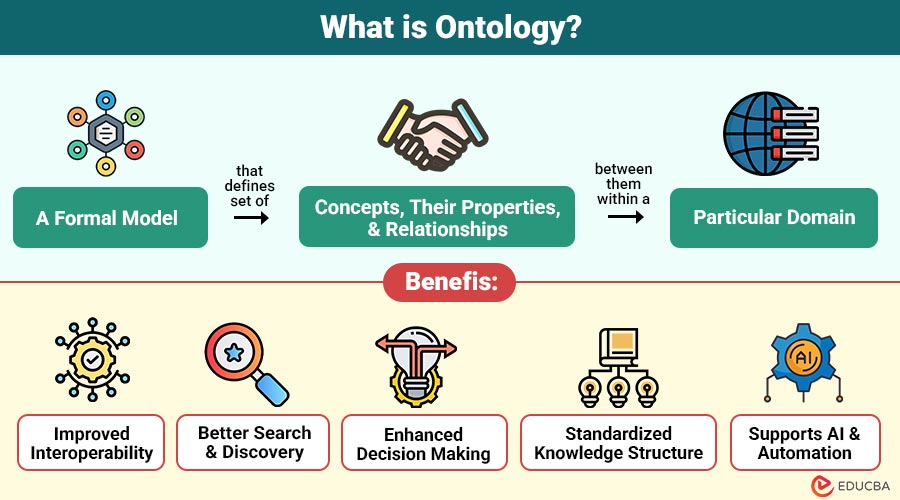
Ontology is a formal model that defines a set of concepts, their properties, and the relationships between them within a particular domain. It establishes a shared vocabulary and structure so humans and intelligent systems can interpret information consistently and meaningfully.
Table of Contents:
- Meaning
- Why Ontology Matters?
- Key Components
- Working
- Types
- Differences
- Benefits
- Challenges
- Real-World Examples
Key Takeaways:
- Ontology creates a unified knowledge structure that standardizes concepts, properties, and relationships across domains.
- It improves system interoperability by enabling consistent data exchange with shared meanings and semantic understanding.
- It enhances search accuracy through contextual relationships, enabling smarter, more relevant information discovery.
- Logical rules support advanced reasoning, enabling better decisions and uncovering hidden insights efficiently.
Why Ontology Matters?
Information today is scattered across documents, databases, websites, systems, and departments. Without a unified understanding, information becomes fragmented. It solves this by providing:
1. Standardized Knowledge Structure
It creates a unified, consistent structure that clearly organizes information, ensuring everyone interprets data accurately across domains.
2. Interoperability Between Systems
It enables different systems to communicate seamlessly by using shared meanings, reducing data conflicts and integration complexities.
3. Improved Semantic Search
It enhances search accuracy by understanding concepts, relationships, and context, delivering more relevant results than keyword matching.
4. Logical Reasoning and Inference
It supports automated reasoning engines that derive new insights, detect inconsistencies, and uncover implicit knowledge within datasets.
5. Uniform Understanding Across Stakeholders
It ensures all stakeholders interpret terms consistently, reducing misunderstandings, improving collaboration, and aligning decisions across organizational teams.
Key Components of an Ontology
Here are the key components that form the structure:
1. Concepts (Classes)
Concepts represent high-level categories grouping similar entities within a domain, forming the foundation for structured knowledge organization.
Example:
Customer, Product, Disease, Course, Ingredient
2. Instances (Individuals)
Instances are specific, real-world examples of concepts, representing concrete objects that populate and illustrate defined ontology classes.
Example:
Customer → “Sarah Patel”
Product → “Galaxy S23”
3. Attributes (Properties)
Attributes describe characteristics of concepts by assigning values, helping define entity details, and differentiating instances within domains.
Example:
Product → color, price, brand
4. Relationships
Relationships define meaningful connections between entities, showing how concepts interact, depend on each other, or influence domain behavior.
Example:
Customer buys Product
Doctor diagnoses Patient
5. Axioms
Axioms are logical rules that constrain, validate, and govern ontology behavior, ensuring consistent reasoning, structure, and domain accuracy.
Example:
“A child must have at least one parent.”
How Ontology Works?
It functions by combining structured definitions, logical rules, and relationships.
1. Identify the Domain
Determine the specific knowledge area to model concepts, relationships, and structured information accurately.
2. Define Main Concepts, Entities, and Categories
Establish core terms, classes, and groups that represent essential domain knowledge within a structured framework.
3. Specify Attributes and Characteristics
Assign detailed properties that describe concept behavior, qualities, constraints, and domain-specific distinctions clearly.
4. Add Relationships and Connection Rules
Create logical links and regulations to define how concepts interact, depend on, and relate to one another within the ontology.
5. Integrate with Existing Data Sources
Connect structures to databases, documents, and systems for enriched semantic understanding and interoperability.
Common Technologies:
1. Web Ontology Language
A formal language enabling the creation of expressive ontologies with classes, properties, restrictions, and logic rules.
2. Resource Description Framework
Framework storing data as triples, enabling machine-readable relationships for semantic interoperability across systems.
3. Protege, TopBraid Composer
Tools allowing users to design, edit, validate, visualize, and manage ontologies with collaborative features.
Types of Ontologies
Here are the types of ontologies used to organize knowledge across different levels and purposes:
1. Upper
It provides universal, high-level categories applicable across domains, offering foundational concepts shared by multiple knowledge systems.
2. Domain
It organizes specialized knowledge for a specific field, capturing terminology, relationships, and rules unique to that domain.
3. Task
It defines the structured knowledge required to perform a particular activity, detailing steps, constraints, and essential operational elements.
4. Application
An application ontology customizes domain and task knowledge for a specific system, enabling tailored workflows, integrations, and contextualized reasoning.
Differences Between Ontology vs Taxonomy vs Knowledge Graph
Here is a clear comparison to understand how these three knowledge structures differ:
| Feature | Ontology | Taxonomy | Knowledge Graph |
| Purpose | Defines concepts, properties, and multiple relationships | Organizes concepts into a hierarchy | Connects real entities and relationships |
| Relationship types | Rich and complex | Mostly “is-a” | Flexible and dynamic |
| Level of detail | High | Moderate | Very high |
| Usage | Semantic modeling, reasoning | Classification | Intelligent search and recommendations |
Benefits of Using Ontology
Here are the major benefits organizations gain by implementing ontologies:
1. Improved Interoperability
It enables seamless data exchange, ensuring different systems interpret shared information accurately and consistently.
2. Better Search and Discovery
Ontology-powered search delivers precise, context-aware results by understanding relationships beyond basic keyword matching.
3. Enhanced Decision Making
Logical rules and defined relationships help systems infer insights, improving decision accuracy and significantly reducing uncertainty.
4. Standardized Knowledge Structure
It provides a unified vocabulary and definitions, enabling teams to communicate clearly and maintain consistent organizational knowledge.
5. Supports AI & Automation
Structured ontologies help AI think better, reduce mistakes, and understand information more clearly in different tasks.
Challenges While Designing Ontologies
Here are the major challenges teams commonly face when creating and maintaining ontologies:
1. Time-Consuming Development
Creating a complete ontology demands expert knowledge, detailed analysis, and structured planning across multiple iterations.
2. Knowledge Evolution
Domain knowledge changes over time, requiring frequent ontology updates to maintain accuracy, relevance, and consistency.
3. Complexity in Large Domains
Highly detailed, large-scale ontologies often become difficult to manage, maintain, validate, and update effectively over time.
4. Integration Issues
Connecting ontologies to existing data sources requires significant mapping, alignment, transformation, and compatibility efforts.
Real-World Examples
Here are some real-world examples where ontologies play a critical role in real systems:
1. Google’s Knowledge Framework
Connects billions of entities using ontology to enhance search accuracy and understanding.
2. Amazon’s Product Knowledge Model
Defines product attributes and relationships to support better categorization, discovery, and recommendations.
3. Clinical and Bioinformatics Systems
Uses to model diseases, lab results, medications, and treatments, enabling medical decisions.
4. Financial Regulation Models
Models financial risks, compliance rules, and transactions using ontologies to enhance clarity.
Final Thoughts
Ontology is a powerful framework for organizing complex information, enabling systems and people to understand data with clarity and consistency. Defining concepts, relationships, and rules enhances search, decision-making, and AI-driven automation. For any business, ontologies organize knowledge, help systems work together, and enable smarter, scalable digital solutions—making them vital in today’s data-driven world.
Frequently Asked Questions (FAQs)
Q1. What is the main purpose of ontology?
Answer: To provide a structured, shared representation of concepts and relationships in a specific domain.
Q2. How is ontology different from a taxonomy?
Answer: A taxonomy provides simple hierarchical classification, while ontology offers rich relationships and logical rules.
Q3. Can ontologies support AI systems?
Answer: Yes. Ontologies provide semantic understanding, enhancing AI reasoning and context interpretation.
Q4. Are ontologies useful for small businesses?
Answer: Absolutely. They help with product organization, SEO, customer insights, and knowledge management.
Recommended Articles
We hope that this EDUCBA information on “Ontology” was beneficial to you. You can view EDUCBA’s recommended articles for more information.


